MOONSTRUCK - PART 1
The full November moon rose bright and beautiful over the back yard in the early evening sky. The scene never fails to cast its magic. I added yet another picture to the extensive collection of photographs of the moon I’ve already taken over the years and proudly posted it on Facebook. “I think there’s a partial eclipse at 2:30 am if you feel like staying up to view it,” commented one of my friends. “It’s supposed to be the longest partial eclipse in almost 600 years.” Another comment made that once in a thousand years - clearly an event not to be missed.
 |
| November Full Moon, seen from my kitchen window |
Information on the internet confirmed the time frame and gave viewing instructions. The show was supposed to start around 1:30 am, but you wouldn’t be able to see anything until about an hour later, with the peak expected around 4:04 am. Photographs showed awesome views of the moon in a bright red, which results from the sunlight reflecting off the earth’s atmosphere.
 |
| Partial Eclipse, photo from the internet |
By 10 pm, the wind had picked up and raindrops were running down the window panes. The weather app on my I-phone predicted light drizzle for the next couple of hours, with a tendency of clouds clearing up around 3 am. A while ago, I was standing on the platform at the railway station in the pouring rain, while that same weather app stated bright sunshine. Hoping that the most recent update of my phone improved the app, I set the alarm and went to bed at midnight.
There’s nothing like being roused from deep sleep by an alarm clock going off at 3:30 am to put a damper on enthusiasm. I dragged myself out of bed for a glance from the kitchen window. A few clouds were sailing across a clear sky.
 |
| Clouds in the sky in the middle of the night |
At this time of night, the moon is on the other side of the house. Sometimes it’s so bright, the light sparkles through the cracks of the blinds.
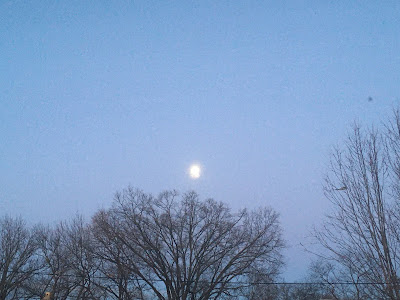 |
| Full Moon above Peachtree Road in the early morning |
There was none of that, but I guessed that was the nature of an eclipse. I raised the blinds to take a look at the wonder. Way up in the sky there was a tiny dot, a crescent, really. The rest was shadow, as black and white as could be, not the faintest trace of color. The street lights were fully functioning, for once, which did nothing to improve the scenario.
 |
| Partial Eclipse of the moon above Peachtree Road, 11/ 19/ 2021 |
I never considered that the photos on the internet must have been taken through a telescope, with a camera that’s a lot stronger than mine. I took a picture anyway, to make getting up in the middle of the night worth while and went back to bed. A quote from meditation retreat crossed my mind, before I fell asleep: Expectation is a setup for disappointment.
MOONSTRUCK - PART 2
“August’s Sturgeon Full Moon at Brighton Beach - outdoors, in nature!” read the announcement of the Open Center in NYC:
Join us for a special evening of ceremony at the beach under the light of a full moon in August also known as the Sturgeon Full Moon. We meet at Brooklyn’s Brighton Beach, where we may partake in a beautiful water blessing and cleansing, and in a sunset and moonrise ritual.
 |
Full Moon by the Ocean- Photo from the announcement by the Open Center
|
After more than a year of Covid with plenty of time in the cozy, but limited space of my apartment the scenario was irresistible, even if the ceremony sounded a little ominous. Immersion in the water was optional, said the description, and I was confident I could handle everything else: wear white or pastel colors and bring white or blue flowers for the ceremony.
Heavy rains and thunderstorms hung in the air in the days leading up to the event. Hurricane Henri was making its way up the East Coast, but not expected to reach the city until the day after the event. Friday came and went without a notice of cancellation, and Saturday arrived with the sun peeking out between the clouds every now and then. By the time the train reached Brighton Beach there were clear blue spaces in the sky.
 |
| Subway to Brighton Beach - photo from the internet |
The highrises along the boulevard at Brighton Beach don’t have the aura of a fancy seaside resort. It’s just a neighborhood with the bonus of a beach location and the opportunities that come with it: sandcastles, sunbathing and swims in the ocean. I settled down on my towel in the sand and took in the scenario. Clouds were gathering on the horizon, but that often happens by the ocean during the time approaching sunset. I remember that well from many summer vacations spent by the sea in childhood.
 |
| Brighton Beach, Boulevard by the ocean (Photo aus dem Internet) |
One by one, the other participants showed up. They weren’t hard to recognize: people bringing flowers to the beach are rather scarce. When the teacher/mistress of ceremonies arrived, we gathered in a circle, about 20 people of various ages and nationalities, plus a young and lively German shepherd dog. We were invited to introduce ourselves and explain what brought us to the ceremony. Plain and simple yearning for the moon and the ocean seemed a bit thin, so I said something noncommittal about rebalancing energies after the experience of the Pandemic. It was a motivation I shared with many of the participants.
 |
| The sky above Brighton Beach, August 21, 2021 |
A heavy cloud bank had closed in by the time the ceremony began. Darkness swallowed the horizon, fusing the sky and the water into a wall of solid gray. The air felt misty. Then humidity condensed into raindrops. I hate it when my hair gets wet and frizzy in the rain, but I didn’t want to be a wimp and possibly interfere with the energy of the ritual by unfolding my umbrella. Still and stoic, I sat through the first exercise, thinking of the cleansing qualities of the water while slowly getting soaked.
When I opened my eyes, umbrellas had come out and the puppy was pulling its owners towards the water’s edge for a walk. Several people had donned hoods and hats. Unflappable, as if there was no such thing as inclement weather, the teacher stood in the middle of the circle, a friendly smile on her face, rain dripping from her hair and her clothes. The young woman who sat next to me looked miserable, her sweatshirt soaked through, rain running down her face from the edge of the hood. I used that as an excuse to dig out my own umbrella from my backpack, open it, and offer to share it with her.
The last thing I saw before closing my eyes for the next exercise was lightning flashing across the sky. Then, the beating of the drum began again, mixing with the rumble of thunder, still in the distance. It occurred to me that holding on to a metal rod might not be wise. Clutching the plastic grip at the end of the rod made it harder to balance the umbrella against the rising winds, however. I abandoned the meditation and opened my eyes.
Someone was obviously blinking morse-code with an immense flashlight behind the clouds above the ocean. Then, a fiery zigzag tore the sky in two, followed by a clap of thunder like a gunshot. Rain was pouring down by the bucket. Everybody looked at the mistress of ceremonies, questions written on the faces. Had we done anything to invoke this? How safe was it to sit on the open beach by the water in the middle of a thunderstorm?
 |
| Flashes of Lightning (Photo from the Internet) |
The woman stood stood straight and unmoving like a lightning rod. A shamanic healer, trained and initiated in Peruvian, Mayan, Ecuadorian and Maori traditions, I trusted that she knew what she was doing. “Keep calm, it’s ok”, we were instructed. “If anyone gets hit by lightning, just stay still for the next one; you always get hit twice.” Another gunshot followed, as if to underscore her statement.
I can very well imagine that certain highly developed individuals are able to fend off the wrath of the elements merely through the power of their minds. I know for sure that, at this point of my life, I am not one of them. The couple with the dog had not returned, so I wouldn’t be the first to break the aura of the circle. I grabbed my belongings and headed for shelter as fast as the deep sand would permit, leaving my flowers behind to appease the anger of the gods.
“What kind of a shit show was that,” exclaimed the woman who joined me shortly afterwards , crouching against the wall of the bathroom building under three feet of overhanging roof. In her company, I felt confident enough to make a dash for the subway station in the middle of the raging storm. We were soon joined by other participants in the ceremony and had a really good time chatting on the train on our way back into the city. It would have been fun to stop somewhere to have dinner together, but in view of Hurricane Henry’s early arrival it appeared prudent to head home while transportation was still running.
 |
| Brighton Beach Subway Station (Photo from the Internet) |
Was I disappointed? Actually, no. If anything, I’d expected an adventure that would give me a story to tell - and that’s exactly what I got.
------------------------------------------------------------------------------
MONDSÜCHTIG - TEIL 1
Hell und strahlend ging der Novembervollmond am frühen Abend über den Hinterhöfen auf. Der Anblick verzaubert mich immer wieder. Ich machte ein Foto und stellte es stolz auf Facebook. “Ich glaube, heute Nacht um halb zwei ist eine partielle Mondfinsternis, falls du Lust hast, aufzubleiben, schrieb eine Freundin. “Es soll die längste partielle Mondfinsternis in 600 Jahren sein.” Im nächsten Kommentar wurden daraus 1000 Jahre - kurz, ein Ereignis das man nicht verpassen möchte.
|
Novembervollmond, Blick von meinem Küchenfenster
|
Das Internet bestätigte den zeitlichen Rahmen und gab Hinweise zur Betrachtung. Der Beginn des Schauspiels wurde für 1:30 angesetzt, aber erst einen Stunde später würde etwas zu sehen sein. Der Höhepunkt wurde für 4:04 angesetzt. Fotos zeigten den Mond rot angestrahlt, von Sonnenlicht, das von der Erdatmosphäre reflektiert wird.
|
| Partielle Mondfinsternis, Photo aus dem Internet |
Um 22 Uhr stürmte es draussen und Regentropfen rannen die Fensterscheiben herunter. Die Wettervorhersage auf meinem I-Phone meldete Nieselregen für die nächsten Stunden, aber zunehmend aufklarenden Himmel ab 3 Uhr morgens. Vor einiger Zeit stand ich im strömenden Regen auf dem Bahnsteig, während die Wetter-App strahlenden Sonnenschein verkündete. In der Hoffnung, dass das letzte update meines I-phones die App verbessert hat, stellte ich den Wecker und ging gegen Mitternacht ins Bett.
Nichts ist besser geeignet, der Begeisterung einen Dämpfer aufzusetzen, als ein Wecker, der einen morgens um halb vier aus dem Tiefschlaf reisst. Ich schleppte mich trotzdem aus dem Bett um einen Blick aus dem Küchenfenster zu werfen. Vereinzelte Wolken zogen über den klaren Himmel.
|
| Nächtliches Wolkenspiel |
Am frühen Morgen ist der Mond allerdings auf der anderen Seite des Hauses. Manchmal scheint er so hell, dass das Licht durch die Ritzen der Jalousie scheint.
|
| Vollmond über Peachtree Road am frühen Morgen |
Nichts davon an diesem Morgen, aber das lag wohl in der Natur einer Mondfinsternis. In Erwartung des atemberaubenden Anblicks zog ich die Jalousien hoch. Ich musste eine Weile suchen. Ganz weit oben am Himmel stand ein winziger Punkt, eher sowas wie ein Halbkreis. Der Rest war ein blasser Schatten , so schwarz-weiss wie man es sich nur vorstellen kann; nicht die Spur von Farbe, geschweige denn rot. Ausnahmsweise funktionierte auch die Strassenbeleuchtung. Das trug nicht dazu bei, den Anblick zu verbessern. Die Fotos auf dem Internet waren wahrscheinlich mit einer starken Kamera durch ein Teleskop aufgenommen.
|
Partielle Mondfinsternis über der Peachtree Road, 19.11.2021
|
Damit ich nicht ganz umsonst aufgestanden war, machte ich trotzdem ein Foto und ging wieder ins Bett. Bevor ich einschlief, ging mir ein Zitat von der Meditationswoche durch den Kopf: Hohe Erwartungen ziehen oft grosse Enttäuschungen nach sich…
MONDSÜCHTIG - TEIL 2
“ Der Vollmond im August, im Zeichen des Störs - draussen, in freier Natur in Brighton Beach” - verkündete die Anzeige des Open Center in New York City:
“Wir laden ein zu einer ganz besonderen Veranstaltung, einer Zeremonie am Strand im Mondlicht, zur Feier des Vollmonds im Zeichen des Störs. Wir treffen uns in Brighton Beach in Brooklyn. Dort besteht die Möglichkeit, an einer Segnungs- und Reinigungszeremonie sowie einem Sonnenuntergangs - und Mondaufgangsritual teilzunehmen.”
|
Vollmond am Meer - Photo aus der Anzeige des Open Center
|
Nach mehr als einem Jahr Covid mit viel Zeit in meiner gemütlichen, aber doch begrenzten Wohnung war das Szenario unwiderstehlich. Die geheimnisvolle Zeremonie war mir allerdings etwas unheimlich. Das Eintauchen ins Wasser war aber den Teilnehmern freigestellt, und alles andere traute ich mir zu: Weiss oder Pastellfarben für die Kleidung, blaue oder weisse Blumen mitbringen für die Zeremonie.
In den Tagen vor der Veranstaltung hingen heftiger Regen und Gewitter in der Luft. Hurrican Henri stürmte die Ostküste hoch, wurde aber erst am Sonntag, dem Tag nach der Veranstaltung, in New York City erwartet. Der Freitag ging ohne eine Absage der Zeremonie vorüber, und der Samstag begann sogar mit ein bisschen Sonnenschein. Als ich am späten Nachmittag mit der U-Bahn in Brighton Beach ankam, waren zahlreiche blaue Flecken am Himmel.
|
| Subway nach Brighton Beach - Photo aus dem Internet |
Die Hochhäuser am Boulevard lassen keine Vision von eleganten Badeorten aufkommen - Brighton Beach ist ein ganz normales Wohnviertel das zufällig am Meer liegt, und die damit verbundenen Vorzüge für die Anwohner mit sich bringt: Sandstrand, Burgenbauen, Sonnenbaden und Schwimmen im Meer. Ich liess mich auf meinem Handtuch im Sand nieder und beobachtete die Szene. Am Horizont zogen sich Wolken zusammen, aber das ist keine Seltenheit vor Sonnenuntergang. Daran erinnere ich mich noch ganz genau, von den Ferien am Meer in meiner Kindheit.
|
| Brighton Beach, Uferpromenade und Strand (Photo aus dem Internet) |
Einer nach dem andern trudelten die Teilnehmer ein. Sie waren nicht schwer zu erkennen; Leute, die mit Blumen am Strand auftauchen sieht man relativ selten. Als die Zeremonienmeisterin eintraf, schlossen wir uns zu einem Kreis zusammen, ungefähr 20 Menschen verschiedenen Alters und unterschiedlicher Nationalitäten, sowie ein junger Schäferhund. Wir wurden aufgefordert uns vorzustellen und zu sagen, warum wir gekommen waren. Das primitive Verlangen nach Mond und Strand erschien mir ein bisschen flach als Begründung, also dachte ich mir etwas Unverbindliches über Energieausgleich nach der Anspannung der Pandemie aus. Viele Teilnehmer berichteten Ähnliches.
|
| Der Himmel über Brighton Beach, 21.8. 2021 |
Als die Zeremonie begann, hatte sich der Himmel vollkommen zugezogen. Der Horizont war in der Dunkelheit verschwunden, Meer und Himmel zusammengeschweisst zu einer soliden grauen Wand. Die Luft fühlte sich feucht an. Dann konzentrierte sich Feuchtigkeit zu Regentropfen. Ich kann es nicht ausstehen, wenn meine Haare im Regen nass und kräuselig werden, aber ich wollte mich nicht als Schwächling outen und möglicherweise die Energie des Rituals stören, indem ich einen Regenschirm aufspannte. Still und unbewegt konzentrierte ich mich auf die reinigende Kraft des Wassers, das mir unbeirrt und stetig in die Klamotten sickerte.
Einige Regenschirme waren in der Runde aufgetaucht, als ich die Augen wieder öffnete. Verschiedene Menschen hatten Kapuzen und Hüte aufgesetzt, und der Schäferhund zog seine Besitzer zu einem Ausflug ans Wasser. Unerschütterlich, als gebe es kein schlechtes Wetter, stand die Zeremonienmeisterin in der Mitte des Kreises, ein freundliches Lächeln auf dem Gesicht, während ihr der Regen aus den Haaren und Kleidern tropfte. Die junge Frau, die neben mir sass, sah erbarmungswürdig aus, das Sweatshirt völlig durchgeweicht. Ich benutzte das als Entschuldigung, meine Regenschirm aus dem Rucksack zu holen, aufzuspannen und ihr einen Platz darunter anzubieten.
Das letzte, was ich sah, bevor ich die Augen für die folgende Meditation schloss, war ein Blitz, der über den Himmel zuckte. Dann vermischte sich der dumpfe Rhythmus der Trommel mit Donnergrollen, noch in einiger Entfernung, aber bereits deutlich vernehmbar. Ich fragte mich, ob es klug war, in einem Gewitter einen Metallstab festzuhalten und verlagerte meine Hand auf den Plastikgriff meines Regenschirms. Allerdings wurde es nun deutlich schwieriger, den Schirm gegen die aufkommenden Sturmböen zu verteidigen. Schliesslich gab ich das Meditieren auf und öffnete die Augen.
Hinter den Wolken gab offensichtlich jemand Morsezeichen mit einer überdimensionalen Taschenlampe. Eine feurige Zickzacklinie schnitt den Himmel in zwei Teile, gefolgt von einem Donnerschlag wie ein Kanonenschuss. Ratlose Blicke richteten sich auf die Zeremonienmeisterin. Hatten wir irgendwas falsch gemacht und aus Versehen die Naturgewalten entfesselt? Wie sicher ist es, mitten im Gewitter ungeschützt in Ufernähe am Strand zu sitzen?
|
| Zuckende Blitze (Photo aus dem Internet) |
Unerschütterlich wie ein Blitzableiter stand die Zeremonienmeisterin an ihrem Platz. Ausgebildet und eingeweiht in der schamanischen Heilkunst Perus, Ecuadors, der Mayas und der Maori wusste sie bestimmt, worauf sie sich eingelassen hatte. “Es ist alles in Ordnung,” sagte sie. “Wenn jemand vom Blitz getroffen wird, geschieht das immer zweimal, bleibt also einfach ganz ruhig.” Wie zur Bekräftigung dieser Aussage folgte ein weiterer Donnerschlag von Gewehrschussqualität.
Ich halte es durchaus für möglich, dass es hochentwickelte Individuen gibt, die in der Lage sind, sich allein Kraft ihres Geistes die Elemente vom Leib zu halten. Allerdings bin ich absolut sicher, dass ich zum gegenwärtigen Zeitpunkt nicht dazu gehöre.
Die Hundebesitzer und ihr Schützling waren nicht zur Gruppe zurückgekehrt, also war ich nicht die erste, die aus die Aura der Kreises ausbrach. Ich raffte meine Habseligkeiten zusammen und machte mich auf den Weg zu einem Unterstand so schnell es der tiefe Sand erlaubte. Meine Blumen liess ich am Strand zurück um die Götter zu besänftigen.
“Was war denn das für eine Scheissveranstaltung,” rief die Teilnehmerin aus, die sich bald darauf zu mir gesellte. Unter dem überhängenden Dach des Toilettenhäuschens fanden wir vorübergehend Schutz, und dann liefen wir im strömenden Regen bei Blitz und Donner zur U-Bahnhaltestelle. Dort gesellten sich weitere Besucher der Vollmond-Zeremonie zu uns. Die Fahrt zurück in die Stadt verging schnell bei angeregter Unterhaltung. Es wäre nett gewesen, noch irgendwo zusammen essen zu gehen, aber in Hinblick auf Hurrican Henris verfrühte Ankunft in New York City erschien es angebracht, nach Hause zu fahren solange der öffentliche Nahverkehr noch nicht eingestellt war.
|
U-Bahn Station Brighton Beach (Photo aus dem Internet)
|
War ich enttäuscht von der verregneten Veranstaltung? Ehrlich gesagt, nein. Ich hatte ein Abenteuer erwartet von dem ich erzählen konnte - und genau das hatte ich bekommen.


