 |
| Sedona Mago Retreat Center, 120 steps meditations site |
The Sedona Mago Center for Well-Being and Retreat is located 2 1/2 hours north of Phoenix in the Red Rocks of the Arizona Desert. Spread out across a vast space are memorial - and meditation sites, gardens, lakes and waterfalls, lecture halls, a dining hall, and guest rooms. The final stretch of the road that leads to the center does not feed the expectation of something so magnificent. 11 miles on a dirt road, through ruts, holes and bumps that shake you up and slow you down. Actually, it’s a good preparation for a week of meditation retreat.

Guest room and Pomegranate tree
Discovering the teacher, Andrew Holecek, an expert on meditation, lucid dreaming, dream yoga and death and dying, is one of the beneficial outcomes of the lockdown during the first phase of the Pandemic. Together with Bob Thurman, the director of Tibet House NY, he taught an online course on the Buddhist approach on death and dying.
A few months later, I attended Andrew’s online course on “Emergency Meditations,” offered by New York City’s Open Center. It was fascinating to learn that emotions dissolve within 90 seconds if you don’t hold on to them. Holding on includes sedation and trying to push them away. Instead, just watch the emotion like an observer, dare to feel it and locate it in your body. Watch your breath. That doesn’t just happen, of course. It requires intention and practice.
One morning, a defect in the heating system caused all radiators in my apartment to simultaneously spew water. Call the landlord, reach out to the neighbors, secure containers under the leaks or get electrical extension cords off the floor - clueless what to do first I froze with panic. Situations like this often replay in my mind for weeks to come, causing anxiety and discomfort.
After the flood was cleaned up and the causes fixed, I suddenly realized that it was over. Take a deep breath and be in the moment. You’re safe, everything is ok. I considered my options: to let the incident go and return to my day, or keep it alive in my mind, e.g. by calling a friend and reporting the incident with dramatic embellishment of every detail. I let it go and it left me alone. I didn’t share it until I was sure that my mind had settled.
Andrew’s meditation group through his online forum “Night Club - an international community of students and teachers interested in meditation, lucid dreaming and the nature of reality” - provides a chance to practice meditation under the guidance of several different teachers once a week.
When “Mindfulness and Beyond,” a week-long in-person retreat in Sedona was announced for October 2021, I seized the chance of a much needed break in my busy life and a deeper dive into meditation: three sessions a day, a total of 8 hours of meditation, lecture, discussion, breath- and body work. We were invited to keep silence outside of the sessions for several days. I liked that a lot. As nice as it is to meet people, chat and exchange experience, it’s also a source of distraction when you’re trying to turn the gaze inside.
Time disappears, while we learn to observe and explore the “inner landscape.” It’s not about getting rid of thoughts. The mind thinks, that’s what it does. What requires practice is becoming still amid the ebb and flow of thoughts, images, sense impressions and emotions, releasing them, rather than getting involved. “Meditation is a laxative, not a sedative,” as Andrew puts it. 
Retreat Center, night of the full moon
This kind of calm abiding or “Samata” is the foundation for other kinds of meditation. Analytic meditation may focus on a topic or a question. In the beautiful Buddhist practice of “Tonglen” giving and taking, you imagine breathing in dark, heavy energy or pain and breathing out good energy and light. The practice is often dedicated to specific situations or people. You can also do it for yourself. 
Countryside in Sedona
The vast, magnificent grounds of the retreat center invite practicing outdoors: Lying on our backs, we practice “sky-gazing” on Bliss Rock, mixing our minds with the vast Arizona sky. The pure nature of mind is as clear as the sky. Disturbing sensations pass through it like the clouds that sail across the sky. 
View from retreat center on two consecutive days

“Open wandering” means to walk slowly along the paths, taking in views, sounds and smells without getting caught up in them. I notice a tiny gap between hearing the sound and the moment when my mind assigns the label: “fountain in the lake.”
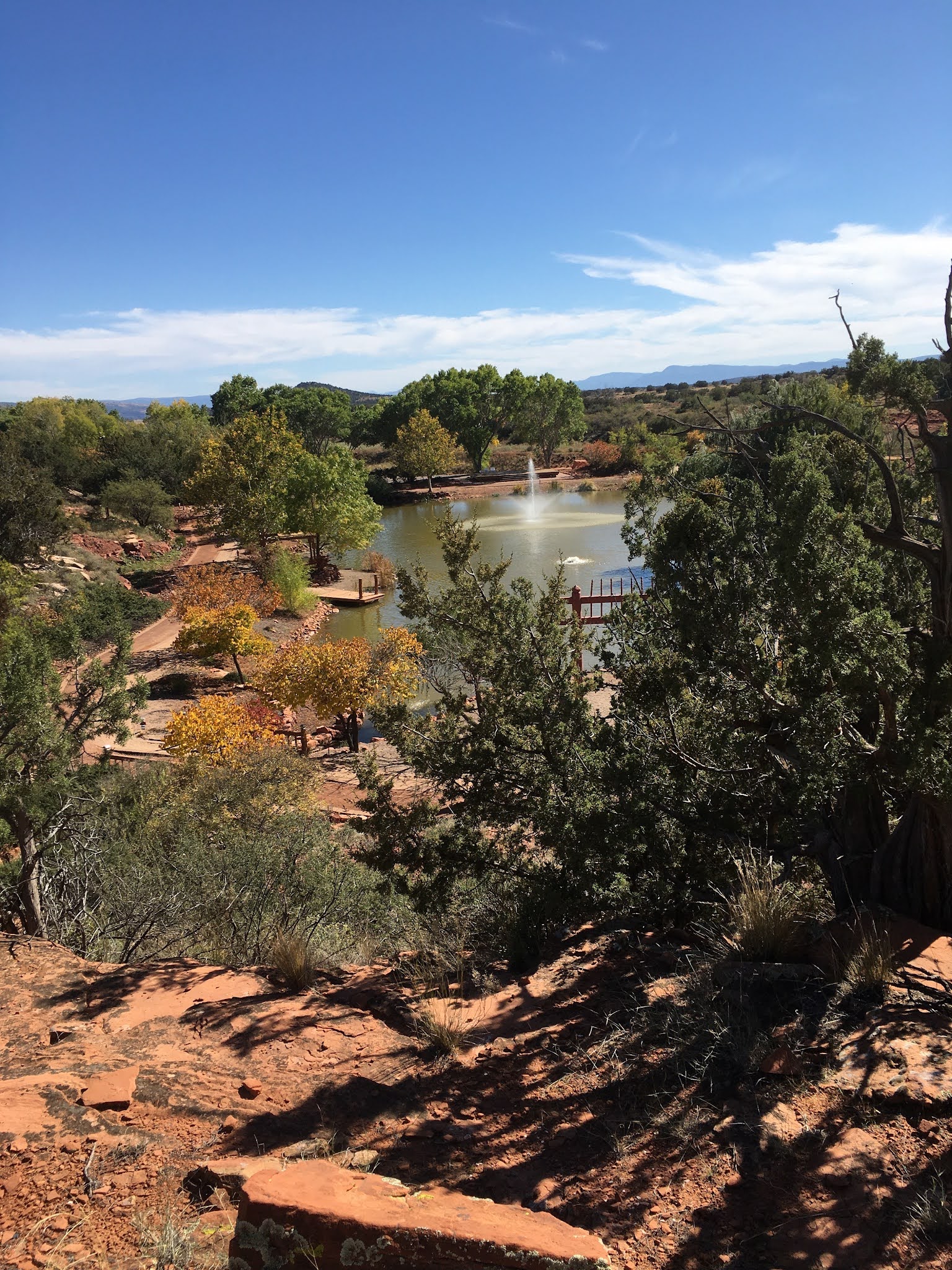
Retreat center, the lake from above
We don’t see things as they are. We label what we perceive and navigate along the reality we’ve constructed. If we’re not aware of that and fail to revisit and reassess our concepts we get stuck or miss the point.
 |
| Retreat center, at the lake |

The labyrinth in the evening
Slowly, I walk the labyrinth. My footsteps sound different on gravel and on sand. A pencil drops from my pocket and falls into the adjacent lane. Too lazy to retrace my steps, I reach over and pick it up. I continue to walk. The lane makes a wide turn, back to the outside edge. A moment ago, I was so close to the center, I could have touched it! My mind turns outside of myself, assessing the situation. Did I miss the center, picking up that pencil? How long have I been in here? I’m going to miss the beginning of the next session! 
Labyrinth and full moon, Mago lecture hall in background
I resist the impulse to step across the lanes and rush to the lecture hall. Instead, I return to putting one foot in front of the other at a slow, regular pace.
Sometimes, the path veers away from the goal. A promising approach runs into a dead end, a seemingly straight shot turns into a detour. Everything that happens provides experience you can learn from. When you make clear to yourself that life really functions one step at a time, everything becomes doable. 
The center of the labyrinth
The lane leads me to the center of the labyrinth. I circle it and wind my way back out. There’s plenty of time until the next session. Walking the labyrinth didn’t take more than ten minutes. “Erring and erring, we walk the unerring path.”
At the end of the week, the whiteboard in the lecture hall displays quotes to remember as we return to our everyday lives: 
Sedona Sunrise
“There is no tyranny as great as the tyranny of success.”
“Real silence is silencing your protest as to how things are.”
“The journey is the destination”
“ There is no way out. The magic is to discover a way in.”
“ You must be present and patient to win.”
“We confuse the satisfaction of desire with its temporary transition.”
“ Happiness occurs when where you are coincides with where you want to be.”
 |
| Sedona, sky after sunset |
My flight home departs from Phoenix Sky Harbor at 10:15 pm. I have a middle seat on a full flight that is as bumpy as the gravel road that leads to the retreat center. This is my first flight in a while and I catch myself holding my breath. “Jesus Christ” exclaims the young woman who sits next to me and clutches the armrest as the plane gets another shake. Maybe I’m not overreacting after all.
Examine what it is that you don’t want to feel. The feeling is the same as the gravel road, but I felt a lot safer knowing that there was solid ground under my seat. “We’re always one breath away from death” Andrew keeps telling us.
Balancing the mind between the possibilities of a safe arrival and a plane crash is a challenge. Then again, looking at the present moment, we’re still up in the air, and, for all I know, progressing toward our destination. The flight attendants sit in the back, completely absorbed in the content displayed by their phones. I take a couple of deep breaths.
Another one of Andrew’s priceless quotes comes to mind. He has collected them during decades of studying Buddhism and other wisdom traditions and never misses an opportunity to share them: "The worst things in my life never actually happened."
I give the benevolent forces of the universe and the pilot’s expertise the benefit of the doubt. I must have dozed off, because the next thing I remember is the announcement to prepare for landing at Newark Airport.
 |
| Breakfast in Sedona |
Getting home, everything feels different. Is my apartment really that spacious and full of light? I’ve forgotten where things are in the kitchen and preparing breakfast is a challenge after being spoilt by the kitchen staff at Sedona Mago for a week. Finding the rhythm of everyday life will take a while - but that’s the magic and the chance of every new beginning.
 |
| Sedona, Hot-air balloons rising into the morning sky |
------
|
| Sedona Mago Retreat Center, 120 steps |
Das Sedona Mago Center for Well-Being and Retreat (Zentrum für Wohlbefinden und Besinnungstage) liegt 2 1/2 Stunden nördlich von Phoenix in den Roten Felsen der Wüste von Arizona. Gedenk- und Meditationsstätten, Gärten, Seen und Wasserfälle, Vortragsräume, eine Kantine und zahlreiche kleine Hütten, wo die Besucher untergebracht sind, liegen verstreut auf dem ausgedehnten, malerischen Gelände. Egal woher man kommt, die letzten 20 km legt man im Schneckentempo zurück, auf einer Schotterpiste voller Schlaglöcher und tief eingegrabenen Furchen. Ich habe den Verdacht, dass man die Strasse mit Absicht unbefestigt lässt. Auf diese Weise können wir uns schon vor Beginn der Meditationswoche auf eine langsamere Gangart einstellen, und der Geist wird gründlich durchgeschüttelt.
|
| Gastzimmer und Granatapfelbaum |
Die Entdeckung des Kursleiters, Andrew Holecek , bekannter Lehrer und Autor zu den Themen Meditation, Traumyoga, Tod und Sterben ist ein positiver Nebeneffekt des Lockdowns zu Beginn der Pandemie im Frühling letzten Jahres. Zusammen mit Bob Thurman, dem Direktor des buddhistischen Kulturzentrums Tibet House NY leitete er einen online-Kurs über die buddhistische Auffassung von Tod und Sterben.
Einige Zeit später nahm ich an Andrews online-Kurs über “Notfallmeditationen” teil, den das Open Center anbot. Ich war überrascht zu erfahren, dass Emotionen innerhalb von 90 Sekunden verfliegen, wenn man sie nicht festhält. Versuche, sie zu betäuben oder zu verdrängen lediglich eine andere Form des Festhaltens. Statt dessen, nimm’ die Position eines Beboachters ein. Was fühlst du genau? Wo befindet sich das Gefühl im Körper? Was passiert mit dem Atem? Diese Beobachtungen macht man natürlich nicht einfach so. Man muss sie bewusst herbeiführen lernen und üben.
Eines Morgens führte ein Defekt der Heizungsanlage dazu, dass sämtliche Heizkörper in meiner Wohnung Wasserfontänen von sich gaben. Ich erstarrte in Panik und wusste nicht, wo ich anfangen sollte: den Hausbesitzer anrufen, die Nachbarn alarmieren, Schüsseln unter die Heizkörper stellen oder elektrische Verlängerungskabel vom Boden aufheben. Das Gefühl von Hilflosigkeit, das mit derartigen Situationen verbunden ist, läuft mir oft wochenlang hinterher.
Als die Überschwemmung beseitigt und die Heizung repariert war, spürte ich auf einmal: das war’s. Ein tiefer Atemzug bewerkstelligte die Rückkehr ins Hier und Jetzt. Alles ist in Ordnung, du bist in Sicherheit. Mir wurde plötzlich klar, dass ich das Ereignis loslassen, oder in meiner Vorstellung lebendig halten konnte, indem ich z.B. Freunde anrief um mit dramatischer Ausschmückung sämtlicher Einzelheiten von der Panne zu erzählen. Ich liess sie los, berichtete niemandem davon, bis ich sicher war, dass ich mich beruhigt hatte, und ie Angst liess mich in Ruhe.
Die Meditationsgruppe, die sich wöchentlich auf Andrews Online-Forum “Night Club” trifft, bietet Gelegenheit, unter Leitung verschiedener Lehrer Meditation kennenzulernen und regelmässig zu üben. “Night Club” ist eine internationale Gemeinschaft von Menschen, die sich für Meditation, die Welt des Träumens und die Natur von Wirklichkeit interessieren.
Als Andrew für Oktober diesen Jahres eine Meditationswoche in Arizona anbot, sah ich die Chance für eine willkommene Pause von meinem Alltag und eine Vertiefung meiner Erfahrung mit Meditation: 3 Sitzungen täglich, insgesamt 8 Stunden Meditation, Vortrag, Diskussion, Körper- und Atemübungen. Für etwa die Hälfte der Woche wird ausserhalb der Sitzungen Schweigen vereinbart, was mir sehr entgegenkommt. So interessant es ist, Leute kennenzulernen und Erfahrungen auszutauschen, so ablenkend kann es sein wenn man versucht, die Aufmerksamkeit nach innen zu richten.
|
| Retreat Center, Vollmondnacht |
Das Zeitbewusstsein verschwindet während wir die “innere Landschaft” erkunden. Dabei geht es nicht darum, Gedanken loszwerden. Der Geist ist zum Denken da, und das ist in Ordnung so. Inmitten der Flut von Eindrücken, Gedanken, Bildern und Gefühlen zum stillen Beobachter zu werden, sie los- anstatt sich auf sie einzulassen, bedarf allerdings der Übung. “Meditation ist ein Abführ- und kein Beruhigungsmittel,” beschreibt Andrew den Vorgang.
“Samata” - wie diese Art der stillen Beobachtung genannt wird, ist die Grundlage für andere Formen der Meditation. Analytische Meditation beinhaltet Reflexion über ein Problem, häufig mit dem Ziel, Konzepte in Frage zu stellen die man für selbstverständlich hält.
Die buddhistische Praxis des “Tonglen” - Nehmen und Geben - basiert auf der Vorstellung, dass man dunkle, schwere Energie einatmet und positive Energie und Licht ausatmet. Sie ist oft auf spezifische Situation oder Personen gerichtet, um Not und Schmerz zu lindern. Man kann sie auch für sich selber anwenden.
|
| Landschaft in Sedona |
Das weitläufige, wunderschöne Gelände des retreat centers lädt zu Meditationen in freier Natur ein. Den Blick nach oben gerichtet, strecken wir uns auf dem “gesegneten Fels” aus und lassen unser Bewusstsein mit dem unendlichen Blau über der Wüste verschmelzen. Der wahre Natur des Bewusstseins ist so klar wie der Himmel. Alles Störende sind vorbeiziehende Wolken.
|
| Blick vom Retreat Center and zwei aufeinanderfolgenden Tagen |
“Wandernd ohne Ziel” durchstreifen wir langsam das Gelände, nehmen die Geräusche, Anblicke, den Duft der Salbeisträucher und Obstbäume wahr ohne uns davon gefangen nehmen zu lassen. Eine winzige Lücke fällt mir auf zwischen dem Moment, wo ich ein Rauschen wahrnehme, und dem Augenblick, wo ich es als “Springbrunnen im See” identifiziere.
|
| Retreat center, Blick auf den See |
Wir sehen die Wirklichkeit nicht so, wie sie ist. Wir ersetzen unsere Eindrücke und Wahrnehmungen durch Bezeichnungen und grenzen sie damit ein. Das ermöglicht uns, unser Leben zu führen, aber wenn wir unsere Vorstellungen nie in Frage stellen, durch neue Erkenntnis und Erfahrung modifizieren und bereichern, fahren wir uns fest oder leben an der Wirklichkeit vorbei.
|
| Retreat center, Seeufer |
Das Leben als Einwanderin bietet ständig Gelegenheit, Vorstellungen zu hinterfragen. Wenn man das Land verlässt, wo man aufgewachsen ist, ist man ständig “aus dem Zusammenhang gerissen.” Gespräche, bei denen ich jedes Wort verstehe, aber trotzdem nur einen vage Vorstellung habe, wovon die Leute reden, sind eine ständige Einladung, sich Neuem zu öffnen und dazuzulernen. Das passiert mir in den USA, weil ich nicht hier aufgewachsen bin, und es passiert mir in Deutschland, weil es nicht mehr das gleiche Land ist, das ich vor 20 Jahren verlassen habe.
|
| Das Labyrinth nach Sonnenuntergang |
Langsam folge ich dem Pfad in das Labyrinth. Auf Sand klingen meine Schritte anders als auf Kies. Ein Stift fällt mir aus der Tasche, auf die benachbarte Spur. Ich bin zu bequem, zurückzugehen und greife über die Begrenzung, um ihn aufzuheben. Dann gehe ich weiter. Der Pfad macht eine riesige Kurve und führt mich zurück an die äussere Begrenzung des Labyrinths. Gerade noch war ich so nah am Zentrum das ich es hätte berühren können! Meine Geistesgegenwart hat sich in Luft aufgelöst; ich stehe sozusagen neben mir und versuche, die Situation einzuschätzen. Habe ich das Zentrum verpasst, als ich den Stift aufgehoben habe? Wie lange laufe ich schon hier herum? Bestimmt verpasse ich den Anfang der nächsten Veranstaltung.
|
| Labyrinth bei Vollmond, Vortragssaal im Hintergrund |
Ich widerstehe dem Impuls, über die Begrenzungen des Pfades zu steigen und mich, quer durch das Labyrinth, schnellstmöglich zum Vortragssaal zu begeben. Langsam setze ich einen Fuss vor den anderen und folge dem vorgezeichneten Weg.
|
| Das Zentrum des Labyrinths |
Manchmal führt der Weg scheinbar weg vom Ziel. Ein vielversprechender Ansatz endet in einer Sackgasse; eine Zielgerade entpuppt sich als Umweg. Das alles vermittelt Erfahrung von der man lernen kann. Wenn man sich klarmacht, dass das Leben aus unendlich vielen kleinen Schritten besteht, von denen einer auf den anderen folgt, wird alles möglich.
Der Pfad durch das Labyrinth führt in den Kreis des Zentrums und wieder hinaus! Bis zum Beginn der nächsten Veranstaltung ist noch mehr als genügend Zeit. Mein Weg durch das Labyrinth hat am Ende nur etwa 10 Minuten gedauert. “Immer wieder irrend wandern wir auf dem unfehlbaren Weg.”
Am Ende der Woche fasst die Liste von Zitaten auf der Tafel Gedanken zusammen, die uns helfen können, “auf Kurs” zu belieben wenn wir in unser tägliches Leben zurückkehren:
|
| Sedona, Sonnenaufgang |
“Die schlimmste Tyrannei ist die Tyrannei des Erfolgs.”
“Wirklich still werden bedeutet den Protest dagegen einzustellen, dass die Dinge nicht so sind wie wir sie gerne hätten.”
“Der Weg ist das Ziel.”
“Es gibt keinen Ausweg. Der Zauber besteht darin, den Weg nach innen zu finden.”
“Gewinnen erfordert Präsenz und Geduld.”
“Wir verwechseln die Erfüllung von Wünschen mit ihrer vorübergehenden Transzendenz.”
“Wir sind glücklich wenn der Ort, an dem wir uns befinden der Ort ist, wo wir sein wollen.”
|
| Sedona, der Himmel nach Sonnenuntergang |
Mein Flug zurück nach New Jersey verlässt den Flughafen in Phoenix abends um viertel nach 10. Ich habe einen Mittelplatz in einem vollen Flieger erwischt, und die Reise ist so holperig wie die Schotterpiste auf dem Weg zum Retreat Center. Ich bin schon eine Weile nicht mehr geflogen und erwische mich dabei, wie ich den Atem anhalte. “Herr im Himmel” flüstert die junge Frau neben mir und krallt sich an der Armlehne fest, während das Schlechtwettersystem die Maschine schüttelt. Offenbar bin ich mit meinem Unbehagen nicht allein.
Was es ist es genau, das du nicht fühlen willst? Das Gefühl ist genauso wie im Minibus auf dem Feldweg, aber mit dem Bewusstsein von festem Boden unter meinem Sitz habe ich mich sicher gefühlt. “In jedem Augenblick sind wir einen Atemzug vom Tod entfernt,” sagt Andrew oft.
Das seelische Gleichgewicht zwischen den Möglichkeiten eines Flugzeugabsturzes und einer sicheren Landung zu finden ist keine leichte Übung. In diesem Augenblick sind wir allerdings noch in der Luft und, soweit mir bekannt ist, auf dem Weg zu unserem Ziel. Den Blick gebannt auf den Bildschirm ihrer Handys gerichtet, sitzen die Flugbegleiter seelenruhig auf ihren Sitzen in der Versorgungsstation. Ich atme ein paar Mal tief durch.
Ein weiterer Spruch aus Andrews unerschöpflicher Sammlung von unschlagbaren Zitaten, gesammelt über Jahrzehnte intensiver Beschäftigung mit dem Buddhismus und anderen “Weisheitstraditionen,” kommt mir in den Sinn: “Die schlimmsten Ereignisse in meinem Leben sind nie wirklich passiert.” Ich beschliesse, mich den guten Kräften des Universums und der Kompetenz der Piloten anzuvertrauen. Das nächste, woran ich mich erinnern kann, ist die Ankündigung, dass wir uns im Landeanflug auf Newark befinden.
|
| Frühstück in Sedona |
Zu Hause ist mir alles fremd. Ist meine Wohnung wirklich so gross und hell? In der Küche suche ich nach Geschirr und Besteck. Nachdem uns das Küchenpersonal in Sedona eine Woche lang verwöhnt hat, ist die Zubereitung des ersten Frühstücks eine Herausforderung. Den Rhythmus des Alltags zu finden wird eine Weile dauern - aber genau darin liegt der Zauber und die Chance jedes neuen Anfangs.
|
| Sedona, Heissluftballons steigen auf im Morgenhimmel |

