Showing posts with label Concord Community Music School. Show all posts

Saturday, September 14, 2019

A Journey through J.S. Bach's Well-Tempered Clavier

Twenty years ago, everybody was excited, and also a little scared, regarding the beginning of the new millennium.  Musicians had yet another reason to celebrate: July 28th 2000 marked the 250th anniversary of Johann Sebastian Bach’s death. One of the many special concerts and projects in honor of the occasion inspired my own journey through the 48 Preludes and Fugues of his Well-Tempered Clavier.

“Bach - on the threshold of hope” was the title pianist Sean Duggan gave a concert series he held in New York City in the spring of 2000. Over a period of five weeks, he performed all of Bach’s major keyboard works in 15 concerts.  Duggan, a Benedictine monk and two-time winner of the International Bach Competition in Washington, DC, describes his motivation for the concert series as follows:
"The present performer justifies his endeavor as an attempt to draw attention musically to the spiritual import of the turning of the millennium, and to celebrate by means of some of the greatest music ever written the hope and opportunity which the new millennium brings."  

Program of the concert series
Hope, possibility, confidence, courage, direction, persistence – I could feel it in the music. I needed it, more than ever, to take on the task I saw before me: quit my job in Germany that granted me tenure, three months of paid vacation, paid sick leave, full health- and retirement benefits, and start to look for a job in the US that would provide me with a visa and just enough money to survive and afford my piano lessons with Seymour Bernstein in New York.

Three years earlier - after a search that lasted almost twenty - I finally found in him the teacher who could teach me everything I was lacking as a pianist. I started to study with him, “commuting” from Germany two, three times a year. The lessons changed everything – but they only took me so far.

In the winter of 1999/2000 I took a sabbatical to study full time with Seymour in New York; one lesson a week and no other obligations to keep me from practicing. At the time of Duggan’s concert series my sabbatical was almost over and I had to admit to myself that I’d barely scratched the surface of everything I wanted to know and needed to learn. I knew what I wanted to do – the challenge was to build the courage.

Bach’s music brought my inner world back into balance, when it threatened to spin out of orbit. I was working on the last Prelude and Fugue from WTC 1. It took me almost a year to learn the fugue, the longest one, also one of the hardest. The music seemed to mirror my struggle. It gave me the feeling that someone else had been on that path before and eventually, mastered it. Once I had mastered the fugue I felt the need for more. One learnt, twenty-three to go to complete Book 1 of the Well-Tempered Clavier. The beginning of a journey.

I applied, when I got word that the Concord Community Music School in New Hampshire was looking for a full-time faculty member for piano. I got the job, and the promise that the school would sponsor me for a Green Card, if things worked out. Concord NH was not the place of my dreams, but compared to Cologne, Germany it was in the vicinity of New York City and piano lessons with Seymour Bernstein.
The Concord Community Music School

The job turned out well. The school supported the concept of the “artist-teacher,” and playing my debut as a soloist in the faculty concert series boosted my confidence. Outside of the music, I was homesick for New York, my teacher and my friends for just about every minute of the seven years I spent in New Hampshire.

The Well-Tempered Clavier became my lifesaver while my Green Card application was pending. Requirements of the INS increased my teaching load to a degree that threatened practicing and performing. At first I was desperate. Then, I had an idea. If Sean Duggan performed all of Bach’s major keyboard works, could I attempt a complete performance of WTC 1?

Fortunately I had already learnt most of the pieces before my teaching ordeal began. The challenge was to play all 24 Preludes and Fugues in one recital. I grouped them together, gradually extending, building concentration, confidence and stamina – I imagine it’s what you do when you train for a marathon. The task gave me a goal outside of teaching up to 50 students a week. That was the most important thing.

There’s no telling how long it takes for a Green Card to get approved. One of my friends was into his 7th year and his 3rd lawyer. At the end of first school year after my application had been submitted, I played a first run-through the entire book 1 of the WTC at Seymour Bernstein’s studio in New York. On my return to Concord, a message from my lawyer awaited me that was nothing short of a miracle: Congratulations, your Green Card has been approved.
Green Card
Book 2 of the WTC became my emotional anchor in the transition from being employed at CCMS to becoming an independent teacher and freelance musician in the Greater NYC area 10 years ago. All my life, I’d taught at schools. This was the ultimate challenge to self-reliance and the adventure was happening in a foreign country.

Reception after the farewell recital at the school
 I didn’t take the plunge all at once. With the help of friends and colleagues, I found a handful of students in Maplewood and a room with a piano at the de Hart center, which the city rented to me for a small fee. Every weekend, I commuted from Concord for one afternoon of teaching these students.  On the way back on the bus, when that familiar feeling of homesickness on leaving the city already lingered by the highway like a familiar commuter, I listened to the WTC 2. After a while, certain pieces associated automatically with certain landmarks on the road.

Cityscape NYC, Central Park

Lonely Landscape in New Hampshire 
My little studio in Maplewood survived through an entire school year and started to grow. When I found an apartment where I was allowed to practice and teach, I took that as a good enough omen to relocate. I also began to learn Book 2 of the WTC and presented it in a series of mini concerts and a complete performance at the Ethical Culture Society here in Maplewood in the spring of 2013.
Move to Maplewood - the piano arrives

Still life with books and boxes
I’ve stayed with the Preludes and Fugues ever since. They’re at the beginning of my day at the piano,and I feel fortunate and privileged to have such a spiritual resource in my life.

Twenty years into the new millennium, the struggle for justice, human rights and the preservation of the planet has become more urgent than ever. As we near the elections, it will take even more of our energy. I can’t vote, because don’t have citizenship in this country. What I can do is share the spiritual resource of Bach’s music with others.

Two much beloved Bach-Scores

Once a month throughout the coming year, I will present a “guided tour” through two Preludes and Fugues at the Ethical Culture Society of Essex County here in Maplewood. In the course of the project we will cover all 24 Preludes and Fugues of Book 1, beginning with an introduction on September 15, 2019 and ending with a performance of the entire book on September 11, 2020.

I’m not advocating escapism – withdrawing into yourself and letting the world run its course. Instead, I hope to create a space where people can take a break, refuel and be inspired through Bach’s music. The compositional technique of counterpoint, which he mastered like no other composer before and after, represents in music what we encounter in life: a network where everything hangs together. What happens in one voice has an impact on the entire system of independent, but not self-sufficient voices that share responsibilities in the common task of keeping the whole in balance.

For me personally, this project is a gesture of gratitude – for being alive, for all I have learnt on my path, for having a roof over my head, food on the table, music and wonderful people in my life. I don’t request financial compensation for the project, but to honor the effort, I suggest a $ 10 donation for each listening session, $ 25 for the concert, to benefit the Ethical Culture Society and the Interfaith Hospitality Network of Essex County (IHN). Nobody will be turned away if that is too much, and admission for students to all events is free. 
For dates of the monthly events and further information, please visit the website of the Ethical Culture Society of Essex County: http://www.essexethical.org

***
„Bach- an der Schwelle der Hoffnung“ war der Titel einer Konzertreihe, den der Pianist Sean Duggan der Konzertreihe gab, die er im Frühling des Jahres 2000 in New York City hielt. In einem Zeitraum von fünf Wochen spielte er sämtliche Klavierwerke von J.S. Bach, verteilt auf 15 Konzerte. Duggan, ein Benediktinermönch, der zweimal den Internationalen Bach-Wettbewerb in Washington DC gewann, beschreibt seine Motivation für die Konzertreihe wie folgt: „Der Künstler versteht sein Unterfangen als einen Versuch, musikalisch auf die spirituelle Bedeutung des Jahrtausendwechsels aufmerksam zu machen, und die Hoffnung und das Potential, die darin liegen, durch die großartigste Musik, die je geschrieben wurde zu feiern.“
Programmheft der Konzertreihe
Hoffnung, Potential, Vertrauen, Mut, Richtung und Ausdauer – davon sprach die  Musik, und ich brauchte diese Qualitäten mehr denn je um die Aufgabe in Angriff zu nehmen, die vor mir lag: eine feste Stelle in Deutschland aufzugeben, die mir ein sicheres Einkommen, drei Monate bezahlten Urlaub, Kranken- und Rentenversicherung garantierte und mich auf die Suche nach einer Stelle in den USA zu begeben, die mit einem Arbeitsvisum verbunden war und genug Geld für einen bescheidenen Lebensstandard und meinen Klavierunterricht bei Seymour Bernstein einbrachte.
Drei Jahre zuvor hatte ich – nach einer Suche von fast 20 Jahren – in ihm endlich den Lehrer gefunden, der mir alles beibringen konnte, was mir als Pianistin und Lehrerin fehlte. Zwei, drei Mal im Jahr flog ich nach New York, um bei ihm Unterricht zu nehmen. Es veränderte alles, und gab doch nur einen ersten Eindruck von dem, was möglich war.

Im Winter 1999/2000 nahm ich unbezahlten Urlaub und ging für ein halbes Jahr nach New York, um jede Woche eine Stunde zu nehmen und den Rest der Zeit mit Üben zu verbringen. Im Frühjahr, als Sean Duggan seine Konzertreihe spielte, war meine „Auszeit“ fast zu Ende, und ich hatte das Gefühl, gerade mal an der Oberfläche von allem gekratzt zu haben, was ich wissen und lernen wollte. Die Konsequenzen waren mir klar – die Schwierigkeit bestand darin, den Mut aufzubringen.

Bachs Musik stellte mein inneres Gleichgewicht wieder her, wenn die Angst überwältigend wurde. Ich arbeitete gerade an der letzten Fuge aus dem 1. Band des Wohltemperierten Klaviers. Es ist die längste und eine der schwersten. Es dauerte fast ein Jahr, bis ich sie wirklich kannte und spielen konnte. Mein eigenes Ringen spiegelte sich in der Musik wieder. Sie gab mir das Gefühl, dass andere vor mir denselben Weg gegangen waren und überlebt hatten. Als ich die Fuge endlich konnte, hatte ich Verlangen nach mehr. Zum Glück gab es ja noch 23 andere – der Beginn einer Reise.

Als ich von einer Stellenausschreibung an der Concord Community Music School in New Hampshire erfuhr, bewarb ich mich. Ich bekam die Stelle und das Versprechen, dass die Schule eine Green Card für mich beantragen würde, wenn wir gut miteinander auskämen.  Concord, New Hampshire war nicht der Ort meiner Träume, aber verglichen mit einem Transatlantikflug von Köln waren 6 Stunden im Bus zur Klavierstunde bei Seymour Bernstein in New York ein entscheidender Vorzug.  
Die Arbeit an der Schule gefiel mir gut. Man förderte das Ideal des „Künstler-Lehrers.“ Ich war stolz auf mein erstes Solokonzert in der Lehrerkonzertreihe und es stärkte mein Selbstvertrauen. Außerhalb der Musik hatte ich Heimweh nach New York, meinem Lehrer und meinen Freunden, die ganzen sieben Jahre, die ich in New Hampshire gelebt habe.

Die Musikschule in Concord NH
Das Wohltemperierte Klavier wurde zum geistigen Lebensretter während des Beantragungs- verfahrens für die Green Card. Um den Qualifikationsbestimmungen der Einwanderungsbehörde zu entsprechen, musste ich mein Stundendeputat so stark erhöhen, dass Üben und Konzertieren daneben kaum noch möglich erschienen. Zuerst war ich verzweifelt. Dann hatte ich eine Idee. Wenn Sean Duggan es geschafft hatte, das gesamte Klavierwerk von Bach aufzuführen, konnte ich mir eine Gesamtaufführung des 1. Bandes des Wohltemperierten Klaviers vorstellen?

Zum Glück hatte ich zu die meisten Stücke gelernt bevor die Unterrichtstortur begann. Die Herausforderung bestand darin, alle 24 Präludien und Fugen in einem Konzert zu spielen. Ich stellte sie zu Gruppen zusammen, die nach und nach länger wurden, und mehr Konzentration und Ausdauer erforderten, so wie man wohl für einen Marathon trainiert. Die Aufgabe gab mir ein Ziel, außerhalb der bis zu 50 Schüler, die ich jede Woche unterrichten musste. Das war das Wichtigste.

Niemand weiss, wie lange es dauert, bis der Antrag auf eine Green Card entschieden wird. Einer meiner Bekannten wartete seit sieben Jahren und hatte den dritten Rechtsanwalt. Gegen Ende des ersten Schuljahres, nachdem mein Antrag eingereicht worden war, spielte ich zur Probe einen ersten Gesamtdurchlauf durch das Wohltemperierte Klavier 1 für einige Freunde und Bekannte in Seymour Bernsteins Studio in New York. Als ich nach Concord zurückkam, erwartete mich eine Nachricht meiner Rechtsanwältin: Herzlichen Glückwunsch, Dein Green Card Antrag ist bewilligt.

Green Card
 Das 2. Buch des Wohltemperierten Klaviers wurde mein emotionaler Anker während des Übergangs von meiner Musikschulstelle in Concord zum Dasein als freiberufliche Lehrerin und Musikerin im Großraum New York vor 10 Jahren. Die Umstellung erforderte mindestens genauso viel Mut wie die Umsiedlung in die USA; denn mein Leben lang war ich Schulen angestellt gewesen. Ich hatte noch nie mein Brot als Selbständige verdient.
Empfang nach dem Abschiedskonzert an der Schule
Ich vollzog den Übergang in Etappen. Mit der Hilfe von Freunden und Kollegen fand ich ein paar Schüler in dem Städtchen Maplewood, NJ, 20 km von New York City entfernt. Für wenig Geld konnte ich einen Raum mit Klavier in einem Bürgerzentrum mieten. Einmal pro Woche fuhr ich von Concord nach Maplewood um meine Schüler zu unterrichten. Wenn das Heimweh auf dem Rückweg im Bus schon wie ein zuverlässiger Pendler an der Autobahn wartete, hörte ich den 2. Band des Wohltemperierten Klaviers. Im Lauf der Zeit wurden bestimmte Stücke zu Orientierungspunkten an der Strecke.
Stadtlandschaft New York City, Central Park


Einsame Landschaft in New Hampshire 

Mein kleines „Studio“ in Maplewood überlebte das erste Schuljahr. Die Nachfrage nach Unterricht stieg, und als ich eine  bezahlbare Wohnung fand, wo ich üben und unterrichten durfte, nahm ich allen Mut zusammen und zog um. Ich fing an, den 2. Band des Wohltemperierten Klaviers zu lernen und spielte es 2013 in einer Reihe von Mini-Konzerten und  einer abschließenden Gesamtaufführung hier in Maplewood.

Umzug nach Maplewood- der Flügel wird geliefert


Den Präludien und Fugen aus dem Wohltemperierten Klavier bin ich auch danach treu geblieben. Sie stehen am Anfang meines „Klaviertages“ und ich schätze mich glücklich, dieses spirituelle Reservoir in meinem Leben zu haben.

Fast 20 Jahre sind vergangen im neuen Jahrtausend. Das Ringen um Gerechtigkeit, Menschenwürde und die Sorge um die Umwelt sind dringender denn je. Im Vorfeld der US-Wahlen werden sie noch mehr Aufmerksamkeit und Anstrengung erfordern. Weil ich keine amerikanische Staatsbürgerschaft habe, kann ich nicht wählen, aber ich kann das spirituelle Reservoir, das in Bachs Musik liegt, anderen mitteilen.
Heißgeliebte Notenbücher


Während des kommenden Jahres werde ich einmal im Monat freitags abends zwei Präludien und Fugen aus dem 1. Band des WTK spielen und detailliert vorstellen – eine Art „Führung“ durch die Musik, mit dem Ziel mehr zu hören, besser zu verstehen und intensiver zu fühlen.
Das ist keine Form von Weltflucht – sich in sich selbst zurückziehen und den Lauf der Welt ihrem Schicksal überlassen. Ich möchte einen Raum schaffen, wo Menschen zusammenkommen können um eine Auszeit zu nehmen, Ruhe zu finden, und Inspiration durch Bachs Musik. Die Kompositionstechnik des Kontrapunkts, die er beherrschte wie kein anderer vor und nach ihm, spiegelt in der Musik was wir im wirkliche Leben erfahren: ein Netzwerk, in dem alles zusammenhängt. Was in einer Stimme passiert, beeinflusst das gesamte System selbständiger, aber nicht unabhängiger Stimmen. Alle tragen Verantwortung in der gemeinsamen Aufgabe, das Ganze im Gleichgewicht zu halten.

Im Laufe von 12 Monaten werden wir alle 24 Präludien und Fugen hören. Das Projekt beginnt am Sonntag, 15 September 2019 mit einer allgemeinen Einführung, und endet am Freitag, 11. September 2020 mit einer Gesamtaufführung. Alle Veranstaltungen finden im Gebäude der Ethical Culture Society, 516 Prospect Street, Maplewood NJ statt. Termine und weitere Informationen finden sich auf der Website http://www.essexethical.org

Für mich persönlich ist dieses Projekt eine Geste der Dankbarkeit: dafür, am Leben zu sein, für alles, was ich auf meinem Weg gelernt habe, dafür, ein Dach über dem Kopf, Essen auf dem Tisch, Musik und gute Menschen in meinem Leben zu haben. Ich bekomme kein Honorar für das Projekt, bitte aber um eine Spende von $10 für die monatlichen Veranstaltungen und $ 25 für das Abschlusskonzert zugunsten der Ethical Culture Society und des InterfaithHospitality Network of Essex County.  Wem das zu viel ist, der ist trotzdem willkommen, und für Schüler ist der Eintritt zu allen Veranstaltungen kostenlos.

Saturday, July 30, 2016

Never too late / Es ist nie zu spät

“Never too late,” said the headline on the invitation card that announced Pat’s first public solo recital at the Concord Community Music School on a Sunday afternoon in February. She played it a few months before she turned 70.

On the day a severe storm buried New Hampshire in piles of snow, diminishing hopes to get a sizable audience. Pat said that it didn’t matter, her daughter had made it in from London with her family the previous day, and that was the most important thing. If she ended up playing just for them that was just fine.

 In the afternoon, the snow was still falling, but people were pouring into the recital hall. Friends, neighbors, fellow students and faculty from the school, it seemed that everyone who knew Pat had made every effort to be there for her concert. There were barely enough programs for her little granddaughters to hand out.
       
Wearing an elegant dress suit, Pat’s husband Victor went on stage and announced the program, which featured Bach’s Partita in B-flat major, three waltzes by Dvorak and three selections from Barber’s Souvenirs. Pat’s recital was a feast for both of them, and only later did I find out that it was the date of their wedding anniversary.

 You could hear, see and feel that she enjoyed every moment of her playing. With competence and grace she navigated around the occasional little mishaps that come with every performance. The recital hall was filled to the last place, and the audience gave her a standing ovation at the end. The recital had a human quality many professional performers on the stage of Carnegie Hall can’t live up to.

I was Pat’s teacher for five years and she was an inspiration. She told me her story when we started to work together: She had some piano instruction as a child, but discontinued lessons after two or three years. In college, she hung out with people from the music department. She had the money to rent a practice room, but it wasn’t enough to pay for lessons.

She raised two children, mostly on her own, she taught school, and implemented a program for children with learning disabilities, at a time when these issues got little attention. She eventually left teaching, held a leading position at City Bank in New York, and then she was Vice President of the New Hampshire Charitable Foundation. She loved that job, and she wouldn’t have retired, if her partner Victor hadn’t been diagnosed with cancer.

They got married, and decided to make the most of their time together while his stamina held up, They traveled, and spent the summer months in their house in Northern Maine. Initially, the doctors gave him about a year. He outlived that prognosis by about nine years, and continued to do well, but along the way both he and Pat knew that things were unlikely to stay that way for ever.

Pat always appeared energetic and cheerful, but sometimes, I could feel the underlying tension that rose from the question: how much longer? Music was the only thing that was pointing upward in her life, she told me in one of these moments.

Within her first year of lessons, she became serious about playing the piano. She practiced two hours every day, and she found she couldn’t live without an instrument during the months they spent by the ocean in the summer. She moved her piano from home to Maine, and replaced it with a beautiful refurbished Steinway. Her playing did justice to the instrument. With great enthusiasm, she began to participate in the performance workshops and recitals the school offered for adult student.

After I moved to Maplewood we didn’t see each other very often, but we kept in touch through phone and e-mail. Pat continued to play the piano, and share music with others. She regularly played in nursing homes and at the hospital. She told me she’d put together a repertoire of about fifty songs from the American Song Book, and she asked her audience to choose their favorites from the list. She accompanied other instrumentalists, and she found duet partners.

July 31st was Pat’s birthday. She would have been 78 this year. I’d lost track of time and asked her how much longer until her 80th birthday during our last conversation on the phone this February. She said she had a few years to go. She had many plans, and there was a lot more music she wanted to play. When a mutual friend of ours called about a week later and told me that Pat had died of sudden heart failure while on skiing vacation with her daughter and her grandchildren, it seemed unbelievable that someone who was so full of life could simply be gone.  

I’m grateful that Pat was in my life, for the inspiration that came from her, and for everything she did for me. Once, while I was still living in Concord, I wasn’t feeling well, and called her to ask if she could pick up a couple of things for me at the store. She came, and when she saw me she said that I either came home with her or she would be staying with me. The way I looked I shouldn’t be left alone, she insisted. Pat and Victor were probably as close to parents as it got for me, in a part of the country where I’d never been before, and didn’t know anyone to begin with. I enjoyed many hours of their generous hospitality in their homes in Concord and in Maine. Pat always lent me an ear when I tried out new repertoire; and she organized performance opportunities for me in Maine. She supported me in everything I did, even when it came to leaving Concord, although she knew that would mean the end of our lessons together. I will always cherish her memory, and I miss her, but I am grateful that she was spared a slow and agonizing decline.

Pat Vasbinder, playing at the hospital in Concord NH

„Es ist nie zu spät“ lautete das Motto auf der Einladung zu Pats erstem öffentlichen Klavierrecital, das sie einige Monate vor ihrem 70. Geburtstag an einem Sonntag Nachmittag im Februar an der Musikschule in Concord spielte.

An dem Tag begrub ein starker Sturm die Stadt unter Massen von Schnee, und die Hoffnung auf ein zahlreiches Publikum sank von Stunde zu Stunde. Pat sagte das wäre ihr egal. Ihre Tochter war mit ihrer Familie am Tag zuvor aus London eingetroffen und das war alles was zählte.

Am Nachmittag schneite es immer noch, und die Leute strömten in den Konzertsaal. Freunde, Nachbarn, Mitschüler und Lehrer an der Musikschule, jeder, der Pat kannte, legte sich ins Zeug um bei ihrem Konzert anwesend zu sein. Die beiden kleinen Enkelinnen hatten kaum genug Programme zum Verteilen.
In einem eleganten Anzug betrat Pat’s Mann Victor die Bühne und kündigte das Programm an: Bach’s Partita in B-Dur, drei Walzer von Dvorak und  Auszüge aus Barbers Souvenirs. Pats Konzert war ein Fest für beide, und ich fand erst später heraus, das es an ihrem Hochzeitstag stattfand.

Man konnte hören, sehen und fühlen, wie sehr Pat jeden Moment des Konzertes genoss. Geschickt und anmutig kompensierte sie die kleinen Missgeschicke, die jede Aufführung mit sich bringt. Der Konzertsaal war voll bis auf den letzten Platz, und nachdem der letzte Ton verklungen war, erhoben sich alle von den Sitzen und spendeten laut und lange Beifall. So manche Aufführung in der Carnegie Hall kann nicht mithalten mit der tiefen Menschlichkeit, die von Pats Spiel und von ihrem Konzert ausging.

Fünf Jahre lang hatte Pat bei mir Unterricht. Sie war eine Inspiration. Zu Beginn unserer Zusammenarbeit erzählte sie mir ihre Geschichte. Als Kind hatte sie zwei oder drei Jahre Klavierunterricht. Im College war sie viel mit den Musikstudenten zusammen; sie hatte Geld für einen Überaum, aber für einen Lehrer reichte es nicht.

Sie zog zwei Kinder gross, vorwiegend allein, sie unterrichtete an einer Schule und entwarf ein Lernprogramm für Kinder mit Lernschwierigkeiten, zu einer Zeit, wo derartige Auffälligkeiten noch wenig Beachtung fanden. Sie wechselte beruflich ins Management, hatte eine Führungsposition bei Citibank in New York und dann bei der New Hampshire Charitable Foundation. Sie hatte viel Freude an ihrer Tätigkeit dort, und hätte sie nicht aufgegeben, wenn ihr Partner Viktor nicht an Krebs erkrankt wäre.

Das Paar heiratete, und beschloss, soviel Zeit wie möglich zusammen zu verbringen, und zu reisen, solange es Victors Gesundheit erlaubte. Aus dem einen Jahr, das ihm die Ärzte ursprünglich gaben, wurden neun, und lange Zeit ging es Victor gut. Aber man wusste nie, wie lange es noch so weiter gehen würde, und beiden war die Begrenztheit der verbleibenden Zeit sehr bewusst.

Pat war immer voller Energie und Zuversicht, aber manchmal spürte ich doch die Belastung, die auf ihr lag. „Die Musik ist das einzige, mit dem es in meinem Leben aufwärts geht,“ sagte sie mir einmal in einem dieser Momente.

Vom Anfang ihres Klavierunterrichts an war sie ernsthaft und eifrig bei der Sache. Sie übte jeden Tag zwei Stunden, und stellte fest, dass sie den Sommer in Maine nicht ohne Klavier verbringen konnte. Sie liess ihr Klavier von zu Hause nach Maine bringen, und schaffte sich einen schönen, renovierten Steinway Flügel an. Ihr Spiel wurde dem Instrument gerecht. Mit grosser Begeisterung begann sie, sich an den workshops und Konzerten für die erwachsenen Schüler der Musikschule zu beteiligen.

Nachdem ich nach Maplewood zog, sahen wir uns nur noch selten, aber wir über e-mail und Telefon blieben wir in Kontakt. Pat spielte weiter Klavier, nicht nur für sich, sondern auch für andere. Sie spielte regelmässig in Seniorenheimen und im Krankenhaus in Concord. Sie erzählte mir, dass sie sich ungefähr 50 Stücke aus dem American Songbook angeeignet hatte, und ihre Zuhörer konnten sich ihre Lieblingsmelodien aussuchen. Sie begleitete andere Instrumentalisten und Sänger, und sie fand Partner zum Vierhändigspielen.

Der 31. Juli war Pats Geburtstag. Sie wäre dieses Jahr 78 geworden. Ich hatte die Zeit aus den Augen verloren, und frage bei unserem letzten Gespräch Anfang Februar, wie lange es noch wäre bis zum 80. Sie sagte, sie hätte noch ein paar Jahre. Sie hatte viel vor, und es gab noch eine Menge Stücke, die sie spielen wollte.

Als eine gemeinsame Freundin eine Woche später anrief und sagte, dass Pat während des Skiurlaubs mit ihrer Tochter und ihren Enkelkindern an plötzlichem Herzversagen verstorben sei, schien es unbegreiflich, wie jemand der so voller Leben war auf einmal nicht mehr da sein konnte.

Ich bin dankbar dass ich Pat gekannt habe, und ein Stück Weges mit ihr zusammen zurücklegen konnte; für die Inspiration, die von ihr ausging, und für alles, was sie für mich getan hat. Einmal, als ich noch in Concord wohnte, rief ich sie an und bat sie, mir ein paar Dinge einzukaufen, weil es mir nicht gutging. Wenig später kam sie vorbei, und als sie mich sah, sagte sie ich käme jetzt entweder mit ihr nach Hause, oder sie bliebe bei mir. Ich sähe nicht so aus, als sollte man mich alleine lassen.

Pat und Victor wurden so eine Art „Ersatzeltern“ für mich, in einem Teil des Landes wo ich noch nie gewesen war und anfangs niemanden kannte. Ich habe oft ihre Gastfreundschaft genossen, in Concord und in ihrem Haus in Maine. Pat hörte immer zu, wenn ich neue Stücke ausprobierte, und organisierte Auftrittsmöglichkeiten in Maine für mich. Sie unterstützte mich in allem, was ich tat, sogar als es darum ging, Concord zu verlassen, obwohl es das Ende ihres Klavierunterrichts bei mir bedeutete. Ich wollte, Pat wäre noch hier; trotzdem bin ich dankbar, dass ihr ein, langsames, qualvolles Dahinsiechen erspart geblieben ist .  

Pat Vasbinder, playing at the hospital in Concord NH

Friday, December 5, 2014

Imagine

“Imagine”
Everything’s possible – Dare to dream

Everything’s possible I thought on that gorgeous morning in July 1996. I was sitting outside by Rockefeller Center in Manhattan, enjoying breakfast from a paper bag, like a real New Yorker: a toasted roll with egg and cheese, and coffee from a paper cup with the friendly inscription Have a nice Day. The roll was a tiny bit soppy, but I didn’t care. I was completely happy with my first breakfast in New York, purchased from one of those popular carts, where mobile vendors sell all sorts of edible goodies.  


Breakfast Cart


This was my first morning in Manhattan, and I was infinitely proud that I had managed to walk a few blocks from my hotel to Fifth Avenue without being robbed, mugged or shot to death. It seemed like a small miracle considering the terrible things you always hear in the news.

Everything’s possible – twenty-five years after my first encounter with the United States I was finally back. During my year as an exchange student in the 1970’s I only got to know life in the rural Midwest. The feeling remained that my image of America had a hole, exactly in the place where the map locates New York City.

         I had plans to come back much sooner and fill the hole, but life played out differently. I met my future husband shortly before I graduated from high school in Germany. We traveled a lot, but the US was a part of the world that didn’t interest him. So, my encounter with New York remained a dream. It was the first dream I fulfilled for myself after my husband and I divorced.


Statue of Liberty
         Of course I wanted to see the sites all tourists are headed for: Times Square, the Statue of Liberty, the Brooklyn Bridge, Central Park, the Empire State Building and so forth. But to begin with, I simply drifted along with the crowd on the busy sidewalks. The buildings on both sides of the avenues are reaching for the sky, same as the people who arrive from every country in the world, from every culture and background. You feel that energy. The tempo is Allegro, the dynamics are in the forte-range. Occasionally there is some tension, but overall you’re part of a peaceful concert. The fact that a place like Manhattan is possible fills me with hope for mankind. 
 
         People watched me with astonishment when I stopped at red traffic lights. It took a while until I found the courage to follow those who simply cross the street when there’s no traffic. To this day, I sometimes stop out of habit. It will probably take the rest of my life to rid myself of the reflex to hesitate in front of imaginary obstacles.

         Everywhere, I encountered every day miracles that seemed unthinkable in Germany.
         Businessmen in elegant suits were holding lunch break in Bryant Park, a small area of trees and green, surrounded by skyscrapers in the center of Manhattan. The men were sitting on folding chairs, their stocking feet resting on an extra chair, shoes parked in the grass, ties thrown back across their shoulders. Their faces bore a blissful expression as they enjoyed the light of the midday sun.

         I discovered the largest bookstore I’d ever seen. It had three floors and it was open from 10am until midnight. People were sitting on the floor between the shelves, working their way through stacks of books. The shop assistants seemed to consider that completely normal. Securely and without complaints they stepped across the human obstacles while doing their work. Germany came to mind, where someone would came running as soon as they caught you reading the text on the dust cover, with a sharp reminder that the right to read was bound to the obligation to buy.

         The small café on the third floor had a view of Broadway. It was fine to sit there with a cup of coffee and browse through books for hours. By German standards, coffee and books you don’t own are a completely incompatible combination.
        
         “Cafes are New York’s public living room,” one of my friends in New York would tell me a few years later, “especially for all the people whose apartments are so tiny, all they can accommodate is a bed and a closet.”

         High school kids and college students spend hours in the cafes with their laptops. It’s a meeting place for friends; business partners negotiate contracts. I don’t know any other city where so much of personal life is shared in public. Once, I absorbed a complete lecture on inheritance law in the state of New York from the people at the next table. I felt enriched, even though I didn’t have any immediate use for the information.   
Central Park, the lake


         If you need a break from the quick pulse of the city, Central Park allows you to switch to a slower pace. The park is a green island in the heart of Manhattan. You see skyscrapers rising up above the treetops, but they stay outside. The paths in the park are as crooked as the streets in Midtown Manhattan are straight. I wonder if they were designed with the principle of Japanese crooked bridges in mind: the bad spirit can’t get across, because it can only move straight ahead.
         By the time I leave the park, I‘ve usually forgotten what it was that troubled my mind when I entered. I’m surrounded by nature. My steps slow down, and I take a deep breath.
         Before the park gets really quiet, you have to cross the “Loop”, though. The only road in the park is closed for traffic, and reserved for those who like to keep up a certain tempo even when they are relaxing: bikers, horse carriages, bike rikshas and the runners who are training for the next New York City Marathon. Different organizations sponsor running events on many Sunday mornings, and the loop becomes as busy as a highway. In spite of the tempo the gesture of containment remains, because the loop doesn’t lead anywhere – it’s a loop, after all. People run for the sake of running, the goal is to stay in the moment, rather than arrive anywhere.

Kid's marathon

 
         Those who’ve come to spend the day spread out blankets and picnic baskets on sheep meadow.
Central Park, Sheep Meadow

 Supposedly it did host a flock of sheep in days gone by.


 A painter sets up an easel under the trees.
Painter in Central Park


 Dogs befriend each other, while their owners enjoy a snack in the café. 
The latest in canine fashion is always a reason to take out the camera.


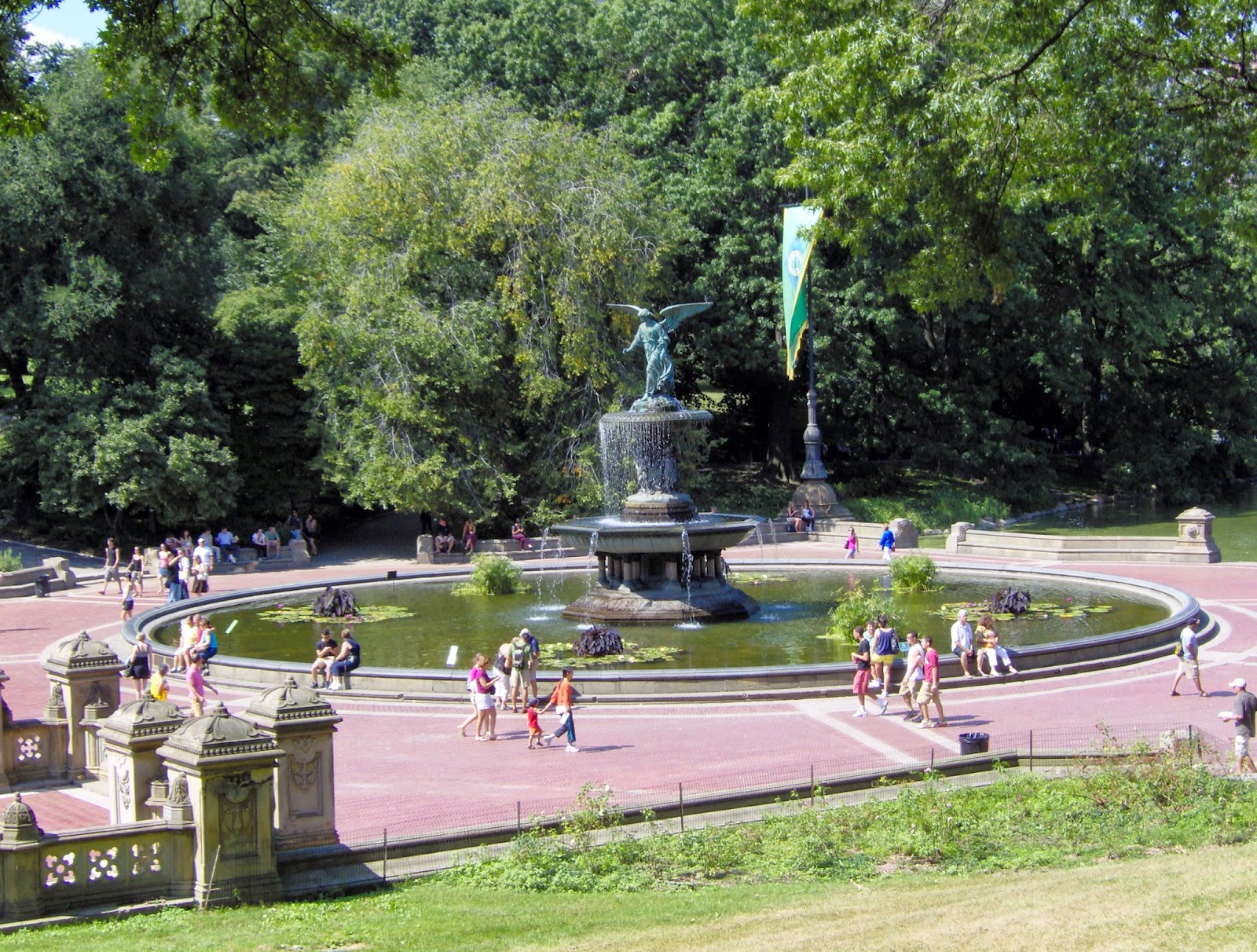
 Musicians feel drawn to the square by Bethesda Fountain. 


Bethesda Fountain


Jazz and four-part madrigals blend with the sound of the fountain’s rushing water and create a symphony.

         A famous site in Central Park is Strawberry Fields, with the memorial for John Lennon. It is a sanctuary for anyone who still feels the uplifting spirit of the 1960’s. IMAGINE, reads the inscription. Everything is possible. Dare to dream. I had a feeling it might be addressed to me, when I stood there for the first time.

         Strawberry Fields is on the edge of the park, on the Upper Westside. The small, tree-lined streets that cross the Avenues from East to West lead into a different world. The cozy, richly decorated brownstones tell stories about the people who live there. On my first visit to New York, I had no idea that in one of them lived the teacher, who would teach me everything that I’d been searching for as a pianist as long as I could think.

         Many hours at the piano and on planes across the Atlantic would pass between the first encounter with him the following summer, and my emigration to the United States in 2001. The decision to fly to New York for piano lessons a couple of times every year changed my view of the world and my priorities. Imagine says John Lennon, Dare to Dream.

         In 1999/2000 I spent the entire winter in New York. Once a week I saw my teacher for a lesson. Outside of that, I mostly saw practice rooms and pianos. The city remained outside, but I could feel its energy, as a force that kept me moving, as a living reality of possibilities. Before I returned to Germany, I played a solo recital for the first time in more than twenty years.

         My first job in the United States got me a work permit, and, eventually, a Green Card. Unfortunately, the job was not in New York. For seven years, I taught at a community music school in a small town in New England, surrounded by woods, mountains, and stifling silence. The only thing that conveyed a sense of motion was the music.
Winter in New Hampshire

The Concord Community Music School - A place of motion in New Hampshire

        
         Conferences, master classes, a few visits to friends took me to different places across the US. New York City remained the place where the motions of life and music flowed together. A friend of mine called it my soul home.   

         The heart of New York City is Manhattan, and Manhattan is an island, a long stretch of land between the Harlem River, the Hudson, and the East River, that merge at the southern tip of Manhattan. Some time passed before I realized that. At some point, I began to ask myself why every trip to the city ended in a traffic jam, crossing a bridge or passing through a tunnel. A glance at the map revealed the geographical situation.

         A solid piece of land, surrounded by three rivers. The encounter of motion and stillness. A solid foundation within myself, surrounded by the motion of life, open for the changes that come along with it – that’s something I wish for, an image where I can find myself.


On the way to my lesson with my teacher I sometimes visit John Lennon in Central Park. Performing has become a regular part of my life by now. Seventeen years ago, when I stood at the memorial for the first time, I had only just started to become serious about practicing again. Back then, I could barely imagine what has become possible in the meantime. Today, I find it hard to imagine that it’s ever been different.

Imagine – everything is possible – dare to dream.


John Lennon Memorial


This article was translated from the original German and posted. with kind permission by Edition Forsbach. It has been published in the volume "Inselgeschichten - Von Fehmarn bis Manhattan" (Island Stories), ISBN 978-3-943134-26-1 and is available through Amazon