Friday, August 31, 2012

The Best of Cappuccina (April 28, 1995 - August 30, 2012)


Studio Cat


Posing with the Studio Giraffe

Maintaining the Music Library

Teaching Assistant


 Favorite Activities


Travel Cat - her biggest trip: Cologne Germany to Concord, New Hampshire USA

Computer Specialist
Drinking water from a glass by the sink

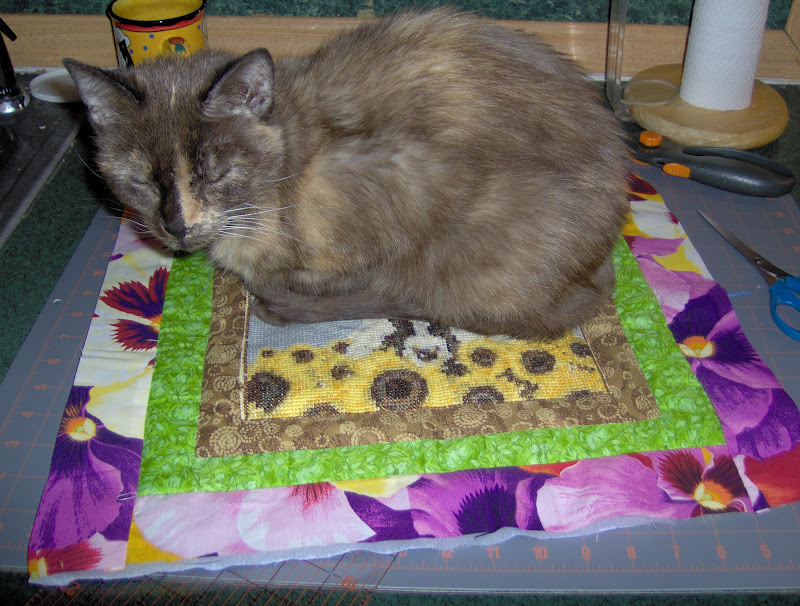
Quilting Assistant

Looking out the kitchen window
Observation of Wildlife - Eye to Eye with the Squirrel

Fishing for Tea Bags


Recording Engineer - or just another warm place?

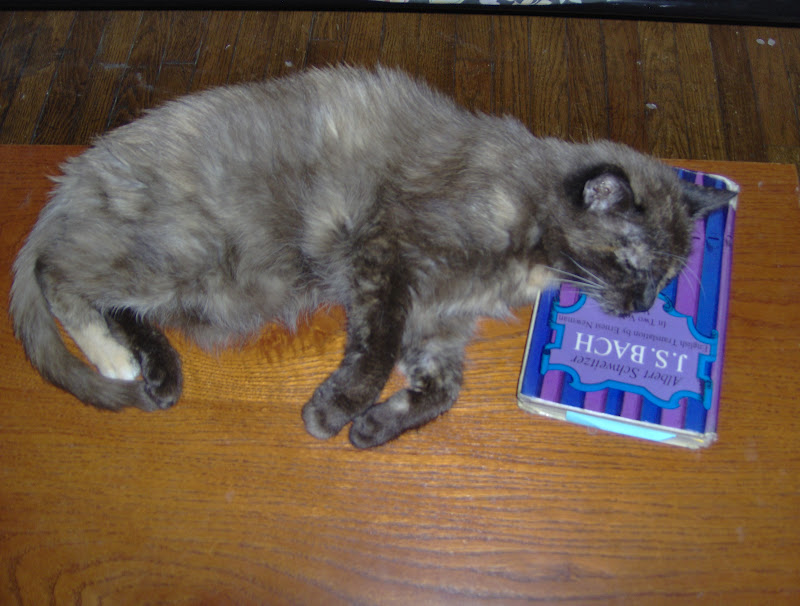
The Bach- Expert

Back- up for the Answering Machine

Favorite Places


Her favorite place on the radiator


Between the burners on the gas stove


On the warming pad we got last winter

Sun bathing under the piano - the last picture of her, taken 8/23/2012


Tuesday, August 7, 2012

A Break for the Brain - and an Interesting Idea / Eine Pause für das Gehirn und eine interessante Idee

It’s a hot summer, which, I find, always slows down the brain. The effect becomes particularly obvious if all you’re practicing is Preludes and Fugues. I have to say, though, that I find them more appropriate for the summer than more physically demanding virtuoso works. Let’s say Bach makes you sweat on the inside. 
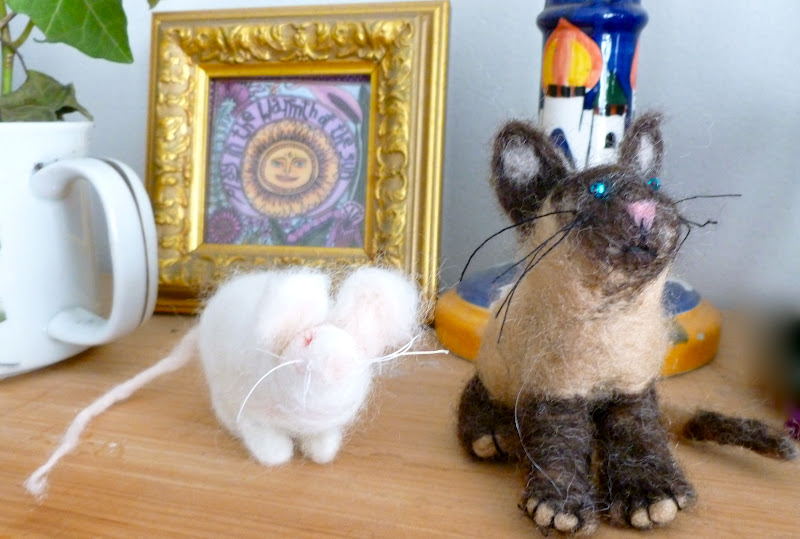
Piano aside, sometimes, the mind needs a break, which gives me an excuse to indulge in my passion for needlework and crafts. So, a while ago - the day after the end of piano camp, to be precise - I took a class in needle felting at The City Quilter, a quilt shop in  in New York. I had bought a book there that describes how to make little felted animals, but I was too lazy to figure it out by myself. 


It is so easy, you won’t believe it. All you need is a a felting needle, a piece of unspun wool and thick piece of foam, so the needle doesn’t break while you’re felting. You can buy it, or you can use your mattress, if you don’t live close to a store. For the animals, you pre-shape the body and the head by rolling the wool into a ball or a roll, and then you prod it into shape by poking it with the needle. The needle, which has a very sharp tip, has little hooks on the side. They cause the fibers to connect as you run it up and down through the material. That’s also the way to connect the body parts, one end has to be left open to make that work. As the teacher, Nancy Rabatin, put it, it’s like working with clay, only less messy - in fact it’s no mess at all. 


The technique reminds me of voicing a piano. The texture of the felt of the hammers influences the quality of the sound, and in order to even it out the technician pokes it with a needle. That doesn’t mean, of course, that I now feel qualified to do it, just because I’ve learnt how to make little felted animals.

That said, though, my former piano student Bob Smith recently sent me an article from the New York Times, For More Pianos, Last Note Is Thud in the Dump about old, unwanted pianos being taken to the dump. I found that quite depressing. If your upright piano has deteriorated to that condition, you could probably consider shaping the hammers into little felted animals - intricate work, of course, because it requires working on a very small scale. I suggest you practice on something else before trying it on the real object. The front of the piano removed, that would give you a kind of puppet theatre, something very special. 

The blackbird is just visiting,
I don't recommend the puppet theatre piano idea for high-end grand pianos
Thinking of the attention toy pianos get  ( the link takes you to a youtube video of the performance at South Street Seaport in June) , the puppet piano could become a unique collector’s item, and who knows, it might even inspire composers to write daring new works. Wendy Mae Chambers , here’s an idea for you...  

Der Sommer ist heiss, und das verlangsamt die Gehirntätigkeit. Der Effekt macht sich besonders bemerkbar wenn man ausschliesslich Präludien und Fugen übt. Allerdings muss ich sagen, dass ich das angenehmer finde als körperlich anstrengendere Virtuosenstücke. Bach bring einen eher innerlich zum Schwitzen. 

Klavier beiseite, machmal braucht der Geist eine Pause, und das gibt mir eine Entschuldigung mich meiner Leidenschaft für Handarbeit und Basteln zu widmen. Vor einiger Zeit, genauer gesagt, am Tag nach dem Klaviercamp, nahm ich an einem Kurs für Nadlefilztechnik beim “City Quilter”, einem Handarbeitsgeschäft in New York, teil. Ich hatte dort ein Heft gekauft, dass beschrieb wie man kleine Tiere aus Filz herstellt, aber ich war zu bequem, es selber auszutüfteln.  


Es ist unglaublich einfach. Man braucht lediglich ein Stück dicken Schaumstoff, damit die Nadelspitze beim Filzen nicht abbricht - die Matraze tut’s auch, wenn kein Geschäft in der Nähe ist - eine Filznadel, und einen kleinen Strang ungesponnener Wolle. Die Körperteile werden als Kugeln oder Rollen vorbereitet, die man dann mit der Nadel in die richtige Form bringt. Die Nadel hat eine sehr scharfe Spitze, und kleine Haken an der Seite, wodurch sich die Wollfasern verbinden, während auf und ab man sie durch die Wolle führt. In dieser Weise verbindet man auch die Körperteile. Wie die Lehrerin, Nancy Rabatin  sagte, es ist so wie Arbeiten mit Ton, nur ohne die Schweinerei.


Die Technik erinnert mich an das Intonieren eines Klaviers. Die Beschaffenheit des Filzes hat einen grossen Einfluss auf die Tonqualiät, und um diese zu regulieren und die verschiedenen Töne einander anzugleichen, bearbeitet der Klaviertechniker den Hammerfilz mit Nadeln. Das bedeutet natürlich nicht, dass ich mich nun qualifiziert fühle, mein Klavier selbst zu intonieren, nur weil ich gelernt habe, wie man kleine Filztiere herstellt.

Allerdings muss ich sagen, dass es mich auf eine Idee bringt, wenn ich an den Artikel aus der New York Times denke For More Pianos, Last Note Is Thud in the Dump , den mir mein ehemaliger Schüler Bob Smith vor einiger Zeit geschickt hat. Es ging um alte, abgetakelte Klaviere, die niemand mehr will, und die nun auf die Müllkippe gefahren werden. Ich fand das ziemlich deprimierend. 

Wenn Euer altes Klavier diesen Zustand erreicht hat, könnte es doch vielleicht einer Überlegung wert sein, die Hammerköpfe zu kleinen Filztieren umzugestalten, piddelige Arbeit natürlich, weil man auf sehr kleinem Massstab arbeiten muss. Ich schlage vor, Ihr übt erstmal mit etwas anderem, bevor Ihr es am richtigen Objekt versucht. Wenn man dann die vordere Abdeckung des Klaviers entfernt, hat man ein Klavierpuppentheater, und das wäre doch etwas ganz Besonderes! 

Die Amsel ist nur zu Besuch,
Ich empfehle die Puppentheaterklavieridee nicht fuer hochwertige Fluegel
Wenn ich sehe, wie viel Aufmerksamkeit die Spielzeugklaviere erregen ( der Link bringt Euch zu einem Video von unserer Aufführung am South Street Seaport im Juni) könnte das Klavierpuppentheater vielleicht sogar zu einem einzigartigen Sammlerobjekt werden, und Komponisten zu kühnen neuen Werken anregen. Wendy Mae Chambers , hier ist eine Idee für Sie...

Friday, July 13, 2012

Teen Pianophoria! - the second week.

“If performing is an act of generosity - and I believe it is -” said Marcia Eckert, the director of the camp after the final concert last Friday, “then the students have been extremely generous this evening. In the two weeks that we worked together, we got to know them not only as serious and committed musicians, but as wonderful human beings as well.”
I can’t think of a better way to sum up Teen Pianophoria! this year. It was generosity all around, the way everybody, students as well as teachers, shared what they knew and supported each others’ growth. There is the friendship that bridges differences in levels of experience and accomplishment, the tolerance of different approaches and opinions, which were taken as an incentive to think and broaden one’s perspective. 
The students presented a two-hour program, but it didn’t seem long, because everybody played with total commitment and deep expression. It was amazing how these pieces and the students’ mastery had grown in the course of these two weeks, an example of what becomes possible when a group of like-minded spirits come together in an atmosphere of cooperation and harmony. It was a wonderful experience, I miss the community, and I hope we’ll all get together again next summer.

The students:
Philip, Benji, Samantha, Laurie, Eisa-Marie, Sara, Alex (1st row, l to r)
Evan, Luis, Liam, Anya, Erika, Hanna, Evelyn, Jacob, Gavin ( 2nd row, l to r)
“Wenn eine Aufführung ein Akt der Grosszügigkeit ist - und davon bin ich überzeugt - “ sagte Marcia Eckert, die Leiterin des Kurses nach dem Abschlusskonzert am letzten Freitag, “ dann sind die Schüler am heutigen Abend überaus grosszügig gewesen. In den zwei Wochen unserer Zusammenarbeit haben wir sie nicht nur als ernsthafte und engagierte junge Musiker, sondern auch als wunderbare junge Menschen kennengelernt.”
Ich kann mir keine bessere Zusammenfassung von “Teen Pianophoria!” in diesem Jahr vorstellen. Grosszügigkeit herrschte allenthalben, in der Art und Weise, wie Schüler und Lehrer miteinander umgingen und sich gegenseitig unterstützten. Freundschaft überbrückt Unterschiede im Leistungs- und Erfahrungsniveau, Toleranz kennzeichnet den Umgang mit unterschiedlichen Meinungen und Ansätzen, die als Denkanregung genutzt werden, und als Chance, den eigenen Horizont zu erweitern.
Das Abschlusskonzert dauerte zwei Stunden, die schnell vergingen, weil alle mit Hingabe und grossem Ausdruck spielten. Es war erstaunlich, wie die Beherrschung dieser Stücke in den zwei Wochen gewachsen war, ein Beispiel dafür, was möglich ist, wenn ein Gruppe von Gleichgesinnten in einer Atmosphäre von gegenseitiger Unterstützung und Harmonie zusammenkommt. Es war eine wunderbare Erfahrung, ich vermisse die Gemeinschaft, und hoffe wir kommen alle im nächsten Sommer wieder zusammen.  

More Teen Pianophoria! Photos   

Masterclass with Raj Bhimani,
Evelyn and Raj
Masterclass with Raj Bhimani,
Liam and Raj

"Down- time" in the hallway

and "Down-time" in Central Park

An hour to go until the concert

The entire group:
1st row (l to r) Liz Wolf, Marcia Eckert, Philip, Benji, Samantha,Laurie, Eisa-Marie, Sara
2nd row (l to r) Thomas Osuga, Evan, Luis, Liam, Anya, Erika, Hanna, Evelyn, Jacob, Gavin, Birgit Matzerath, Alex

Saturday, June 30, 2012

“Teen Pianophoria” - the first week / Teen Pianophoria - die erste Woche


Judging from the photographs, you could think that young pianists spend more time socializing than in the practice room during “Teen Pianophoria” - but practice time for the young musicians is teaching time for the teachers, and every time I look at my watch it’s later than I think, even without me taking pictures.
This is my first year teaching full-time at “Teen-Pianophoria.” I’ve done some presentations there, and I taught a little last year. The 16 students who attend the camp at Hunter College in NYC this summer form the largest group ever, so another teacher was needed. 
Many students come from New York City, but I’m not the only commuter from New Jersey, and some students are on the road a lot longer than I am. Occasionally, there have been students from abroad in the past; this year, it’s Sara who has travelled the farthest. Her father works in New Delhi, so the family moved there last year. Most of the time, Sara has been working by herself at the piano; so far, she’s been unable to find a suitable teacher.  
All the other students have their own piano teachers, with whom they study permanently, either privately or at a school. The purpose of the camp is to gather ideas, Marcia Eckert, who is the founder and director of the camp, explained on the first day. 
In addition to a private lesson each day and a duet session, there are master classes, presentations on subjects that relate to playing, like Performance Wellness, Yoga, Dalcroze, Improvisation, Listening to music, etc. Of course, there is also practice time, about 3 hours total, with part of it reserved for the private lesson and duet rehearsal. 
We “rotate,” so that we get to know all the students, and the students get to know all the teachers. They may have to put up with different suggestions to solve a problem, but that’s the idea: to gather as much information as possible, and then experiment with it to find the best solutions. Not everything works the same way for everybody, and in the end, you have to find out yourself what works for you. All students play at least intermediate repertoire, so they already bring some background to the experience.
For me, this is the first experience of real “team teaching.” Every day, we exchange ideas about our experience at the lessons, discuss progress, repertoire, approaches, and it is just as reassuring as it is inspiring. Exposure to different ideas broadens your view - that is true for both teachers and students.

Masterclass with Deirdre O'Donohue,
student: Gavin Cappon

Masterclass with Major Scurlock (l), Erika performs the piano concerto in C-major K467,
accompanied by faculty member Thomas Osuga

Performance Wellness Class, Group Improvisation


First thing in the morning: trying to remember stretches from Yoga Class,
Luis, Samantha, Evelyn, Erika
Picknick in Central Park - the cafeteria is closed on Fridays

Erika, Hanna, Anya, faculty members Liz Wolff and Thomas Osuga


"Happy Birthday" to Erika, Alex and Luis, who all celebrate their birthdays during the two weeks of the camp 

The birthday people get the first choice - Luis and Alex

Alex, Benji and Philip

"Open your Hymn Books", commented faculty member Liz Wolf, when Liam started to play Bach's solemn Prelude in B-major from WTC I, and Evan harmonized the piece on the keyboard


Rachmaninov's 2nd piano concerto,
everybody joined in singing the orchestra part ( or something like it ), including the soloist

Afternoon break, in conversation: Marcia Eckert and Laurie, Sara and Eisa; Luis,
Alex and Benji playing cards


Die Fotos könnten den Eindruck wecken, dass die jungen Pianisten mehr Zeit in munterer Gesellschaft miteinander verbringen als im Überaum. Indes, der Eindruck täuscht, Übezeit für die jungen Musiker ist Unterrichtszeit für die Lehrer, und jedes Mal wenn ich auf die Uhr sehe ist es später als ich dachte, auch wenn ich keine Fotos mache.
Zum ersten Mal unterrichte ich den ganze Tag bei “Teen Pianophoria.” Ich habe einige Präsentationen gehalten und im letzten Jahr einige Tage unterrichtet. Die 16 Schüler, die dieses Jahr den Kurs besuchen sind die grösste Gruppe seit seinem Bestehen, und so wurde eine weitere Lehrperson gebraucht.
Viele Schüler kommen aus New York City, aber ich bin nicht der einzige “Pendler” aus New Jersey, und manche sind länger unterwegs als ich. In der Vergangenheit sind gelegentlich Schüler aus dem Ausland gekommen; dieses Jahr hatte Sara die weiteste Reise. Ihr Vater ist letztes Jahr nach Neu Delhi versetzt worden, so dass die Famile umziehen musste. Meistens hat Sara allein an ihrem Klavierrepertoire gearbeitet, einen geeigneten Lehrer hat sie an ihrem neuen Wohnort bisher nicht gefunden. 
Alle anderen haben ihre eigenen Klavierlehrer, bei denen sie entweder privat oder an einer Schule Unterricht nehmen. Der Kurs soll Ideen vermitteln, erklärte Marcia Eckert, die Gründerin und Leiterin, am ersten Tag.
Zusätzlich zum täglichen Einzelunterricht und Vierhändigspielen gibt es Meisterklassen, Vorträge und workshops zu Themen die mit dem Klavierspiel zusammenhängen; Lampenfieber, Yoga, Dalcroze, Improvisation, Musikhören etc. Natürlich ist auch Zeit zum Üben, insgesamt etwa 3 Stunden, die den Privatunterricht und das die Ensembleprobe mit einschliessen.
Die Lehrer unterrichten jeden Tag andere Schüler, so dass alle Schüler alle Lehrer und alle Lehrer alle Schüler kennenlernen. Für die Schüler kann das bedeuten, dass sie sich mit verschiedenen Vorschlägen auseinandersetzen müssen, aber das ist die Absicht: so viel Information wie möglich aufnehmen, damit experimentieren und herausfinden, was für einen persönlich am besten funktioniert. Nicht jedem passt die gleiche Lösung. Alle Schüler spielen wenigstens Repertoire der Mittelstufe, so dass sie bereits einige Voraussetzungen für diese Aufgabe mitbringen.
Für mich ist es die erste Erfahrung mit richtigem “Team teaching.” Jeden Tag tauschen wir uns aus über die Erfahrungen, die wir im Unterricht gemacht haben, diskutieren über Fortschritte, Repertoire, Ansätze, und ich empfinde es als Unterstützung und Inspiration zugleich. Andere Ideen erweitern den Blick, nicht nur für Schüler, auch für Lehrer. 

Monday, June 25, 2012

K'un - the performance/ K'un - die Auffuehrung

Setting out for the performance
Aufbruch zur Auffuehrung
Last Thursday morning temperatures were well into the 90's. We had orders to pick up our pianos at a place about 6 blocks away from the performance space, so I revived my luggage cart.


Letzten Donnerstag morgen war es ueber 30 Grad. Wir hatten Anweisung, unsere Klaviere an einem Sammelplatz selber abzuholen und zum etwa 6 Blocks entfernten Auffuehrungsort zu bringen. Da wurde mein alter Gepaecktransporter noch einmal reaktiviert.


Piano assembly
Klavierversammlung

Talk about being overprepared. After waiting in front of the meeting place for 10 minutes, I found out that the pianos had been transported already.


Nachdem ich 10 Minuten am Treffpunkt gewartet hatte, fand ich heraus, dass die Instrumente schon transportiert worden waren.

Performers' Assembly
Pianistenversammlung

Setting up
Aufbauen 
At 4:30, everybody started to play. The greatest challenge was to fold yourself up behind the piano in a half way comfortable position. Wendy, the composer had instructed us to play our piece four times, then take a 5 minute break and start over, another 4 times - until 8:30, with a half hour break. 
One set lasted between 15 and 20 minutes - I think we got faster over time. Sitting on the floor was too low, my arms got really tired; so I tried kneeling. That lasted until the break, then my partner Simone and I moved to the bottom of the stairs and sat on the steps. Security dropped a hint that we presented a safety hazard, but we pretended to be so absorbed in the music that we didn't hear it.


Um 16:30 fingen alle an zu spielen. Die groesste Herausforderung bestand darin, eine halbwegs komfortable Position am Instrument zu finden. Wendy, die Komponistin, hatte uns instruiert, unseren Part 4 mal hintereinander zu spielen, dann 5 Minuten Pause, dann wieder von vorn - bis 20:30, mit einer halben Stunde Pause. Ein Duchgang dauerte etwas 15-20 Minuten - im Lauf der Zeit sind wir etwas schneller geworden. Auf dem Boden zu sitzen war mir zu tief, die Arme wurden sehr schnell muede beim Spielen, so veruchte ich's mit Knien. Das ging bis zur Pause, danach zogen meine Partnerin Simone und ich zu einer Treppe um, wo wir uns auf die untersten Stufen setzen konnten. Das Sicherheitspersonal liess eine Bemerkung von wegen Sicherheitsrisiko fallen - in die Musik vertieft, taten wir so als haetten wir's nicht gehoert.

Musician on break
Musikerpause
 The break gave us a chance to wander around and visit all the other musicians, who were positioned all over Piers 15 and 16, in pairs or as soloists. 


Die Pause gab uns Gelegenheit, umherzuwandern, und die anderen Musiker zu besuchen, die ueberall auf den Pier 15 und 16 allein oder als Duett Aufstellung genommen hatten.


The Quartett
Das Quartett

Wendy Mae Chambers, the composer


It would have been fun to finish up the concert with a party. On the other hand, everybody was eager to get home after 4 hours of playing, and my mind felt about as fuzzy, as this picture.
It's too bad I don't have a sound file, but if you want an impression of the sound, check out a Gamelan orchestra on YouTube. The toy pianos don't have as much variety, but it's close.

Es waere nett gewesen, das Konzert mit einer Party zu beenden. Andererseits waren nach 4 Stunden Spielen alle darauf erpicht, sich auf den Heimweg zu machen, und meine Denkfaehigkeit war ungefaehr so unscharf wie dieses Foto. Leider habe ich keine Tonaufnahme, aber ein Gamelan Orchester vermittelt einen gewissen Eindruck, wenn auf der Klang der Spielzeugklaviere weniger Nuancen hat.