“We are the music makers and we are the dreamers of dreams…”
Sir Edward Elgar’s music to Arthur O’Shaugnessy’s poem The Music Makers closes quietly. Matthew Lewis, who currently celebrates his 20th season as conductor of St George’s Choral Society, keeps a long moment of silence after the last note has faded, before he lowers his hands. The gesture gives way to thunderous applause, standing ovations and enthusiastic bravos.
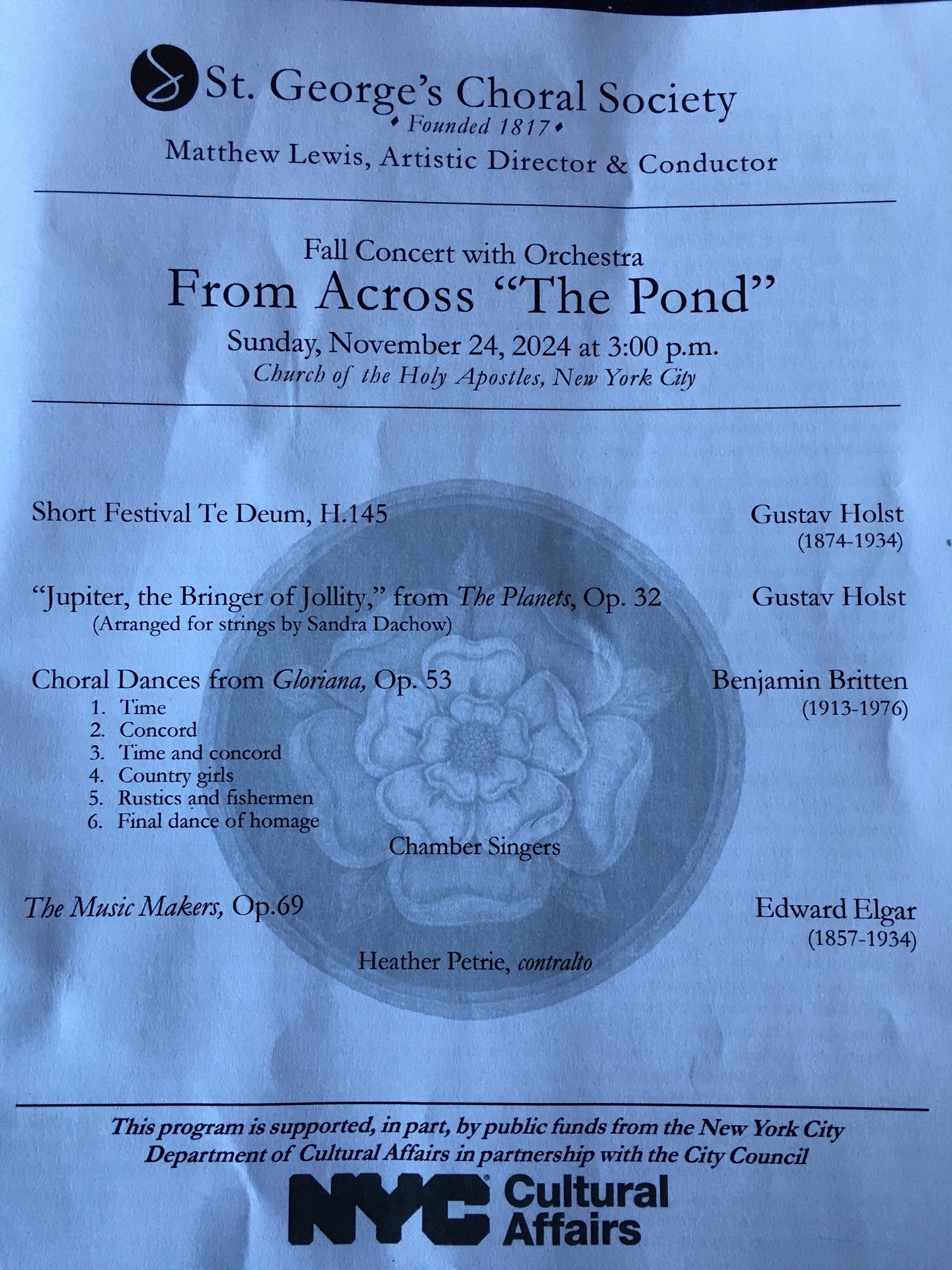 |
| Program of the concert |
Then the order of the performance dissolves. The sounds of choir and orchestra are replaced by the hum of voices; excited voices, hearts still filled with the music we’ve listened to. Audience members make their way through the crowd to congratulate the musicians. Orchestra members start packing up their instruments, some surely eager to rush off to the next gig. Someone waiting in line to congratulate soloist contralto Heather Petrie takes the chance to try a few notes on the Glockenspiel that stands silent, awaiting attention. We are all in this together - the thought crosses my mind, as I rush up front to congratulate Heather and hug Mimi, my friend who sings in the choir, writes the program notes and treated me to the ticket. We all met years ago, singing with Musica Viva New York at All Souls church on the Upper Eastside. Old friends reconnect and are introduced to new friends.
We chat for a while, and then everyone heads home. Dusk is settling over the city when I set out into the street to walk the couple of blocks back to Penn Station to catch the train back to New Jersey.
On the way to the concert earlier, memories hit home and became almost overwhelming. When I first moved from New Hampshire fifteen years ago, I came to this neighborhood every week. I was still employed by the Concord Community Music School that had sponsored me for a Green Card. Once I got that, I didn’t want to stay in New Hampshire for the rest of my life. Cautiously, I tested the waters of trying to make a living as an independent musician and teacher in the greater NYC area. For an entire year, I commuted once a week from New Hampshire to New York - 8 hours on the bus one way - to teach a handful of private students in New Jersey. To be close to the bus for the journey back, I stayed overnight with Julian and Deirdre in Manhattan. They were good friends of one of my students in New Hampshire. Their apartment provided stable ground, a feeling of home, friendship and an abundance of good advice in challenging times. Julian had once played the piano and decided to take up lessons again. She remained my student for several years after I moved to the area for good. Eventually though, the couple retired and moved to their home in Maine. The neighborhood still holds memories, but the feeling of home has been replaced by nostalgia.
Many good friends left the city during the Pandemic and didn’t return. Some have passed away. Places of comfort have vanished. The Open Center where I volunteered in NYC and met many wonderful people didn’t make it through the Pandemic - though I did get word about efforts to restart. The Rubin Museum closed its doors and went 100% virtual in October. The book store at the corner of Broadway and 63rd, where I’ve spent hours in the cafe over a cup of coffee, a giant chocolate chip cookie and a stack of books closed years ago. Sometimes, I went into the city to do just that - browse books in the quiet company of others. Cafés have dwindled, “Manhattan’s public living room,” as a friend once described them, “where people whose apartments are as big as a walk-in closet spend their afternoons.”
These days, most people’s faces are glued to the screen of a phone while their bodies sit in front of a table or walk the streets. Sometimes I feel as much of a stranger as I did when I first came. Not just here, but in the world.
The music from the concert still resounds in my mind; the last piece on the program especially: Edward Elgar’s “The Music Makers” op 69 - a monumental piece for choir, contralto solo and orchestra, lasting a good 40 minutes. (Performed in the link by the choir of the University of Regensburg, Germany)
The music that Elgar wrote to Arthur O’Shaughnessy’s poem is like a choral symphony. I listened to it first on YouTube, in a performance by the BBC Choir and Symphony - grandiose, spectacular, perfected in every aspect of the recording and performance. But it didn’t have the intensity of the live concert, or the feeling, or the nuance of the live performance. The voices and the orchestra merged, drew me in and washed over me, taking the sadness away. I’ve heard St George’s Choral Society before; they’re always good. Tthis time, though, they outdid themselves, as if the music had lifted them up and they were riding the wave of the music.
 |
| St. George's Choral Society at the concert |
I left the venue feeling comforted - by an uncomfortable piece. The Music Makers speaks of “empires that come and go, seeing themselves inspired by artistic expression, but the artists themselves, though essential, always remain apart, shaping empires’ violent downfall as well. “World- losers and world-forsakers … Yet we are the movers and shakers Of the world forever, it seems.” (Quote from the program notes, written by Miriam Michael) The artist always remains apart - that’s where Heather Petrie’s expressive, beautiful contralto solo came in.
 |
| Contralto Heather Petrie |
There’s something about live concerts, especially “neighborhood concerts” like this one that can’t be replaced by even the most perfect recording: the experience that we’re all in this together, right now in this unique moment.
The ground floor of Penn Station is buzzing with people in motion when I get there. The vast, ambitious glass-and metal Moynihan Train Hall is finally finished.
 |
| Moynihan Train Hall |
On the second floor, flashing lights on screens and colorful paper cover the windows of empty storefronts and hide the fact that apparently, here’s a dream that hasn’t come true. I wonder if anyone notices. The vast marble halls in front of the empty stores are empty as well. Nobody is there to see…
 |
| Empty storefronts on the 2nd level of Moynihan Train Hall |

We, in the ages lying
In the buried past of the earth
Built Niniveh with out sighing
And Babel itself with our mirth;
And o’erthrew them with prophesying
To the old of the new world’s worth
For each age is a dream that is dying,
Or one that is coming to birth…
reads the third verse of O’Shaughnessy’s poem.
We are the music makers and we are the dreamers of dreams.
Before the sound there’s the dream of the sound. Everything is a dream before it comes alive. Maybe some things don’t change, after all - the imagination remaining the force that keeps the world and us going at the core…
----
Sir Edward Elgars Musik zu Arthur O’Shaugnessy’s Gedicht The Music Makers endet leise. Matthew Lewis, der in dieser Saison sein 20. Jahr als Chorleiter der St George’s Choral Society feiert, bewahrt einen langen Augenblick der Stille, nachdem der letzte Ton verklungen ist. Kaum lässt er die Arme sinken, füllt begeisterter Applaus den Kirchenraum; Zuhörer erheben sich von den Bänken und rufen “Bravo.”
|
| Konzertprogramm |
Die geordnete Konzertformation löst sich auf. Ein munteres Stimmengewirr macht sich breit, begeisterte Stimmen, noch ganz erfüllt von der Musik die wir gerade gehört haben. Zuhörer bahnen sich einen Weg durch die Menge nach vorn, um Sängern und Instrumentalisten zu gratulieren. Orchestermitglieder packen ihre Instrumente ein; einige sicherlich auf dem Weg zur nächsten Mucke. Jemand aus der langen Reihe der Gratulanten die darauf warten, ein paar Worte mit der hervorragenden Solistin Heather Petrie zu wechseln, probiert ein paar Töne auf dem verwaisten Glockenspiel. Wir alle gehören zu diesem Konzert, fährt es mir durch den Sinn, bevor ich mit Heather spreche und Mimi umarme, meine Bekannte, die im Chor singt, die Programmnotizen schreibt und mir die Konzertkarte besorgt hat. Wir kennen uns schon lange, haben viele Jahre lang bei Musica Viva New York an der All Souls Kirche auf der Upper East Side gesungen. Alte Bekannte begegnen sich wieder und werden neuen Bekannten vorgestellt.
Wir reden noch eine Weile, dann macht man sich auf den Heimweg. Es dämmert über der Stadt als ich die kurze Strecke zur Pennsylvania Station zurücklaufe, wo mein Zug nach South Orange abfährt.
Früher am Nachmittag, auf dem Weg zum Konzert, hatten mich Erinnerungen eingeholt, die mich traurig stimmten. Als ich vor 15 Jahren von New Hampshire in die Nähe von New York zog, war ich jede Woche in diesem Viertel von Manhattan. Ich war zu der Zeit immer noch an der Musikschule in Concord, NH angestellt und hatte über diese Stelle meine Green Card - die dauerhafte Aufenthalts- und Arbeitsgenehmigung in den USA - erhalten. Den Rest meines Lebens wollte ich allerdings nicht in New Hampshire verbringen. Vorsichtig begann ich, Arbeitsmöglichkeiten als selbständige Musikerin und Klavierlehrerin in New York und Umgebung anzutesten. Ein ganzes Jahr lang fuhr ich einmal pro Woche von New Hampshire nach New York (8 Stunden mit dem Bus, eine Fahrt), um einen Nachmittag lang Privatschüler zu unterrichten, die mir Kollegen in New Jersey vermittelt hatten. Um für die Rückfahrt schneller am Bus zu sein, übernachtete ich bei Julian und Deirdre in Manhattan. Die beiden waren gute Freundinnen einer meiner Schülerinnen an der Musikschule in Concord; sie hatte mich mit den beiden bekannt gemacht. Ausser einem Dach über dem Kopf und einem Bett für die Nacht fand ich bei Julian und Deirdre offene Ohren für alles was klappte und alles was schiefging, gute Ideen, Unterstützung, Wärme, Freundschaft, Angenommensein. Julian erinnerte sich, dass sie früher einmal Klavier gespielt hatte und fing wieder an, Unterricht zu nehmen. Nach meinem Umzug in die Gegend blieb sie noch für eine Reihe von Jahren meine Schülerin. Nach ihrer Pensionierung zog sie mit ihrer Partenerin nach Maine. Das Stadtviertel, wo die beiden gewohnt haben, ist noch voller Erinnerungen, aber das Gefühl, zu Hause zu sein hat sich zu Nostalgie gewandelt.
Viele gute Freunde verliessen die Stadt während der Pandemie und kehrten nicht zurück. Manche sind nicht mehr am Leben. “Emotionale Stützpunkte” aus den ersten Jahren in New York sind verschwunden. Das Open Center, wo ich ehrenamtliche Mitarbeiterin war, hat die Pandemie nicht überstanden - wenn es auch Gerüchte über einen möglichen Neuanfang gibt. Das Rubin Museum schloss im Oktober seine Tore und bietet nun seine Projekte weltweit auf dem Internet und mit Wanderausstellungen an. Schon vor Jahren schloss der Buchladen an der Ecke Broadway und 63. Street, wo ich Stunden im Cafe bei einem Kaffee und einem riesigen Chocolate Chip Cookie über einem Stapel Bücher zugebracht habe. Manchmal bin ich nur dafür in die Stadt gefahren: um in stiller Gesellschaft von anderen in Büchern zu stöbern. Cafés, die ein Freund einmal als “Manhattan’s öffentliches Wohnzimmer, ” beschrieb, “wo Leute, deren Wohnungen so gross sind wie eine Abstellkammer, Stunden im Gespräch miteinander oder auch mit Arbeit verbringen,” gibt es auch immer weniger.
Heutzutage kleben die Gesichter der meisten am Bildschirm ihres Smartphones während sie an einem Tisch sitzen oder eine Strasse entlanglaufen. Manchmal fühle ich mich so fremd wie am Anfang. Nicht nur hier, sondern in der ganzen Welt.
Die Musik klingt mir noch in den Ohren, als ich nach dem Konzert die Kirche verlasse; vor allem das letzte Stück: Edward Elgar’s “The Music Makers” op 69 - ein monumentales Stück für Chor, Alt solo und Orchester; es dauert etwa 40 Minuten (Aufführung im angegebenen Link: Chor und Orchester der Universität Regensburg)
Elgar machte aus Arthur O’Shaughnessys Gedicht eine Art Chorsinfonie. Vor dem Konzert hatte ich mir eine Aufnahme auf Youtube angehört, mit Chor und Orchester der BBC London, grandios, spektakulär, perfekt in allen Aspekten von Ausführung und Aufnahmetechnik. Trotzdem fehlte die Intensität des Live Konzerts, die musikalischen Nuancen und das Gefühl des unmittelbaren Erlebens. Hier verschmolzen Chor und Orchester zu einer einzigen Klangwelle die meine Traurigkeit fortspülte. Ich habe St George’s Choral Society schon öfter gehört. Alle Aufführungen waren ausgezeichnet, aber diesmal wuchsen die Musiker über sich hinaus.
|
| St. George's Choral Society beim Konzert |
Ich verliess die Kirche getröstet von einem unbequemen Stück. The Music Makers beschreibt “Imperien, die kommen und gehen, inspiriert von künstlerischem Ausdruck, aber die Künstler, die ihn hervorbringen, bleiben immer ausserhalb des Geschehens, sei es der Aufstieg von Weltreichen, oder ihr gewaltsamer Zerfall.“World- losers and world-forsakers … Yet we are the movers and shakers Of the world forever, it seems.” (Zitat aus Miriam Michels Programmnotizen) Der Künstler hat die Vision, steht aber immer abseits - symbolisiert im Solo der Altstimme, mit Intensität und warmem Ausdruck vorgetragen von Heather Petrie.
|
| Die Altistin Heather Petrie |
Live Konzerte wie dieses, in kleinerem, intimen Rahmen, vermitteln etwas, das auch die perfekteste Aufnahme nicht wiedergeben kann: die Erfahrung des gemeinsame Erlebens dieser einmaligen, unwiederholbaren Augenblicke.
Als ich an der Pennsylvania Station ankomme, wimmelt es in der Bahnhofshalle von Menschen, die in alle Richtungen laufen. Es hat lange gedauert, bis die ambitionierte Konstruktion aus Glas und Stahl fertig war.
|
| Moynihan Train Hall |
Im zweiten Stock ist es dagegen still. Grelle Leuchtreklamen und bunt bemalte Plakatwände verdecken die Fenster leerer Ladenlokale und täuschen über die Tatsache hinweg, dass hier anscheinend Träume nicht in Erfüllung gegangen sind. Ob das wohl jemandem auffällt? Ist überhaupt jemand da, dem es auffallen könnte….?
|
| Leere Ladenlokale im 2. Stock |
Jedes Zeitalter ist ein sterbender Traum
Oder die Geburt eines neuen ….
endet die dritte Strophe von O’Shaughnessy’s Gedicht.
Wir sind die Musiker und die Träumer von Träumen…
Bevor der Klang in die Welt geht, erklingt er in der Vorstellung. Alles ist Traum bevor es Wirklichkeit wird. Etwas bleibt unverändert: die Vorstellung als Kraft, die uns und die Welt bewegt.


