Showing posts with label "Sing for Hope". Show all posts

Monday, April 11, 2022

Bach at the Bus Terminal - for the pure joy of making music/ Bach im Busbahnhof - aus reiner Freude am Musikmachen

In the weeks leading up to the date of my first time participating in “Bach-in-the-Subways” I struggled with the worst bout of performance anxiety I’ve experienced in years: a constant level of anxiety, feelings of panic, fear of losing control. Some days I only survived because I promised myself that, at the end of the day, I’d open my laptop and write an e-mail, cancelling the two performances. 


In the evenings I felt better. I’d survived another day, if nothing else. Nothing would be lost if I postponed the decision to cancel by just one more day. I imagined what cancelling would feel like. A release of the tension - and then, a big, black hole of emptiness, a void, nothing. I also imagined following through. Some of the most rewarding things I’ve done in my life were preceded by periods of extreme emotional turmoil. It almost seems like a law of nature.


Entrance to the stage are at Port Authority Bus Terminal


At this point it wasn’t about the playing. I’d done this before, in concert settings, and I was better prepared than ever. The emotional upheaval seemed hopelessly out of proportion with regard to the “objective” importance of the event. “Bach-in-the-Subways“ is street music. No one was going to write a review. The passers-by wouldn’t even know who I am. Port Authority doesn’t allow banners or the distribution of flyers, so we couldn’t even announce that my performance was part of the Bach-in-the-Subways project.


But experience is subjective, and some events may be symbolic. Memories resurface. A bus trip in 1996 reconnected me with the United States and the little town in Minnesota where I’d spent a year as a German exchange student in high school 25 years earlier. That bus trip began at the Port Authority Bus Terminal in New York City. At the time, I’d only just started to play solo again and wouldn’t have dreamt of ever performing the entire WTC 1. 

Bus terminal with concert stage
After my relocation from Germany to the US in 2001, I must have traveled thousands of miles between Concord NH, where I had my first job, and New York City, where my teacher Seymour Bernstein helped me get Bach’s work into my fingers, with infinite patience, one Prelude and Fugue at a time. (If you’re interested to find out more about this, check out my memoir “More than the World in Black and White - How Music came alive and my Life became Music”) On the bus, I often listened to the Well-Tempered Clavier. Being able to play it now should have been a cause for great joy, but all I felt was dread! 


The search for possible reasons didn’t help, so I gave it up. Sometimes, all you can do is suffer, practice and take care of yourself as best you can. 


On the day before the first performance, I played the first four Preludes and Fugues at the Leschetizky Members’ Musicale. The praise was plentiful, but  if I was as tense as I had been, my chances of making it through Nos 1-12 were slim. Time to change the approach. I did another run-through, relaxed, easy, imagining I just played for myself, almost more listening than playing. 


March 21st dawned bright and beautiful. It’s Bach’s birthday, a happy occasion, a reason to celebrate. On the bus on the way to New York,  a sign by the highway caught my attention:  ”Pot-holes are being fixed state-wide.” This undertaking struck me as extraordinarily positive and useful. It actually lifted my spirit. When the Manhattan skyline came into view, I felt like the city was embracing me. 


The organization Sing-for-Hope maintains the piano at the bus terminal. Victoria Paterson,  who works for them, welcomed me with a big smile. “Isn’t it wonderful that we’re playing live again after the Pandemic,” she said. Under the surface of that statement I sensed another, not spoken out loud: isn’t it wonderful that we’re alive to play? 


Something has happened to my playing, fairly recently, in the past couple of months. There’s a smoothness that wasn’t there before; my hands and fingers find their way around the keyboard like the bus glides over the highway after the potholes have been fixed… 


Performance March 21st, 2022
I didn’t notice the noise level at the bus station until I listened to the recording of my performance in the afternoon. Wow, that WAS loud. Occasional “structured” sounds had caught my attention, while I was playing: a dog barking, a bleeping sound like a smoke alarm, an agitated conversation. But the din was just background, part of the space that the music shared with everything else that made itself heard in the building. 


Recording: Prelude and Fugue No 3 in C-sharp major, March 21, 2022


Surprisingly, all of this didn’t disturb me. Instead, it spurred me on, to focus completely on the music, to go all out with regard to expression, to be daring, more daring than I might be in a situation where all is quiet and the attention is focussed on me. It wasn’t carelessness - because no one would notice the occasional note that falls through the cracks - but forgetting myself and becoming who we really are as performers: messengers, who serve the music.


Recording: Preludes and Fugues No 13 and 14 March 28, 2022

------------------------------------------------------

Bach im Busbahnhof - aus reiner Freude am Musizieren


In den Wochen vor meinem ersten Konzert als Teilnehmerin am “Bach-in-the-Subways” Projekt hatte ich so schlimmes Lampenfieber wie lange nicht mehr:  Angst, die Kontrolle zu verlieren, gelegentliche Panikattacken, ein Gefühl ständiger Anspannung. Manche Tage überstand ich nur, indem ich mir vorstellte, wie ich abends mein Laptop öffnen und meine Absage auf den Weg schicken würde. 

Bach in the Subways 2022

Abends ging es mir dann schon besser. Immerhin hatte ich wieder einen Tag überstanden, und absagen konnte ich auch noch am folgenden Tag.  Ich stellte mir vor, wie sich das anfühlt, wenn die Spannung verfliegt - zuerst unendliche Erleichterung, gefolgt vom schwarzen Loch des Nicht-Ereignisses, Leere, bodenlos. Ich stellte mir auch vor, wie es wäre, durchzuhalten. Meiner Erfahrung nach ist es beinahe ein Naturgesetz, daß grosser emotionaler Aufruhr besonders lohnenden Unternehmungen vorausgeht.

Eingang zur Konzertbühne am Busbahnhof

Zu diesem Zeitpunkt hatte die Aufregung nichts mehr mit dem Spielen zu tun. Ich hatte die Musik schon mehrfach in Konzertsituationen aufgeführt und war besser vorbereitet denn je. Das Lampenfieber schien vollkommen unangemessen in Bezug auf die “objektive” Bedeutung des Anlasses. “Bach-in-the-Subways” ist Strassenmusik. Niemand schreibt eine Kritik. Die Passanten würden nicht einmal meinen Namen kennen. Das Verteilen von Handzetteln oder Aufhängen von Plakaten ist im Busbahnhof nicht erlaubt. Wir konnten noch nicht einmal auf das “Bach-in-the-Subways” Projekt aufmerksam machen.


Erfahrung ist subjektiv, und manche Ereignisse haben symbolischen Charakter. Erinnerungen wurden wach. Eine Busreise war der Anlass, der mich 1996 zurückführte in die USA, und in den Ort, wo ich 25 Jahre vorher ein Jahr als Austauschschülerin verbracht hatte. Die Busreise begann am Port Authority Busterminal in New York City. Zu der Zeit hatte ich gerade erst wieder angefangen, Solorepertoire zu spielen und hätte im Traum nicht daran gedacht, dass ich mir je das gesamte Wohltemperierte Klavier aneignen könnte.

Bus Terminal mit Konzertbühne

Nach meiner Umsiedlung von Deutschland in die USA Ende 2001 muss ich Tausende von Kilometern zwischen Concord, New Hampshire, wo ich meine erste Stelle hatte, und New York City zurückgelegt haben, wo mein Lehrer Seymour Bernstein mir half, Bach’s Werk “in die Finger” zu kriegen, mit Engelsgeduld, ein Präludium und eine Fuge auf einmal, eine nach der anderen. (Einzelheiten könnt ihr in meinem Memoir “More than the World in Black and White - How Music came alive and my Life became Music erfahren) Unterwegs im Bus hörte ich oft das “Wohltemperierte Klavier.“  Man sollte meinen, ich müsste begeistert sein, dass ich es jetzt spielen kann, aber die Vorstellung, dass irgendwas verkehrt ist mit meinem Lampenfieber, machte alles nur noch schlimmer. 


Da die Suche nach Gründen nicht weiterhalf, gab ich sie auf. Manchmal ist es am besten, man übt, pflegt sich so gut es geht und erlaubt sich, zu leiden. 


Am Tag vor der ersten Aufführung spielte ich die ersten vier Präludien und Fugen bei unserer Vorspielgruppe, der Leschetizky Members’ Musicale. Ich bekam viel Gutes zu hören, aber so verspannt wie ich war, würde ich wohl kaum Nr 1-12 am folgenden Tag  überstehen. Für mich allein spielte ich alles noch einmal durch, entspannter, ohne Anstrengung, fast mehr Zuhören als Spielen.


Der 21. März begann mit strahlendem Wetter. Es ist Bach’s Geburtstag, sagte ich mir, ein freudiger Anlass. Im Bus auf dem Weg nach New York fiel mir ein Strassenschild ins Auge: “Auf den Autobahnen im ganzen Staat werden die Schlaglöcher repariert.” Diese Unternehmung empfand ich als ausgesprochen nützlich und positiv. Sie machte mich geradezu glücklich. Die Skyline von Manhattan erschien am Horizont und ich hatte das Gefühl, die Stadt umarmt mich. 

Bach mit Geburtstagshut


Die Organisation “Sing-for-Hope” betreut den Flügel auf der Konzertbühne im Busbahnhof. Victoria Paterson, die für die Organisation arbeitet, strahlte übers ganze Gesicht, als sie mich willkommen hiess. “Ist es nicht wunderbar, dass wir wieder live spielen können, “ sagte sie. Unausgesprochen stand hinter dieser Aussage eine andere: Ist es nicht wunderbar, dass wir am Leben sind und spielen können?


Irgendetwas ist in letzter Zeit mit meinem Spiel passiert, da ist eine Geschmeidigkeit, die vorher nicht da war; meine Hände gleiten über die Tasten wie der Bus auf der Autobahn, wenn die Schlaglöcher repariert worden sind…

Performance March 21st, 2022


Der Geräuschpegel im Busbahnhof fiel mir erst auf, als ich mir nachmittags die  Aufnahme des Konzerts anhörte. Lieber Himmel, das WAR laut. Einzelne strukturierte Geräusche während des Spiels hatte ich bemerkt: Hundegebell, ein aufdringliches Piepsen wie ein Rauchmelder, eine heftige Diskussion. Aber der Lärm war nur Hintergrund, Teil des Raums, den sich die Musik mit allen anderen Klängen und Geräuschen im Gebäude teilte.

Aufnahme Präludium und Fuge No 3 in Cis Dur, 21.3.2022

Überraschenderweise störte mich das alles nicht. Im Gegenteil, es spornte mich an, ganz besonders ausdrucksvoll zu spielen, auf Risiko zu gehen, mehr zu wagen als in einer Konzertsituation, wo alles still ist und die Aufmerksamkeit auf mich gerichtet. Nicht aus Nachlässigkeit - weil es hier wohl kaum jemandem auffallen würde, wenn ein paar Töne unter den Flügel fielen - sondern weil ich mich selber vergass und zu dem wurde, was wir als Künstler eigentlich sind: Botschafter, die der Musik dienen.


 Aufnahme Präludien und Fugen No 13 und 14, Fis-Dur und Fis-moll, 28.3.2022 


Thursday, July 7, 2011

Summer Street Music and more... Sommerstrassenmusik und mehr...

The street pianos were a great start of the season, giving occasion to much spontaneous music making in the city.
Die Strassenklaviere waren ein famoser Beginn der Saison, und sie führten zu vielen spontanen Konzerten in der Stadt.


Skrijabin in front of Alice Tully Hall 
 Skrijabin vor der Alice Tully Hall 
and Improvisations in Pop at the Met 
Pop Improvisationen an der Met 


The way to the bus station led me across Central Park one day, and at “Tavern on the Green” I found this contraption. In fact, at first I could only see the pipes on the top, and I thought they must have acquired a new grill, but then I heard the sounds of a piano, and that made me curious. 


Auf dem Weg zum Bus ging ich eines Tages durch den Central Park, und an der  “Tavern on the Green” fand ich dieses Gerät. Zuerst dachte ich, das Restaurant hätte sich einen neuen Gartengrill zugelegt, aber es kam mir so vor als hörte ich Klaviertöne, und das machte mich neugierig.
I couldn’t resist, sat down and played Liszt’s “Consolation,” hoping to give some comfort to the poor piano, and it sounded very grateful. 


Ich konnte nicht widerstehen, setzte mich hin und spielte Liszts “Consolation” um das arme Klavier ein wenig zu trösten. Es klang sehr dankbar.
My all-time favorite among the street pianos was “Manhattan Rhapsody” at the Rubenstein Atrium, where I played Preludes and Fugues by Bach twice to an appreciative audience. 

Mein Lieblingsinstrument unter den Stravieren war “Manhattan Rhapsopy” im Rubenstein Atrium, wo ich zweimal Präludien und Fugen von Bach für ein dankbares Publikum spielte.
The pianos are gone now, but that doesn’t keep New Yorkers from making music. On Tuesday evening, Washington Square Park turned into a meeting place for guitarists. 


Die Klaviere sind jetzt wieder weg, aber das hält die New Yorker nicht vom Musikmachen ab. Am Dienstag abend verwandelte sich Washington Square Park in einen Gitarristentreffpunkt. 
Chess players let themselves be inspired by Jazz. Schachspieler liessen sich von einer Jazzband inspirieren. 


A cellist had positioned himself right under the arc 
Ein Cellist hatte sich unter dem grossen Tor postiert


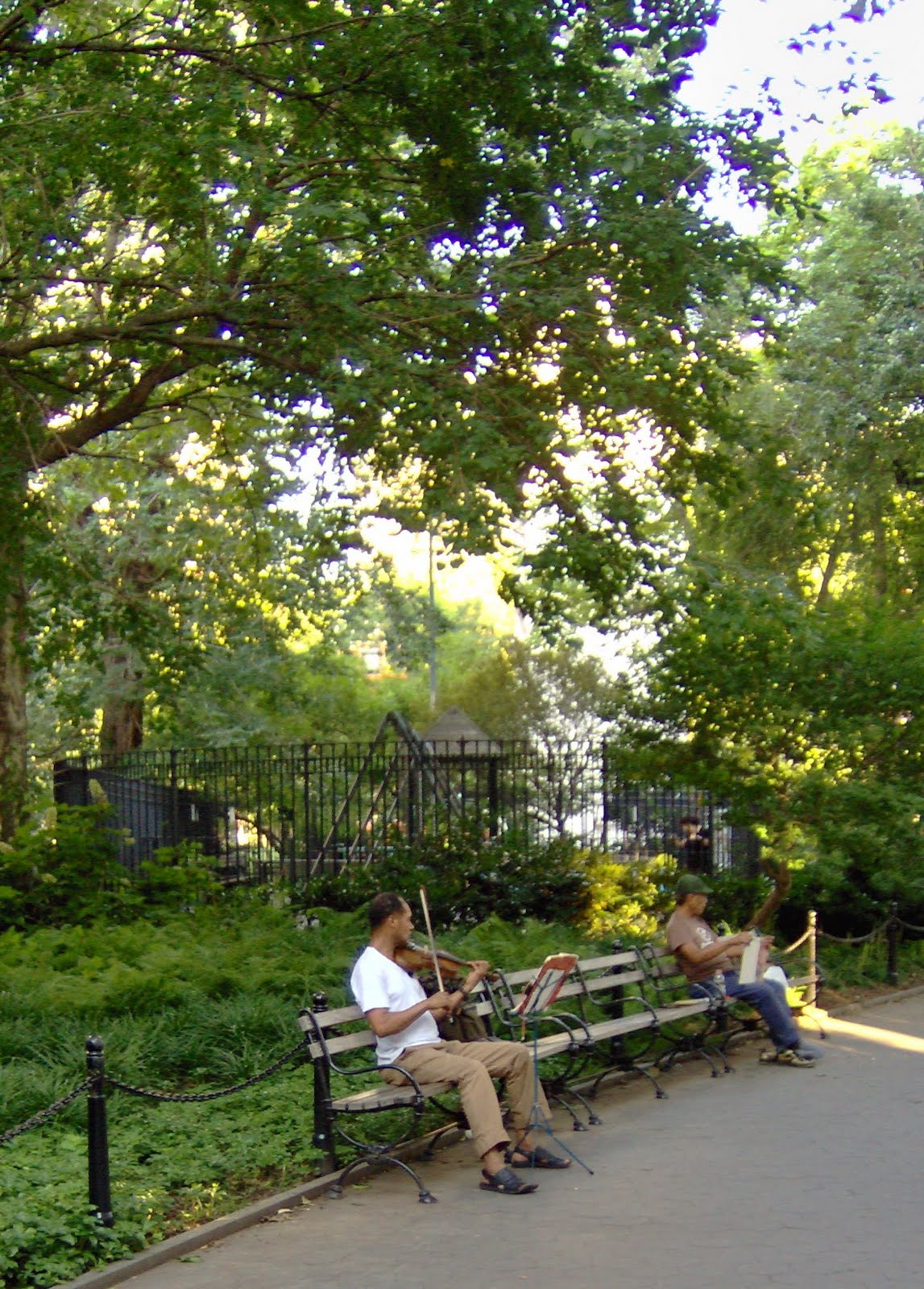
A lonely violinist was practicing for the next lesson in a quiet corner of the park. 
Ein einsamer Geiger übte in einem abgelegenen Teil des Parks für die nächste Unterrichtsstunde. 


Two squirrels were having their dinner upside down.
Zwei Eichhörnchen nahmen ihr Abendessen mit dem Kopf nach unten ein. 


and a dog was contemplating that he could have them for dinner, if he weren’t on a leash.
und ein Hund überlegte, dass sie ein feines Abendessen wäen, wenn er nicht an der Leine wäre.  
In the meantime, the dogs in the dog run ( and their owners) were preoccupied with themselves.
Die Hunde auf dem Hundespielplatz ( und ihre Besitzer) waren derweil mit sich selbst beschäftigt. 


If you find a group of people intently staring at the same spot, there must be something to see.
Wenn so viele Leute angestrengt auf einen Punkt starren, muss es dort etwas zu sehen geben. 


Pip, the red tailed hawk, who had hatched on a window sill on the 12th floor of the NYU library and fledged on June 23rd, (the New York Times followed the story) - was having dinner on the lawn. How did you know it was Pip ? The tail wasn’t fully developed and there weren’t any red feathers yet, either, one of her fans instructed us.   
Pip, der Falke, der auf einem Fenstersims im 12. Stock der Bibliothek der New York University aus dem Ei geschlüpft und am 23. Juni seinen esten Flug unternommen hatte ( man konnte Pip’s Geschichte in der New York Times verfolgen ), nahm auf dem Rasen ihr Abendessen ein. Woher man wusste dass es Pip war? Die Schwanzfedern waren noch nicht voll ausgewachsen, und die rote Färbung fehlte noch, belehrte uns einer ihrer Fans. 


Due to Pip, I was almost late for the Open Sing, where I was heading. Under the direction of Chris Shepard, director of the Dessoff Choirs we sang selections from Haendel’s Messiah. 
Ich war auf dem Weg zum Offenen Singen, und wegen Pip kam ich fast zu spät. Unter der Leitung von Chris Shepard, Leiter der Dessoff Choirs, sangen wir Ausschnitte von Händels Messias.
The Open Sings are a great chance to get to know a variety of famous works from the choral repertory. They are held on Monday evenings at 7:30 at Judd Memorial Church at Washington Square. There’s a different director each time,a different work, and different people, and it’s amazing how it all works out. Music - and animals -  do draw people together.
Die Offenen Singen sind eine ausgezeichnete Gelegenheit, ausgewählte Werke der Chorliteratur kennenzulernen. Sie finden montags abends um halb 8 in der Judd Memorial Church am Washington Square statt. Jede Woche wird ein anderes Werk gesungen, von anderen Leuten und unter anderer Leitung, und es klappt hervorrangend. Musik - und Tiere - bringen die Menschen zusammen. 

Sunday, June 26, 2011

THE STREET PIANOS ARE BACK ! / DIE STRASSENKLAVIERE SIND WIEDER DA!

When I accidentally found the information on the internet, I couldn’t believe it at first: The street pianos are back! 88 of them, all over New York City, between June 18 and July 2nd 2011. And here’s some additional good news: the one at Alice Tully Hall has developed from an upright last year to a grand piano this year. The decor is gorgeous, and the artist has refrained from coloring the keyboard - thank you so much for that! Unfortunately you can’t put up the music stand, so you need to bring your own, or tape the music to the lid.
Sing-For-Hope 2011 
Als ich zufällig auf die Information im Internet stiess, konnte ich es erst gar nicht glauben. Die Strassenklaviere sind wieder da! 88 Stück, überall in New York City, vom 18. Juni bis zum 2. Juli 2011. Es gibt noch weitere gute Nachrichten: das Instrument an der Alice Tully Hall hat sich von einem Klavier im letzten Jahr zu einem Flügel entwickelt. Das Dekor ist grossartig, und der Künstler hat die Tasten nicht bemalt - vielen Dank dafür. Leider kann man das Notenpult nicht ausklappen, man muss also sein eigenes mitbringen, oder die Noten am Deckel festkleben.
Alice Tully Hall PIano 2010


Alice Tully Hall Piano 2011
Another grand piano is located inside the Rubenstein Atrium on 62nd and Broadway, if you prefer a quieter, more concert like atmosphere - in fact, I’m going to play Preludes and Fugues from Bach’s Well-Tempered Clavier there tomorrow from 6:00 to 6:30 pm.
Ein weiterer Flügel steht im Rubenstein Atrium am Broadway/62. Strasse, wenn man einen ruhigeren, eher konzertmässigen Standort bevorzugt - ich werde dort morgen von 18:00 bis 18:30 Präludien und Fugen aus dem Wohltemperierten Klavier spielen.
Last Wednesday, some friends and I gathered at the Alice Tully Hall piano for a little impromptu birthday concert. Having a birthday at the beginning of summer is no guarantee for good weather. Fortunately the overhang from the building kept us dry during a heavy downpour just as people were arriving.
Letzten Mittwoch traf ich mich am Alice Tully Hall Flügel mit einigen Freunden zu einem improvisierten Geburtstagskonzert. Ein Geburtstag am Sommeranfang ist keine Garantie für gutes Wetter. Zum Glück steht dder Flügel unter einem Gebäudeüberhang, der uns während eines heftigen Gewitterschauers zu Beginn des Treffens trockenhielt.
"Chopsticks"
I showed Vika how to play chopsticks. Marcia and I played Moszkowki’s “Spanish Dances,” followed by some music from Manfred Schmitz’ “Jazz Parnass.” As it turned out, Vika, who grew up in St.Petersburg Russia, knew all the melodies - her teacher Ljuba Boruchson had taught them at Childrens’ Music School. “ Heaven knows where she got them, and how she got away with it,” Vika said. Jazz didn't go over too well with the Soviet regime.
Ich zeigte Vika, wie man den Flohwalzer spielt. Marcia und ich spielten Moskowskis “Spansche Tänze”, gefolgt von Musik aus Manfred Schmitz’ Jazz Parnass. Vika, die in St. Petersburg, Russland, aufgewachsen ist, kannte die Melodien. Ihre Lehrerin Ljuba Boruchson hate die Stücke an der Musikschule unterrichtet. “Weiss der Himmel, wie sie damit durchgekommen ist,” sagte Vika. Jazz war beim Sovietregime nicht gerade beliebt.
Spanish Dances
Two young people who had been standing off to the side with a large camera came up to us and introduced themselves. They were following the Street Piano event with their recording equipment in order to produce a feature for Japanese Television. Would we be willing to give an interview? What did we think of the event?
One of the reporters
Zwei junge Leute die schon einige Zeit mit einer grossen Kamera an der Seite gestanden hatten, kamen auf uns zu und stellten sich vor. Sie verfolgten die Strassenklavieraktion mit ihren Aufnahmegeräten, um eine Reportage für das japanische Fernsehen zusammenzustellen. Ob wir wohl ein Interview geben würden? Was hielten wir von der Aktion?
Recording a feature for Japanese Television
I wished we could have the pianos around all year. Wouldn’t it be great to have “Public Music Rooms”, a musical equivalent to the “Bryant Park Reading Room,” where you can sit down, pick up a book from the shelf and read. 
Bryant Park Reading Room
Ich wollte, die Klaviere stünden das ganze Jahr über zur Verfügung. Wäre es nicht toll, “Öffentliche Musikräume” zu haben, eine musikalische Entsprechung zum “Byant Park Leseraum”, wo man sich einfach hinsetzen, ein Buch vom Regal nehmen und lesen kann?
A “Public Music Room” would give you a chance to just go and play a little, or sit there and listen, while you wait at the airport, at the hospital, during lunch break at work, when you need to relax or blow off steam after some unpleasant event at the office. Libraries provide public access to computers - how about public access to pianos? 
Visitors at our Impromptu Concert


Ein öffentlicher Musikraum gäbe einem die Möglichkeit, ein wenig zu spielen, oder einfach zuzuhören, wenn einem danach ist, während man am Flughafen wartet, im Krankenhaus, oder in der Mittagspause, wenn man sich entspannen möchte, oder “Dampf” ablassen muss nach Ärger auf der Arbeit. Büchereien bieten öffentlichen Zugang zu Computern, wieso nicht auch zu Klavieren? 
Of course, there is music playing from loudspeakers everywhere, but playing yourself, or listening to someone play live music is not the same. The energy is different, it’s a “soul-to-soul” connection.
Visitors at our Impromptu Concert
Natürlich tönt überall Musik aus Lautsprechern, aber selber spielen oder jemandem zuhören der live spielt ist nicht dassselbe. Es ist eine “Seelenverbindung,” die Energie ist anders.
While Marcia and I were playing, we hadn’t noticed two people who had been watching us for some time. “I think they might want to play something,” said my friend Carsta, who had been taking pictures.
Während Marcia und ich spielten, hatten wir zwei Leute nicht bemerkt, die uns schon eine Weile zugesehen hatten. “Ich glaube, die möchten auch etwas spielen,” sagte meine Freundin Carsta, die Fotos gemacht hatte.
She was right. After we invited them to the piano, they delighted everybody with the most beautiful Chinese songs. The evening ended on an international note, with an impromptu vocal ensemble, consisting of people from the US, Russia, China and Germany singing Russian folk songs. 
International Impromptu Vocal Ensemble
Sie hatte recht. Nachdem wir die beiden ans Klavier eingeladen hatten, erfreuten sie uns mit wunderbaren Chinesischen Liedern. Der Abend endete mit internationalem Flair, als unser impromptu Vokalensemble, bestehend aus Mitgliedern aus den USA, Russland, China und Deutschland russische Volkslieder sang.


(Thanks to my friend Carsta Schnabel for the photos on this blog/ Meiner Freundin Carsta Schnabel herzlichen Dank fuer die Fotos auf diesem Blog)