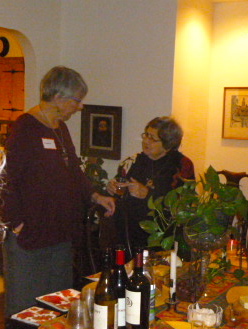
The mood is somber in the little group that has gathered at
the Ethical Culture Society in Maplewood on Tuesday evening, to watch the
election results. Elaine Durbach, who arranges the programs at the society, put
a notice on facebook the previous night and invited everybody to get together,
who didn’t want to live through the suspense alone. I wasn’t sure at first, but
on election day I’m grateful for some company.
I have to teach, so I don’t arrive until 9pm. I take a look
at the numbers on the TV screen, and the race is close. I don’t like it. But
it’s still early. In some states, the polling stations haven’t even closed yet.
The numbers remain unchanged for a long time. “Too close to
call” is the most frequent notice on the TV screen. Nobody in the room says very much. We calm our nerves with the snacks on the
table. We flip channels occasionally, to see whether someone else offers a
brighter outlook. It’s the same everywhere.
 |
| Election night at Ethical Culture Society |
Clinton gains California and goes into the lead. It’s a
moment of relief, maybe things will turn around now. But Trump catches up not
long afterwards, and then it’s “too close to call” again. We get bits and
pieces of political commentary. I can’t stand advertisements, but tonight,
they’re not altogether unwelcome. They provide a bit of a break. The TV station
presents scenes from the headquarters of both parties. A woman breaks out into
tears, when Trump takes the lead again. We feel like crying, too.
Nothing is decided yet, as we break up around midnight, but
for all anyone knows, it will take nothing short of a miracle to turn the
results around. At home, I follow the election coverage of Democracy Now on the internet until they close at 1pm. The results are
not final yet, but what’s out looks more dismal than ever.
The following morning, I wake up and I don’t really want to
know. I look out the window. After days and days of a glorious fall the sky is
crying. My radio is tuned to WQXR, the classical music station, and I don’t
feel like changing it. 20 minutes until the news. I feel the need to brace
myself, and go on facebook. Our organist at All Souls has posted a single quote
from a Bach chorale: “O Mensch, bewein’ dein Sünde gross…” (Cry for thy sins, o man)
WQXR confirms: “America has voted for change.” The statement
is too diplomatic for me at this particular moment, and I find it distasteful.
“Voting for change” was the motto, when president Obama was elected. Angrily, I
shut off the radio.
 |
| Happy Pancake |
Although I’m not hungry at all, I make myself a “Happy
Pancake.” It’s a tried and true method to sweeten the start into the day. I
have to go into the city for my piano lesson with Seymour, and for choir
rehearsal. What I really want to do is hide somewhere and cry. The feeling is
very similar to what I remember from 9/11, a sense of disbelief, and
helplessness in the face of disaster.
 |
| Central Park Nov 9 |
I’ve never seen New York City so quiet, so empty, and the
faces of people so serious. Seymour and the student before me are working on “The
Prophet Bird” from Schumann’s Forest Scenes, when I arrive at the studio. Those
arpeggios are tricky, it takes a certain position of the finger that begins, and
just the right energy of the preparatory motion to make them bubble out of your
hand.
Seymour and the student are completely absorbed in the task.
It is the most encouraging and hopeful gesture I have seen all day. Not
everything has changed. As long as there are teachers and students, music is
going to live on, no matter who is president.
In the course of the afternoon, our choir director sends a message:
Dear Friends,
Today, for many of us,
is a very difficult day. Rehearsal will not be easy this evening but we'll
gather knowing that there is no better way to feel unity, love, and
understanding than through singing together.
It is in moments like these
that music becomes, both, a balm and a source of inspiration. Music is needed
now more than ever. Through it we open our spirit to love and compassion and
help ourselves and others heal. Truly, there is no other group of people that
I'd rather be with and no other activity that I'd rather be doing in a day like
this.
Peace and love,
Alejandro
 |
| Musica Viva New York, concert in March 2016 |
One of the choir members stands up and goes to the front before we
start rehearsal. “I’ve been asked to say a prayer,” Molly says. The text she
reads asks for comfort, wisdom, tolerance and compassion. Many eyes fill with
tears, some people cover their faces with their hands.
There’s nothing like the company of friends and the comfort of music
to nourish hope and activate energies you didn’t know you had. Together with
projections of the worst that could happen, a surge of solidarity and hope
arises in the days that follow.
A friend posts on facebook
It
may take a long long time to process what transpired last night. Like any
tragedy, I expect a full cycle of emotions starting with horror and
incredulity. However, I think it is important now more than ever to keep
President Obama's message of hope alive. The sun rose today as expected and we
will as a people find a way to get through this. Maybe this will even prove to
be the catalyst that finally pulls us all together. To my friends around the
world (despite the fact I proudly voted for Hillary), I must apologize for how
our country has bungled this. I know how acutely this impacts all of you.
Please don't lose faith in us. Better days are ahead...at some point. Our
democracy has survived some pretty awful things in the past and I have to trust
that it's strength will get us through this as well.
 |
| Nov 10th, reflection of the sunrise |
The
message from the Open Center is one of many that come from a variety of groups
and institutions, calling to people to reach out, rather than retreat into
anger and fear:
Dear Friends of The Open Center,
As the election has past and we have a new president
for our county, we wanted to reach out to you, our community, and say that
regardless of how you voted and how you feel by the results, we are all in this
together during this time of change.
If you are feeling anxious during this time, please
remember the basic principles that help to keep one in balance
•
Breathe in,
breath out - repeat
•
Sit still and
witness your breath - meditation helps everything
•
Come together
in community to feel support
•
Grieve or
celebrate but then get back to work and make internal changes and those for the
greater good of our country and the planet
•
Love and take
care of one another - continually finding your way back to compassion and
empathy
For Saturday evening, Betty Levin, 90, member of the Ethical Culture
Society, psychotherapist, peace educator and author of a recently published memoir,
has invited friends and members of the community where she lives for a
“post-mortem” of the election at her home. The date was set a couple of weeks ago.
Regardless of the outcome, Betty said, the divide of the country is a fact that
can no longer be denied. What can we do to bridge the gap?
 |
| Betty Levin, ( r ) in conversation |
 |
| Small-group conversations |
We spend an evening in animated discussion, sharing feelings and
opinions. A woman relates her experience of living with poor white citizens in
rural areas of Minnesota – members of the population who have largely voted for
Trump. She reminds us not to condemn what we don’t know, people who “feel the
boot on their necks, who have no hope of ever getting access to education,
health care, or anything close to a comfortable life for themselves and their
families, no matter how much they work. Someone expresses fear of anti-semitism among Syrian refugees. Ancient Egypt has risen and declined, the Roman Empire,
and now it is America’s turn, is another opinion, expressed quite frequently.
No one has visions of anything but a challenging future.
 |
| A variety of people and opinions |
We don’t have the answers, but starting to search for them is the first
step. One message stands out above all else: don’t stay in your own bubble.
Seek the dialogue with people who don’t share your opinion.
“Are you
going back now,” asked my friend Barbara on Wednesday at choir rehearsal. She’s
witnessed my process of moving here from Germany, and often hosted me in her
apartment, while I was still travelling back and forth, for lessons with
Seymour, for conferences and job interviews. I give her the same answer I gave
the student who broke the news about 9/11, fifteen years ago, and asked whether
I’d cancel my plans to relocate to the US now: “No way!”
 |
| Advertisement at Grand Central Station NYC |
I often think of my grandfather these days, who is reported to have said
“This means war, “ when Hitler was elected in 1933. “If grandpa knew that, why
didn’t he take you and grandma and pack up and leave?” I used to ask my mother
when I was little. She never answered that question. Apart from the fact that
it’s questionable whether there is a safe place you can run to these days, I’m
getting a sense now that you don’t leave the life you have built for yourself
and the people you love at the first signs of danger.
My grandfather stayed, and, for all I know, did his best to do damage
control. He was too old to be drafted. He didn’t allow my mother to join the
Nazi youth organization, and he never joined the party himself; which must have
been quite a challenge, considering the fact that teachers are government
employees in Germany. He put himself at risk, helping Jewish people raise the
money to get out of the country.
My parents used to say that we wouldn’t live to see Germany reunited,
unless there was another war. Nobody could wish for that. November 9th
1989 was the day the Berlin Wall came down. When it happened, it was as
unbelievable as last Tuesday’s election results. We had high hopes in 1989 that
the world would become a safer place. I don’t know whether that has come true.
What has become clear, though, is that it doesn’t just happen. It needs to be
done.
I feel that you have to look at the most dismal outcomes, so that you
know what’s at stake. But there’s no point in scaring yourself out of your
wits. Even the darkest times hold opportunities for the individual to act with
kindness and compassion. And I have the hope that the Unites States in 2016
will find a different, better path than Germany in 1933.
Nach der Wahl
Die Stimmung ist
ernst in der kleinen Gruppe, die sich am Dienstag Abend bei der Ethical Culture
Society in Maplewood versammelt hat. Elaine Durbach, die die Programme für die
Society zusammenstellt, hat am Vortag auf Facebook eine Einladung an alle die
ausgesprochen, die sich der Spannung des Wahlabends nicht alleine aussetzen
wollten. Ich war mir zuerst nicht sicher, aber am Wahltag bin ich dankbar für
die Gesellschaft.
Ich muss
unterrichten und treffe erst gegen 21.00 ein. Ich werfe einen Blick auf die
Zahlen auf dem Bildschirm, und was ich sehe, gefällt mir nicht. Der Abstand zwischen den Kandidaten ist
knapp. Aber es ist früh am Abend. Aufgrund der unterschiedlichen Zeitzonen wird
in manchen Staaten noch gewählt.
Die Ergebnisse bleiben
lange unverändert. „Zu knapp für ein Ergebnis“ ist die meist gesehene Ansage.
Niemand im Raum sagt viel. Wir beruhigen unsere Nerven mit den Snacks auf dem
Tisch. Manchmal wechseln wir den Sender, um zu sehen ob es irgendwo bessere
Nachrichten gibt. Aber das Bild ist überall das gleiche.
|
| Am Wahlabend bei der Ethical Culture Society |
Clinton gewinnt
Kalifornien und geht in Führung. Ein vorsichtiges Aufatmen, vielleicht wendet
sich das Blatt ja jetzt. Aber bald holt Trump auf, und dann heisst es wieder:
zu knapp für ein Ergebnis. Hier und da schnappen wir politische Kommentare auf.
Werbung kann ich normalerweise nicht ausstehen, aber heute bringt sie Momente
der Entspannung. Der Sender zeigt Aufnahmen der beiden Parteizentralen. Bei den
Demokraten bricht eine Frau bricht in Tränen aus, als Trump in Führung geht.
Uns ist auch zum Heulen.
Noch nichts ist
entschieden, als wir uns gegen Mitternacht auf den Heimweg machen, aber so wie
es aussieht, muss ein Wunder geschehen, damit Clinton die Wahl noch gewinnt. Zu
Hause verfolge ich noch einen Weile die Berichterstattung von Democracy Now auf dem Internet. Sie
endet um 1 Uhr nachts.
Am nächsten
Morgen werde ich wach und will eigentlich gar nicht wissen, was los ist. Ein
Blick aus dem Fenster – nach Tagen wunderbaren Herbstwetters weint der Himmel.
Mein Radio ist aus WQXR eingestellt, den New Yorker Sender für klassische
Musik. Ich habe keine Lust, das zu ändern. Noch 20 Minuten bis zu den
Nachrichten. Ich habe das Gefühl, ich muss mich wappnen und gehe auf facebook.
Unsere Organistin von der All Souls Kirche zitiert einen Bach- Choral: O Mensch, bewein’ dein Sünde gross.“
WQXR bestätigt
meine Vermutung: „Amerika hat für den Wechsel gestimmt.“ Diese Aussage ist mir zu
diplomatisch. Ausserdem finde ich sie geschmacklos, denn sie nimmt Bezug auf
das Wahlmotto von Prãsident Obama. Verärgert stelle ich das Radio ab.
|
| Fröhlicher Pfannekuchen |
Ich habe
überhaupt keinen Hunger, mache mir aber trotzdem einen „Fröhlichen
Pfannekuchen. “ Das ist eine bewährte Methode den Aufbruch in den Tag zu
versüssen. Ich muss in die Stadt, habe Klavierunterricht bei Seymour Bernstein,
und anschliessend Chorprobe. Eigentlich möchte ich mich irgendwo verkriechen
und weinen. Das Gefühl ist so ähnlich wie nach den Angriffen vom 11. September,
eine Mischung von Unglaube und Hoffnungslosigkeit angesichts der
Katastrophe.
|
| Central Park Nov 9th |
Ich habe New York
City noch nie so still, so leer, und die Gesichter der Menschen so ernst
gesehen. Seymour und eine Schülerin sind in das Stück Vogel als Prophet aus Schumanns Waldszenen
vertieft, als ich beim Studio ankomme. Da gibt es einige knifflige
Verzierungen, die nur gelingen, wenn der Finger, der die Figur beginnt, in der
richtigen Position ist, und die Vorbereitungsbewegung den richtigen Schwung
hat.
Die konzentrierte
Arbeit der beiden ist das hoffnungsvollste, was mir bisher an diesem Tag
begegnet ist. Nicht alles hat sich geändert. So lange es Lehrer und Schüler
gibt, wird die Musik weiterleben, egal wer Präsident ist.
Im Lauf des
Nachmittags sendet unser Chorleiter eine Nachricht an den Chor:
Liebe Freunde,
Der heutige Tag ist sehr schwer für viele von uns.
Es wird nicht leicht sein, heute Abend zusammen zu proben, und doch werden wir
uns in dem Bewusstsein zusammenfinden, dass es keinen besseren Weg gibt,
Gemeinschaft, Liebe und Verständnis zu spüren als im gemeinsamen Singen.
In Momenten wie diesen wird Musik zum Trost,und
gleichzeitig zur Quelle von Inspiration.
Mehr denn je brauchen wir jetzt die Musik. Sie wird unseren Geist
empfänglich machen für Liebe und Mitgefühl, sie wird uns und anderen helfen, zu
heilen. Es gibt keine Gruppe von Menschen, mit denen ich diesen Abend lieber
verbringen würde als mit euch, und keine Tätigkeit, die ich lieber ausüben
würde.
Liebe und friedvolle Güsse, Alejandro.
|
| Musica Viva New York, concert in March 2016 |
Eine der
Sängerinnen im Chor geht vor Beginn der Probe nach vorn und sagt, dass sie
gebeten worden ist, ein Gebet zu sprechen. Der Text den sie liest bittet um
Trost, Weisheit, Toleranz und
Mitgefühl. Viele haben Tränen in
den Augen. Manche schlagen die Hände vors Gesicht.
Die Gegenwart von
Freunden und das gemeinsame Erlebnis der Musik nähren Hoffnung und setzen
Energien frei von deren Existenz man vorher nichts wusste. Zusammen mit
Spekulationen über das Schlimmste, was passieren kann, spürt man auf einmal
eine Welle von Solidarität und Hoffnung.
Ein Freund
schreibt auf facebook:
Es mag lange dauern, das was passiert ist wirklich
zu verarbeiten. Wie bei jeder Tragödie erwarte ich das volle Spektrum der
Gefühle, angefangen von Schrecken und Ungläubigkeit. Trotzdem denke ich, dass
es nun wichtiger denn je ist, Präsident Obamas Botschaft der Hoffnung lebendig
zu halten. Auch heute ist die Sonne aufgegangen, und als Nation werden wir
einen Weg finden, mit der Situation fertig zu werden. Vielleicht wird sie sogar zum Katalysator, der
uns endlich alle an einen Strick ziehen lässt. Obwohl ich stolz bin, für Hilary
gestimmt zu haben, entschuldige ich mich bei meinen Freunden in aller Welt für
den Schlamassel, den wir angerichtet haben. Ich weiss, wie sehr das alles auch
Euch betrifft. Bitte verliert nicht den Glauben an uns. Irgendwann wird es auch
wieder bessere Tage geben. Unsere Demokratie hat schon einige schlimme
Situationen überstanden, und ich muss daran glauben, dass ihre Kraft uns auch
jetzt nicht verlässt.
|
| 10.11.2016, Widerschein des Sonnenaufgangs |
Die Nachricht vom
Open Center, einer
Bildungseinrichtung in New York City, ist nur eine von vielen, die von
verschiedensten Gruppen und Einrichtungen an die Menschen ergehen, mit dem
Aufruf, sich die Hand zu reichen, statt sich in Wut und Furcht zurückzuziehen.
Liebe Freunde des Open Center
Jetzt wo die Wahlen vorbei sind und wir einen
neuen Präsidenten für unser Land haben, wenden wir uns an Euch als
Gemeinschaft, mit der wir uns verbunden fühlen, um zum Ausdruck zu bringen,
dass, egal wie Ihr gewählt habt, und wie Ihr Euch angesichts des Ergebnisses fühlt,
wir alle miteinander verbunden sind in dieser Zeit des Umbruchs.
Wenn Ihr Angst habt in dieser Zeit, denkt an die
Grundlagen, die helfen, ausgeglichen zu bleiben:
- - einatmen, ausatmen – wiederholen
- - Still sitzen und den Atem beobachten –
Meditation hilft immer
- - Kommt zusammen und findet Unterstützung in
der Gemeinschaft
- - Trauert oder feiert, und dann geht wieder
an die Arbeit und führt die innere Veränderung herbei, die nötig ist, um für
das Gute in diesem Land und auf dieser Welt wirksam zu werden
- - Geht liebevoll miteinander um und sorgt
füreinander – fortwährend bemüht um mehr Mitgefühl und grösseres Verständnis.
Betty Levin, 90
Jahre alt, Mitglied der Ethical Culture Society, Psychotherapeutin, aktiv in
der Friedenserziehung und Autorin eines kürzlich erschienenen Memoirs, hat für
Samstag abend Freunde und Einwohner ihres Wohnorts zu einer Nachbesprechung der
Wahl zu sich nach Hause eingeladen Das Treffen wurde schon vor einigen Wochen angesetzt. Egal wer
gewinnt, sagte Betty, die Spaltung des Landes ist eine Tatsache die man nicht
länger verleugnen kann. Was können wir tun, um sie zu überwinden?
|
Betty Levin, ( r ) im Gespräch,
unten: kleine Gesprächsrunden
|
Wir verbringen
einen Abend in angeregter Diskussion, tauschen uns aus über Einschätzungen der
Situation und Empfindungen dazu. Eine Frau spricht über ihre Erfahrungen aus
der Arbeit mit verarmten weissen
Mitbürgern im ländlichen Minnesota – die Bevölkerungsgruppe, in der Trump viele
Anhänger gewonnen hat. Sie ermahnt uns, nichts zu verurteilen, was wir nicht
kennen, „Menschen, die keinen Fuss auf die Erde kriegen, egal wie viel sie arbeiten,
keinen Zugang zu Bildung, Gesundheitsversorgung, keine Ausicht auf ein halbwegs
normales Leben für sich oder ihre Familien.“ Jemand ist besorgt wegen möglichen
Antisemitismus unter syrischen Flüchtlingen. Das alte Ägypten sei
untergegangen, und das Römische Reich, und nun sei Amerika an der Reihe – diese
Einschätzung wird öfter gegeben. Niemand prophezeit eine rosige Zukunft.
|
| Verschiedene Menschen und Meinungen |
Wir haben keine
Anworten auf die Fragen, aber der Beginn der Suche danach ist der erste
Schritt. Eine Botschaft nehmen alle mit nach Hause: es reicht nicht aus,
sich nur unter Gleichgesinnten zu
bewegen. Man muss das Gespräch mit Menschen wagen, die anderer Meinung
sind.
|
| Werbeplakat Grand Central Station NYC |
„Gehst du jetzt
zurück,“ fragte meine Freundin Barbara am Mittwoch bei der Chorprobe. Sie hat
alle Phasen meiner Umsiedlung von Deutschland in die USA miterlebt und mich oft
in ihrer Wohnung beherbergt, als ich noch zwischen beiden Ländern hin- und her
pendelte, zum Unterricht bei Seymour, zu Konferenzen und
Vorstellungsgesprächen. Sie bekommt die gleiche Antwort wie die Schülerin, die
mir am 11. September 2001 die Nachricht vom Angriff auf das World Trade Center
brachte, und fragte, ob ich meinen Umzugspläne jetzt aufgeben würde: „Das kommt
überhaupt nicht in Frage.“
In diesen Tagen
denke ich oft an meinen Grossvater, der 1933 gesagt haben soll: „Das bedeutet
Krieg,“ als Hitler zum Reichskanzler gewählt wurde. „Wenn der Opa das gewusst hat, warum hat er
dann nicht seine sieben Sachen gepackt und mit Oma und Dir das Land verlassen?“
habe ich als Kind meine Mutter oft gefragt.
Sie hat die Frage nie beantwortet.
Abgesehen davon,
dass es fragwürdig ist, ob es überhaupt einen sicheren Ort auf der Welt gibt,
beginne ich zu verstehen, dass man das Leben, das man sich aufgebaut, und die
Menschen, die man kennen - und lieben gelernt hat, beim ersten Anzeichen von
Gefahr nicht einfach im Stich lassen will.
Mein Grossvater
hat Deutschland nicht verlassen, und, soweit mir bekannt ist, sein bestes
getan, um Schadensbegrenzung zu betreiben. Er war zu alt, um noch eingezogen zu
werden. Meine Mutter durfte nicht zum BdM, und er ist nie in die Partei
eingetreten, obwohl das für einen beamteten Studienrat sicher nicht einfach
war. Er hat jüdischen Mitbürgern geholfen, das Geld für die Flucht aus
Deutschland aufzubringen, als das bereits ein Sicherheitsrisiko war.
Meine Eltern
haben immer gesagt, wir würden die Wiedervereinigung Deutschlands nicht
erleben, es sei denn, es gäbe noch einmal Krieg, und das konnte sich niemand
wünschen. Am 9. November 1989 fiel die Berliner Mauer. Als es passierte, war es
genauso unbegreiflich wie das Wahlergebnis von letzter Woche. Wir hatten damals
grosse Hoffnung, dass die Welt sicherer werden würde. Ich weiss nicht, ob das
wahr geworden ist. Klar geworden ist, dass es nicht einfach so passiert. Es
muss getan werden.
Ich glaube, dass man sich das Schlimmste, was
passieren kann, sehr wohl vor Augen führen muss, damit man weiss, was auf dem
Spiel steht. Aber es hat keinen Sinn, sich in Katastrophenstimmung
hineinzusteigern. Sogar in schlimmsten Zeiten kann der Einzelne Möglichkeiten
finden, Gutes zu tun und Leid zu lindern. Und ich hoffe, dass die Vereinigten
Staaten im Jahr 2016 einen anderen, besseren Weg finden werden als Deutschland
1933.