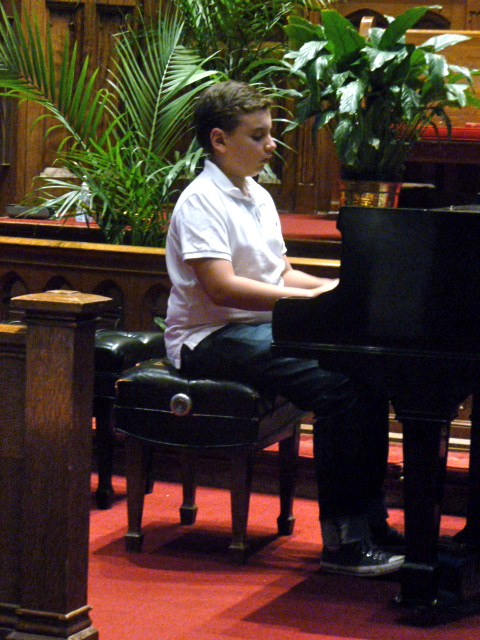
Showing posts with label piano students. Show all posts

Sunday, July 22, 2018

Feeling and Thinking and Motion make Sound - Seymour Bernstein teaches at the Young Artist’s World Piano Festival in St. Paul, Minnesota

The 10-day Young Artists’ World Piano Festival is an excellent opportunity for pre-college pianists to immerse themselves in playing piano, to broaden their musical experience and share it with like-minded companions. Students may be as young as eight and come with their parents, or they may be in high school, aspiring to be professional musicians and prepare to audition at a major music school. All students are supported at their respective levels, resulting in a joyful, vibrant community. The program offers private lessons with a distinguished faculty, and musicianship- and studio classes for everybody. Participating in master classes, a solo-performance – and a concerto competition are opportunities for advanced students who want to challenge themselves.   

Beaming faces after the Senior Honors Recital:
Artisic Director Paul Wirth, students Benjamin Keating, Athena Roscoe, Jacqueline Pham,
 Brianne Ulrich, Calvin Kortba,Tristan Paradee, Executive Director Olivia Young
 Seymour Bernstein was one of the guest artists this year. Observing my teacher teach was a most inspiring experience.

Time disappears, as he works with a young student whose piece ends with a single, very soft note. It takes a certain motion to create that sound, and it’s not easy. The key has to be lowered very slowly. But if it’s too slow, the hammer won’t hit the string and the note won’t speak. If it’s too fast, it comes out too loud, and the piece ends with an ugly clunk.

Seymour’s voice is soft, but intense. His clear instructions and infinite patience create a safe, intimate space on the concert stage of the vast auditorium at Bethel University.  The task absorbs both teacher and student. “Did you like that sound” he asks the student. She shakes her head. “Well, then try it again.”

Private lessons in the auditorium


It’s fashionable to talk about “flow” these days. Seymour doesn’t talk about it. He takes the student through the experience. Yes, one note can be important enough to spend a considerable part of the lesson on it. It takes as long as it takes. There are no shortcuts.

Mechanics alone won’t achieve the goal. “Your technique allows you to play anything you want,” he comments after a young virtuoso’s stunning performance of Chopin’s Scherzo in c-sharp minor.  “But your interpretation is shallow; it doesn’t mean anything.” That’s a harsh verdict. It could hurt a student, unless the teacher shows him how to do otherwise. Together, they set out to mine the score for meaning.

“Chopin’s Scherzos are emotional dramas,” Seymour explains. “The beginning is spooky. If you don’t play it right, you won’t get a feeling for the piece. Feel the f going to f-sharp. How will you shape it? Which one of the three motives is the spookiest? The chords are a call to arms, they have to sound angry.”

How do you make a chord sound angry? Prepare it with a swing stroke and lower the arm into the key, rather than bounce off of it. A phase of experimentation follows.  Once the student has figured out how to do it, decisions have to be made. How do the chords relate to each other? Which one marks the peak of the phrase; it has to be the strongest.

Demonstrating a motion
 At first, it’s about the direction and the speed of the motion, the arm, the wrist and the fingers that transfer the energy into the key. In the process of trying, those elements merge with the sound they create and become an imprint in your mind. Making a physical connection to musical feeling, Seymour calls it. You have to observe what you’re doing and listen into yourself. The sound that expresses how you feel the music resides inside. It can’t be imposed.

The change that’s achieved is almost magical. “This student is seething with emotion,” Seymour comments later. Sometimes, it’s easier to hide behind your skill than share what you really feel. It takes courage, and before that, encouragement. 


The master class as a group experience. All students play their pieces first, as in a concert,
so that performance anxiety doesn't get in the way of attention while Seymour works with them afterwards. 

The score is projected on a screen. That way, everybody can follow explanations
“Why do you play the piano?” No master class ends without a discussion of that question. Playing concerts, winning competitions, even launching a successful performing career doesn’t guarantee happiness or even satisfaction. The lasting benefit of playing a musical instrument is the integration of emotion, reason and physicality. You train this every time you practice. Applied to life, it becomes the key to fulfillment.

Discussion at the end of the master class
After the discussion, there’s often the encore, the surprise, when Seymour shares something special from his life, an experience, a photo, a piece of music that has moved him deeply.  

Leopold Mozart about his little son's first composition


“I hope I won’t break out into tears when I share this with you,” he says, before he reads Leopold Mozart’s comments about little Wolfgang’s first composition: “Wolfgang composed and learnt this little Minuet within half an hour the day before his 5th birthday." That a child this young could compose a melody that is so beautiful…”  
W.A. Mozart, Minuet and Trio in G-major K1


Seymour goes to the concert grand that stands in the spotlight center stage. After a master class program that featured brilliant performances of Chopin’s Scherzo No 3, the first movement of Beethoven’s Waldstein Sonata, and Liszt’s Harmonies du Soir, he plays W.A. Mozart’s Minuet and Trio in G-major K1. Every single note is shaped with the love and care deserving of a masterpiece - a demonstration of humility by a master, who has preserved his awe and reverence of beauty throughout all the years he’s been living with it.


Seymour Bernstein plays W.A. Mozart's Minuet in G-major K1


Fühlen, Denken und Bewegung werden Klang

Seymour Bernstein unterrichtet Teilnehmer des 

"Young Artists World Piano Festival" 

in St. Paul, Minnesota


Das Young Artists’ World Piano Festival bietet eine hervorragende Gelegenheit für jugendliche Pianisten, sich zehn Tage lang intensiv dem Klavierspiel zu widmen, ihre musikalische Erfahrung zu erweitern und mit Gleichgesinnten zu teilen. Die jüngsten sind noch in der Grundschule und kommen mit ihren Eltern, die Ältesten sind im Gymnasium, wollen vielleicht Berufsmusiker werden und bereiten sich auf die Aufnahmeprüfung an einer Musikhochschule vor. Aber unabhängig von Leistungsstand und Ziel werden alle Teilnehmer individuell unterstützt und gefördert. Das Ergebnis ist eine muntere, lebendige Gemeinschaft.

Alle bekommen Einzelunterricht bei qualifizierten Lehrern, nehmen am allgemeinen Unterricht in Theorie und Musikgeschichte und den Studioklassen teil. Schüler, die eine besondere Herausforderung suchen, können an Meisterklassen, einem Solo- und einem Konzertwettbewerb teilnehmen.

Strahlende Gesichter nach dem Preisträgerkonzert:
Paul Wirth (künstlerischer Leiter),Benjamin Keating, Athena Roscoe, Jacqueline Pham,
 Brianne Ulrich, Calvin Kortba,Tristan Paradee, Organisationsleiterin Olivia Young  
Außerdem gibt es Gelegenheit, mit bekannten Künstlern und Lehrern zu arbeiten, die als Gäste eingeladen werden. Seymour Bernstein war dieses Jahr einer von ihnen, was mir Gelegenheit gab, meinen Lehrer beim Unterrichten zu beobachten.

Die Zeit steht still, während er eine junge Schülerin unterrichtet. Das Stück, das sie spielt, endet mit einem einzigen, ganz leisen Ton. Es ist schwierig, die richtige Bewegung herauszufinden. Die Taste muss langsam angeschlagen werden, aber wenn der Hammer nicht genug Schwung hat, um die Saite zu treffen, kommt überhaupt kein Ton. Wenn die Bewegung zu schnell ist, wird er zu laut und das Stück endet mit einem hässlichen Akzent.

Seymour spricht leise, aber mit Intensität. Seine klaren Anweisungen und seine unendliche Geduld verwandeln die große Bühne im Konzertsaal der Bethel University in einen geschützten Raum, in dem man ungehemmt experimentieren kann. Die Aufgabe nimmt Lehrer und Schülerin ganz in Anspruch. „Hat Dir der Ton gefallen,“ fragt er. Sie schüttelt den Kopf. „Dann versuch es einfach nochmal.“

Privatunterricht im Konzertsaal


Heutzutage spricht man oft von „flow“ um diese Atmosphäre zu beschreiben. Seymour spricht nicht darüber. Er vermittelt die Erfahrung. Jawohl, eine einzige Note kann wichtig genug sein, geraume Zeit damit zu verbringen. Es gibt keine Abkürzungen; es dauert so lange wie es dauert.

Mechanik allein führt nicht zum Ziel. „Mit Deiner Technik kannst Du alles spielen“ sagt er nach einer brillanten Aufführung von Chopins Scherzo in cis moll zu einem jungen Virtuosen. „Aber Deine Interpretation ist oberflächlich, sie sagt nichts aus.“ Das ist ein hartes Urteil. Es könnte verletzlich wirken, es sei denn, man zeigt dem Schüler wie es anders geht. Gemeinsam studieren beide den Notentext. „Chopins Scherzos sind innere Dramen“ erklärt Seymour. „Der Anfang ist unheimlich. Wenn der Ausdruck nicht stimmt, bekommst Du kein Gefühl für das Stück. Fühlst Du, wie das F sich in Fis verwandelt? Wie soll das klingen? Welches der drei Motive ist am unheimlichsten? Die Akkorde sind wie ein Aufruf zum Kampf; das muss man hören.“

Wie spielt man einen Akkord, der kämpferisch klingt? Bereite ihn mit einem Aufschwung vor, so dass der Arm beim Anschlag nach unten schwingen kann. Das klingt anders, als sich von der Taste abzustoßen. Man experimentiert. Nachdem der Anschlag gelingt, müssen Entscheidungen getroffen werden. Welcher Akkord muss am lautesten sein, weil er der Höhepunkt der Phrase ist?

Die richtige Bewegung finden
Zuerst geht es um Bewegungsrichtung und – tempo, um Arm, Handgelenk, die Finger, die die Energie auf die Taste übertragen. Im Verlauf der Versuche verschmelzen die einzelnen Elemente mit dem erzeugten Klang. Es ist der Gesamteindruck, der schließlich im Gedächtnis haften bleibt; das, was Seymour „Verbindung zwischen musikalischem Gefühl und Bewegung“ nennt. Man muss in sich hineinhören, und die Spielbewegung beobachten. Der Klang, der Ausdruck des persönlichen Empfindens ist, kommt von innen.

Das Spiel des Schülers wirkt wie verzaubert. „Er sprudelt über vor Ausdrucksbedürfnis,“ sagt Seymour später. Manchmal ist es leichter, sich hinter Virtuosität zu verstecken, als mitzuteilen, was man wirklich fühlt. Es erfordert Mut, und vorher, Ermutigung.

Meisterklasse als Gruppenerfahrung. Alle Schüler spielen zuerst ihr Stück wie im Konzert.
So steht die Aufregung nicht der Aufmerksamkeit im Weg, wenn danach gemeinsam gearbeitet wird.

Die Noten werden projiziert, damit alle den Erklärungen folgen können
„Warum spielt Ihr Klavier?“ Keine Meisterklasse endet ohne diese Frage. Konzerte spielen, Wettbewerbe gewinnen, sogar eine erfolgreiche Karriere als Interpret sind keine Garantie für Zufriedenheit und Glück. Der dauerhafte Wert des Instrumentalspiels liegt in der Integration von Gefühl, Verstand und Bewegung, die ständig geübt und intensiviert wird. Sie ist der Schüssel zu einem erfüllten Leben, nicht nur am Instrument.

Gespräch in der Meisterklasse
Nach der Diskussion gibt es oft noch eine Zugabe, eine Überraschung; ein Erlebnis, ein Photo, ein Musikstück, das Seymour besonders bewegt und beeindruckt hat.
Leopold Mozart über die erste Komposition seines Söhnchens
„Ich hoffe, ich breche nicht in Tränen aus“ sagt er, bevor er Leopold Mozarts Kommentar zu der ersten Komposition seines kleinen Sohnes vorliest: “Wolfgang  hat dieses Menuett am Tag vor seinem 5. Geburtstag in einer halben Stunde komponiert und spielen gelernt. Wie kann so ein kleines Kind so eine schöne Melodie erfinden...“

W.A. Mozart, Menuett und Trio G-Dur K1 
Seymour geht an den Konzertflügel, der in der Mitte der Bühne im Rampenlicht steht. Nach den hervorragenden Aufführungen von Chopins Scherzo in cis moll, Beethovens Walsteinsonate, und Liszts Etüde Harmonies du Soir spielt er W.A. Mozarts Menuett und Trio in G-Dur K1. Jeder einzelne Ton ist mit der Liebe und Sorgfalt gestaltet, die ein Meisterstück verdient – eine Demonstration von Demut von einem Meister, der sich das Staunen und die Ehrfurcht vor Schönheit durch all die Jahre seines langen Musikerlebens hindurch bewahrt hat.

Seymour Bernstein spielt Mozarts Menuett K 1

Friday, May 11, 2018

Music Transcends Borders - Musik überwindet Grenzen

In 1996, Vicky Carter, a pianist and piano teacher in Maplewood/South Orange, thought that it was time to give piano students in town an opportunity to perform in public. She created the annual Community Recital, which is open to students who reside in Maplewood or South Orange and take private lessons. Teachers sign up their students with the chairperson of the organizing committee. All students have to audition, just to make sure they’re ready to play for an audience and have a good experience at the concert.

Twenty-two years later, the recital is still up and running. 45 students – that’s record enrollment. Morrow Memorial Church has been rented for the afternoon. The beautiful space and piano already inspired us last year. Rental costs are split between the performers – with so many, we’ve even been able to reduce the fee from $ 20 to $ 16.

Morrow Memorial Church Maplewood, Interior (form church website)

Have you ever tried to forge seventy-one pieces, played by forty-five students, into a recital program? The only way out is two recitals, one at 1:30, the second at 3:30, on Sunday, May 6th 2018.

There are scheduling restrictions. Someone’s mom is away and won’t return until the afternoon, so the student has to play in the second recital. Someone has a class in the city in the morning, so that’s another one for the second. And of course people want to play in the same recital as their best friend, and don’t get me going on sports events…

Sometimes, I feel as if my brain is going to short-circuit, while Elizabeth Burnett, Kathy Allen-Roth and I ponder over the list of people and pieces. There’s an additional requirement to be met this year: organize the pieces by countries. For the first time, we’re having a theme recital: ”Music transcends Borders.”

I suggested it, fondly remembering theme recitals at the community music schools where I’ve taught in Germany, and at the Concord Community Music School in NH. In a school, they are fairly easy to organize. You post a list on the bulletin board and people sign up.

In a community where children have private lessons and teachers don’t see much of each other throughout the year, it’s a little more difficult, but it can be done. The topic has a lot of options. Every composer was born somewhere, and spent his or her life in a certain place. That gives us something to work with, even if the piece is not inspired by music from that country. And the amount of music composed in the style of a certain country or region by a composer who wasn’t born there suggests that musicians have always been cosmopolitans and learnt from each other.

Mozart’s “Rondo Alla Turca” (Rondo in Turkish Style) was inspired by the marches played by military bands of the Osman Empire, which were popular at the time. 

Much of Chopin’s music remained Polish at heart even though he spent most of his life in France. 
Chopin, Polonaise op 40 No 2, 
performed by Aidan Cunningham

Impressionist composers enriched the language of Western music by sounds from the Far East. 
Hungary’s folk music permeates the compositions of Bela Bartok, who was one of the first to write it down and research it. 

performed by Jasper Cunningham


American Composer Catherine Rollin wrote teaching pieces in Spanish style: 
performed by Janae Khan


performed by Jasper Cunningham

and Swiss musician Hans-Dieter Förster made an arrangement of Scott Joplin’s Rag: The Strenuous Life for piano and violin.

The recital programs don’t exactly represent the world, but Argentina

A. Ginastera: Danza Argentina op2 No 2, performed by Sawyer Dahlen

Armenia, Austria, China, France, Germany, Hungary, Iceland, India, Italy, Japan, Poland, 

Russia, 

performed by Nicholas Pardo

Spain

performed by Isadora Bodekker


performed by Grace Trenouth

and the US

performed by Jack Jerow

( from: Birds Bk 1) performed by Sawyer Dahlen

still leaves us with an impressive list at the end of our three-hour planning session.


P 1 of the four-page program
The effort was worth every minute.  As we clean up refreshments from the reception after the second recital, everybody agrees: This was the best community recital we’ve ever had. The young performers age 6 to 16, beginners to advanced, presented a colorful bouquet of musical styles and time periods, that left no room for boredom. Three hours of music at an amazing level of excellence captivated everyone in the audience.

There is something about theme recitals that brings people together in a special way. There’s that slight shift of focus, a little more on the common idea than the individual performer. I’ve often noticed that it takes pressure off the students and allows them to play with more freedom and more intense expression. Putting their skills to the test in performance is not an end in itself, but a means to an end, a service towards a goal. That’s liberating.

The formal expression was the absence of applause after each piece. All performers came back to the front and bowed together after the music of each country. It was a bit of a challenge, and the audience found it hard to curb their enthusiasm. But the music flowed more smoothly, and connections between compositions became more evident.

Some pieces on the program had a personal connection.

Stephan v. Emiyan: Nocturne

Stephan Emiyan was an Armenian composer, who lived and taught in Lebanon, but remained dedicated to religious songs from his native country in his compositions. He was also the teacher of my student Zoe’s mom, who grew up in Lebanon. Zoe brought the music to her lesson last September, before we even talked about a theme recital.

performed by Zoe Selesnick

Elias Davidsson was born in Palestine, studied music in Austria, then settled in Iceland and worked as a computer programmer before returning to music as a teacher and composer. He gave a master class at Carl-StamitzMusikschule in Cologne, where I taught. Our students often performed his wonderful teaching pieces. I lost touch after moving to the US and traced him down only recently with the help of the internet. He now resides in Germany, and is best known as an activist for peace and global justice.

performed by Jasper and Aidan Cunningham


Elizabeth Burnett, who chairs the organizing committee, makes composition an integral part of her teaching. Her students’ original compositions enrich the program of the community recital every year. 

performed by the composer

Young piano student Shanti Swadia made her own arrangement of Rabindranath Tagore’s Jana Gana Mana, the Indian National Anthem. 

Words of the Indian Natl. Anthem, photo credit
www.prayer-international.org/india/images/indian_anthem.jpg
Gabriel and Jamie Tarrow learnt the American folk song “Homeward Bound” in choir, and they liked it so much that they made their own arrangement for piano and harp.

performed by Jamie Tarrow, Harfe, and Gabriel Tarrow, Piano

As long as young people make music with such dedication, enthusiasm and artistry, something is still going right in this troubled world. The spirit everyone felt at the concerts on Sunday feeds the hope that one day, it may provide a peaceful home for everyone.   


----------

Musik überwindet Grenzen –
Ein gemeinsames Konzert von Klavierschülern in Maplewood/South Orange NJ


1996 beschloss Vicky Carter, Pianistin und Klavierlehrerin in Maplewood/South Orange, dass es an der Zeit wäre, den Klavierschülern am Ort eine Gelegenheit zum öffentlichen Vorspielen zu geben. Sie rief das jährliche Community Recital ins Leben, an dem Schüler teilnehmen können, die am Ort wohnen und bei einem Privatlehrer Unterricht nehmen. Die Anmeldung an die Vorsitzende des ehrenamtlichen Organisationskomitees erfolgt durch die Lehrer. Alle Schüler müssen vorspielen, um sicherzustellen, dass sie dem öffentlichen Auftritt gewachsen sind. Die Teilnahme am Konzert soll eine positive Erfahrung werden.

22 Jahre später gibt es das Konzert immer noch. 45 Schüler – das ist eine Rekordzahl von Anmeldungen. Morrow Memorial Church ist für den Nachmittag gemietet – der schöne Flügel und der festlich Innenraum der Kirche haben uns schon letztes Jahr inspiriert. Die Mitwirkenden teilen sich die Kosten, und mit so vielen konnten wir sogar die Teilnahmegebühr von $ 20 auf $ 16 senken.

Morrow Memorial Church Maplewood, Kircheninneres (von der Kirchenwebsite)

45 Schüler und 71 Stücke in einem Konzertprogramm unterzubringen ist eine Herausforderung. Es wird am 6. Mai zwei Konzerte geben, eins um halb zwei, eins um halb vier.

Dann müssen Terminwünsche bedient werden. Die Mutter eines Schülers kommt erst am Nachmittag von einer Reise zurück, also muss er im 2. Konzert spielen. Jemand hat morgens einen Kurs in New York, kann also auch erst später. Jeder möchte im gleichen Konzert spielen wie der beste Freund oder die beste Freundin. Und von den sonntäglichen Sportveranstaltungen will ich gar nicht erst reden...

Manchmal befürchte ich einen Gehirnkurzschluss, während Elizabeth Burnett, Kathy Allen-Roth und ich über dem Programm brüten. Es gibt nämlich noch ein weiteres und wichtigeres Ordnungskriterium: Die Stücke müssen nach Ländern geordnet werden. Zum ersten Mal hat das Konzert einen Titel: Musik überwindet Grenzen.

Ich habe das vorgeschlagen, in guter Erinnerung an die thematisch ausgerichteten Konzerte, die wir oft in den Musikschulen in Deutschland, und an der Concord Community Music School in New Hampshire hatten, wo ich unterrichtet habe. In einer Schule ist das relativ leicht zu organisieren. Man hängt einen Zettel ans Schwarze Brett und jeder der mitmachen will trägt sich ein.

In einer Stadt wo die Kinder Privatunterricht haben, und die Lehrer sich im Laufe des Jahres kaum sehen, ist es etwas schwieriger. Trotzdem geht es. Das breit gefasste Thema eröffnet viele Möglichkeiten. Jeder Komponist wurde irgendwo geboren, und verbrachte sein Leben irgendwo. Damit kann man arbeiten, auch wenn das Stück nicht von der Volksmusik des jeweiligen Landes inspiriert ist. Und die zahlreichen Stücke, die im Stil einer bestimmten Region komponiert wurden, obwohl der Komponist dort nicht geboren war, lässt ahnen, dass Musiker immer schon Kosmopoliten waren, und voneinander gelernt haben.

Mozarts Rondo Alla Turca wurde von den Märschen osmanischer Militärkapellen inspiriert, eine Musik, die zu der Zeit beliebt war. Die polnische Seele blieb immer präsent in Chopins Musik, obwohl er den größten Teil seines Lebens in Frankreich verbrachte. 

Chopin, Polonaise op 40 No 2, 
gespielt von Aidan Cunningham

Komponisten des Impressionismus bereicherten die abendländische Musik um fernöstliche Klänge. 

Ungarns Volksmusik war die Quelle für viele Stücke von Bela Bartok – er gehörte zu den ersten, die diese Musik aufschrieben und erforschten. 

Bela Bartok, For Children No 5 and 21, 
gespielt von Jasper Cunningham
Die amerikanische Komponistin Catherine Rollin schrieb Unterrichtsstücke im spanischen Stil, 
gespielt von Janae Khan


gespielt von Jasper Cunningham

und der Schweizer Musiker Hans-Dieter Förster schrieb ein Arrangement von Scott Joplins Rag „Strenuous Life“ für Violine und Klavier.

Die Konzertprogramme repräsentieren zwar nur einen Teil der Welt, aber 

Argentinien, 
gespielt von Sawyer Dahlen


Armenien, China, Deutschland, Frankreich, Indien, Island, Italien, Japan, Polen, 

Russland, 


gespielt von Nicholas Pardo

Spanien, 

          
gespielt von Isadora Bodekker


gespielt von Grace Trenouth

die USA

gespielt von Jack Jerow

(Birds Bk 1) gespielt von Sawyer Dahlen


und Ungarn sind doch eine eindrucksvolle Liste am Ende unserer dreistündigen Planungssitzung.

S. 1 des vierseitigen Programms
Es war die Mühe wert. Am Ende des zweiten Konzertes sind sich alle einig: Das war das beste Community Recital, das wir je hatten. Die jungen Pianisten im Alter von 6 bis 16 Jahren präsentierten ein buntes Programm vielfältiger Stile und Epochen das keine Langeweile aufkommen ließ. Insgesamt drei Stunden Musik auf hohem Niveau begeisterte das gesamte Publikum.

Thematische Konzerte bringen Spieler und Publikum in ganz besonderer Weise einander näher. Die Aufmerksamkeit liegt stärker auf dem Thema, und rückt die einzelnen Spieler etwas mehr in den Hintergrund. Ich habe oft beobachtet, dass  Schüler dann ausdrucksvoller und engagierter spielen. Es geht nicht so sehr um Selbstdarstellung sondern um die Vermittlung einer Idee. Das befreit.

Der formale Ausdruck des thematischen Konzertes war die Stille nach den einzelnen Beitrag, und der Applaus für alle Spieler am Ende jeder Gruppe von Stücken, die ein Land repräsentierten. Es war ungewohnt für die Spieler, und dem Publikum fiel es oft schwer, die Begeisterung zurückzuhalten. Die Verbindung zwischen den Stücken kam so aber besser zur Geltung.

Einige Kompositionen hatten persönliche Hintergründe.

Stephan v. Emiyan: Nocturne
 Stephan v. Ermiyan (1930-1994) war ein armenischer Pianist und Komponist, der im Libanon lebte und der religiösen Musik seiner Heimat in seinen Kompositionen zeitlebens verbunden blieb. Die Mutter meiner Schülerin Zoe, die im Libanon aufwuchs, hatte bei ihm Klavierunterricht. Zoe brachte im September die Noten mit in die Stunde, lange bevor wir ein thematisches Community Recital planten.
gespielt von Zoe Selesnick


Elias Davidsson (*1941) wurde in Palästina geboren, studierte Musik in Österreich, ließ sich dann auf Island nieder und arbeitete lange als Computerprogrammierer, bevor er sich als Lehrer und Komponist wieder der Musik zuwand. Ich lernte ihn an der Carl-Stamitz-Musikschule in Köln Porz kennen, wo er eine Meisterklasse gab und seinen schönen Unterrichtsstücke vorstellte, die unsere Schüler oft spielten. Nach meinem Umzug in die USA verlor ich ihn aus den Augen, fand ihn dann aber über das Internet wieder – und bestellte Noten. Davidsson lebt inzwischen in Deutschland und engagiert sich für Frieden und Gerechtigkeit in der Welt.

gespielt von Jasper and Aidan Cunningham

(Blues im Andenken eines treuen Hundes)
gespielt von Theo Winter

Alle Schüler von Elizabeth Burnett, der Vorsitzenden des Organisationskomitees, lernen im Klavierunterricht komponieren. Ihre Stücke bereicherten das Programm in besonderer Weise.

gespielt von der Komponistin

Die kleine Shanti Swadia machte ihre eigene Bearbeitung der indischen Nationalhymne Jana Gana Mana, die von dem indischen Dichter und Nobelpreisträger Rabindranath Tagore verfasst wurde.

Text der indischen Nationalhymne, photo credit
www.prayer-international.org/india/images/indian_anthem.jpg
Jamie und Gabriel Tarrow lernten das Lied „Homeward Bound“ im Chor. Es gefiel ihnen so gut, dass sie es selber für ihre Instrumente Harfe und Klavier bearbeiteten.
(Auf dem Weg nach Hause) 
gespielt von Jamie Tarrow, Harfe, und Gabriel Tarrow, Klavier

So lange junge Menschen noch so ernsthaft, mit so viel Begeisterung, und auf so hohem künstlerischen Niveau Musik machen, ist noch etwas richtig in unserer  leidgeprüften Welt. Der Geist, der in den Konzerten am Sonntag zum Ausdruck kam, stärkt die Hoffnung, dass sich auf ihr irgendwann doch für alle eine friedliche Heimat finden lässt.