Sunday, February 12, 2012

Beginners' Recitals don't have to be boring / Anfängervorspiele müssen nicht langweilig sein

The offer to hold my studio recital as part of the Ethical Culture Society’s “Saturday Arts” series provided me with a venue, and it also left me with a problem. This is the third year of maintaining my studio here in Maplewood. Many students are only in their first or second year of taking lessons with me, and while everybody is doing well, we’re not in a situation that allows us to present an extended program featuring one polished young virtuoso after an other. Under these circumstances, filling a two hour program appeared like a tall order - unless we presented ourselves as who were are: work in progress. 

“What does it take to play the piano?” asked the title of the presentation, and the invitation promised a glimpse behind the scenes of the process.
“Beginners of all Ages” - allowed those to perform first who were most eager to get it over with: the two pre-schoolers, Kayla (4) and Moira (5) and the adult students.  Together with a variety of ages, this part of the program also revealed a variety of interests and activities at the piano: improvisation, playing folk songs from a lead-sheet, as well as playing repertoire.
Beginners of all Ages


Frere Jacques, 
Merrily we roll along
Kayla Gassner-Snyder/ Birgit Matzerath
Anonymous
A Horse of a Different Color
Old Mac Donald
Moira Desloge/
Birgit Matzerath

Improvisation on Black Keys
Raina Hackett /Birgit Matzerath
German Folk Song
Lasst uns froh und munter sein
Andrea Northfield
Ch.V.Alkan (1813-1888)
Barcarolle
Helen Chen
Eric Satie (1866-1925)
Gnossienne No 1
Ivan Selesnik
“Keyboard Patterns” gave an introduction to finding your way around the keyboard, the first task of the beginning piano student. Music is not just a random accumulation of sounds - it consists of patterns. Learning to play those patterns helps us get a better understanding of pieces we learn, we can use them to improvise or compose ourselves, and it also gives us further insight into the way the keyboard is organized. As an example, we used the major scale. I had been a little concerned about the “Relay-Race” through the circle of 5ths I had planned - the scales being connected by a broken Dominant Seventh Chord. “Make sure to practice your scales, nobody wants to listen to you stumble along,” I had reminded the students for weeks. Although we could only practice it once, an hour before the concert, the race proceeded accident-free, while the audience could follow the changing keyboard patterns on their hand-out.
Keyboard Patterns


The Circle of 5ths  - Major Scale Relay

Kyra: C, Hanna: F, Bb, Athy: Eb, Ab; Celeste: Db,Gb; Zoe: B,E; Kenny: A,D; Cleo:G; Kyra:C
Normally you don't hear exercises in a recital program. Yet, isolating different motions and touches is an important part of acquiring the “vocabulary of motions” that allows us to produce different qualities of sound, touch and color, that express the emotion the music conveys. The younger students presented their favorite exercises from Edna Mae Burnam’s “A Dozen a Day.” Celeste and Athy played two Etudes from Czerny’s 8-Bar exercises op 821, and my former student Miles, who is now in his 2nd year of studying Music Education at Montclair State University showed where it all leads to with Chopin’s “Black Key Etude” op 10 No 5
Exercises and Etudes

Edna M. Burnam
(1907-2007)
Exercises from: A Dozen a Day
Walking in the Sunshine, in the Rain, Mandarin Walk
Hopping on RF,LF
Cartwheels
Ping Pong Swinging
Frog Jump
Fit as a Fiddle I
Fit as a Fiddle II


Kenneth Huang, 
Madison Newhook
Cleo Trumbull
Zoe Selesnik, 
Raina Hackett,
Kyra Trumbull
Hanna Cox
Carl Czerny
(1791-1857)
Exercise op 821 No 5
Exercise op 821 No 16
Celeste Cox 
Athena Huang
Frederic Chopin
(1810-1849)
Etude op 10 No.5 ( “Black-Key Etude” )
Miles Cody
The section “Method Books and Teaching Pieces” provided a selection of music that was written with an educational purpose in mind, from Bach’s Two-Part Inventions to examples from contemporary method books.
Method Books and teaching Pieces

J.S. Bach (1685-1750)
Musette
Hanna Cox
J.S. Bach (1685-1750)
Invention No 10 in G-major BWV781
Athena Huang
J.S. Bach (1685-1750)
Sinfonia No 13 in A-major BWV 799
Miles Cody
Leopold Mozart (1719-1787)
Bourlesq, Polonaise,
Minuet
Zoe Zelesnik
Robert Schumann (1810-1856)
Soldiers’ March
Wild Rider
Kenneth Huang
E. Tetzel (1870-1930)
Prelude
Cleo Trumbull
D. Kabalewski (1904-1987)
Little Porcupine
A Little Dance
Madison Newhook
Faber 
J. George
Lonely Pine
Irish Jig
Raina Hackett 
Faber

Scenic Train Ride, Minuet
Kyra Trumbull
Kraehenbuehl
Chattanooga Cha Cha
Cleo Trumbull
Two Sonata Movements gave the audience a chance to get an impression of larger- scale works, and “Does Music really tell a story” presented different examples of music with programmatic titles.
SONATAS AND SONATINAS

W.A. Mozart (1756-1791)
Sonata in C-major K 545 
Allegro
Celeste Cox
Ludwig van Beethoven
(1770-1827)
Sonata in C-minor op.10 No 1
Adagio molto
Miles Cody
“Does music really tell a story?”

Robert Schumann (1810-1856)
Knight Rupert
Athena Huang
Elias Davidsson b. 1941
Christmas Bells
Cleo Trumbull
Martha Sherill Kelsey
Sea Shanty
Hanna Cox
Seymour Bernstein b. 1927
“The Purple Finch”
“The Hummingbird”
( from “Birds” Book 1)
Athena Huang
By that time, the hands of clock in the back of the hall were moving towards 9 pm, and I was getting concerned about the world premiere of “Peter Rabbit,” the Story Suite that concluded the program. Zoe (10) and Kenny (9) had been working on the duets since the fall. The last two rehearsals had been spectacular, but now, it was probably way past their bedtime, and they had already performed several times... With the stamina and focus of professional performers, they kept the attention of the audience to the last note.
Story Suite: How Peter Rabbit Came to Play the Piano
Story and Music: Birgit Matzerath
Zoe Selesnik and Kenneth Huang, Piano Duet
Birgit Matzerath, Speaker
Piano Pieces:


1. Hurry Up
Zoe Selesnik, Kenneth Huang

2. Grandpa and Grandma run      `   for the Bus


3. Poor Peter in the Gutter


4. Bubble Bath Waltz


5. The Cat takes a Walk


6. Cappuccina’s Piano Piece for Peter

After that, performers and listeners were ready for refreshments. I had been commenting on the program the whole time, and was quite relieved that nobody requested my talk about practicing at so late an hour. I heard some enthusiastic responses of the audience to our recital: “I’ve never seen a childrens’ recital presented like that,” and “I really learnt something tonight.”
Beginners’ recitals don’t have to be boring. Putting the students’ accomplishments and efforts into context lets them appear in a different light. Arranging the music around a theme doesn’t only hold the program together, but creates a sense of community among the performers as well. Performance no longer means being out there on your own for a few minutes with everybody’s eyes and ears fixed on you, but your performance becomes a part of a whole. Everybody’s contribution makes a difference, no matter how large or small. 
Having the students perform several pieces at different times in the program kept them alert throughout the program. Presenting a mix of levels and styles kept the audience engaged. 
Theme recitals require a little more thought on the part of the teacher, but the pleasure they give to everyone makes it all worth the effort.  
The complete Program at a glance:
What does it take to play the piano?
Piano Students of Birgit Matzerath
Friday, February 3, 7:30
Ethical Culture Society of Essex County
Prospect Street, Maplewood, NJ 07040
Beginners of all Ages


Frere Jacques, 
Merrily we roll along
Kayla Gassner-Snyder/ Birgit Matzerath
Anonymous
A Horse of a Different Color
Old Mac Donald
Moira Desloge/
Birgit Matzerath

Improvisation on Black Keys
Raina Hackett /Birgit Matzerath
German Folk Song
Lasst uns froh und munter sein
Andrea Northfield
Ch.V.Alkan (1813-1888)
Barcarolle
Helen Chen
Eric Satie (1866-1925)
Gnossienne No 1
Ivan Selesnik

Keyboard Patterns


The Circle of 5ths  - Major Scale Relay

Kyra: C, Hanna: F, Bb, Athy: Eb, Ab; Celeste: Db,Gb; Zoe: B,E; Kenny: A,D; Cleo:G; Kyra:C

Exercises and Etudes

Edna M. Burnam
(1907-2007)
Exercises from: A Dozen a Day
Walking in the Sunshine, in the Rain, Mandarin Walk
Hopping on RF,LF
Cartwheels
Ping Pong Swinging
Frog Jump
Fit as a Fiddle I
Fit as a Fiddle II


Kenneth Huang, 
Madison Newhook
Cleo Trumbull
Zoe Selesnik, 
Raina Hackett,
Kyra Trumbull
Hanna Cox
Carl Czerny
(1791-1857)
Exercise op 821 No 5
Exercise op 821 No 16
Celeste Cox 
Athena Huang
Frederic Chopin
(1810-1849)
Etude op 10 No.5 ( “Black-Key Etude” )
Miles Cody
Method Books and teaching Pieces

J.S. Bach (1685-1750)
Musette
Hanna Cox
J.S. Bach (1685-1750)
Invention No 10 in G-major BWV781
Athena Huang
J.S. Bach (1685-1750)
Sinfonia No 13 in A-major BWV 799
Miles Cody
Leopold Mozart (1719-1787)
Bourlesq, Polonaise,
Minuet
Zoe Zelesnik
Robert Schumann (1810-1856)
Soldiers’ March
Wild Rider
Kenneth Huang
E. Tetzel (1870-1930)
Prelude
Cleo Trumbull
D. Kabalewski (1904-1987)
Little Porcupine
A Little Dance
Madison Newhook
Faber 
J. George
Lonely Pine
Irish Jig
Raina Hackett 
Faber

Scenic Train Ride, Minuet
Kyra Trumbull
Kraehenbuehl
Chattanooga Cha Cha
Cleo Trumbull

SONATAS AND SONATINAS

W.A. Mozart (1756-1791)
Sonata in C-major K 545 
Allegro
Celeste Cox
Ludwig van Beethoven
(1770-1827)
Sonata in C-minor op.10 No 1
Adagio molto
Miles Cody


“Does music really tell a story?”

Robert Schumann (1810-1856)
Knight Rupert
Athena Huang
Elias Davidsson b. 1941
Christmas Bells
Cleo Trumbull
Martha Sherill Kelsey
Sea Shanty
Hanna Cox
Seymour Bernstein b. 1927
“The Purple Finch”
“The Hummingbird”
( from “Birds” Book 1)
Athena Huang

Story Suite: How Peter Rabbit Came to Play the Piano
Story and Music: Birgit Matzerath
Zoe Selesnik and Kenneth Huang, Piano Duet
Birgit Matzerath, Speaker
Piano Pieces:


1. Hurry Up
Zoe Selesnik, Kenneth Huang

2. Grandpa and Grandma run      `   for the Bus


3. Poor Peter in the Gutter


4. Bubble Bath Waltz


5. The Cat takes a Walk


6. Cappuccina’s Piano Piece    ‘   for Peter

--------     Intermission   --------------
“Connecting heart, mind and hands: Practice”
Talk, Discussion and Questions (Birgit Matzerath)
---------------------------------------------------------------------------------------------------------------------
Deutsche Übersetzung
Das Angebot, mein Klassenvorspiel als Teil der Veranstaltungsserie “Kunst am Samstag” der Ethical Culture Society zu halten, verschaffte mir einen Vortragsraum, und gleichzeitig ein Problem. Es ist noch keine drei Jahre her, dass ich angefangen habe, hier in Maplewood zu unterrichten. Die meisten Schüler sind gerade mal zwei Jahre bei mir. Alle machen gute Fortschritte, aber wir sind einfach nicht in der Lage, ein ausgedehntes Programm zu präsentieren, das von glänzenden jungen Virtuosen gestaltet wird. Unter dieser Voraussetzung erschien die Zusammenstellung eines interessanten Programms von zwei Stunden Dauer als eine grosse Herausforderung - es sei denn, wir präsentierten uns als das, was wir sind: Schüler in einem Lernprozess.
“Was muss man tun, um Klavier zu spielen?” fragte der Titel des Konzerts, und die Einladung versprach einen Blick hinter die Kulissen.
“Anfänger jeden Alters” erlaubte denen, zuerst zu spielen, die den Auftritt gerne so schnell wie möglich hinter sich bringen wollten: die beiden Vorschulkinder Kayla (4) und Moira (5) und die drei erwachsenen Schüler. Mit den verschiedenen Altersgruppen gingen auch verschiedene Stilrichtungen in der Musik und verschiedene Interessen einher: Improvisation, das Begleiten von Volksliedern anhand von Akkordsymbolen, und Repertoirespiel.
Beginners of all Ages


Frere Jacques, 
Merrily we roll along
Kayla Gassner-Snyder/ Birgit Matzerath
Anonymous
A Horse of a Different Color
Old Mac Donald
Moira Desloge/
Birgit Matzerath

Improvisation on Black Keys
Raina Hackett /Birgit Matzerath
German Folk Song
Lasst uns froh und munter sein
Andrea Northfield
Ch.V.Alkan (1813-1888)
Barcarolle
Helen Chen
Eric Satie (1866-1925)
Gnossienne No 1
Ivan Selesnik
“Tastenmuster” gab eine Einführung in die Orientierung auf der Tastatur. Musik ist keine zufällige Ansammlung von Tönen, sie besteht aus Klangmustern. Diese Muster kennen- und spielen zu lernen gibt uns ein besseres Verständnis der Stücke, die wir spielen, wir können sie zum Improvisieren und Komponieren benutzen, und sie helfen uns, einen besseren Überblick über den Aufbau der Tastatur zu bekommen.
Als Beispiel benutzten wir die Dur Tonleiter. Ich war etwas nervös wegen des Staffellaufs durch den Quintenzirkel, in dem ein gebrochener Dominantseptakkord die Tonleitern miteinander verband. “Übt Eure Tonleitern!” predigte ich wochenlang, “niemand hat Lust, Euch herumstolpern zu hören.” Obwohl wir das “Rennen” nur einmal komplett proben konnten - eine Stunde vor der Aufführung - ging alles unfallfrei vonstatten. Das Publikum konnte derweil den Wechsel der Tastenmuster auf einer Grifftabelle mitverfolgen.
Keyboard Patterns


The Circle of 5ths  - Major Scale Relay

Kyra: C, Hanna: F, Bb, Athy: Eb, Ab; Celeste: Db,Gb; Zoe: B,E; Kenny: A,D; Cleo:G; Kyra:C
Technische Übungen hört man nomalerweise nie in einem Konzertprogramm. Das gesonderte Üben einzelner Bewegungsabläufe ist aber sehr wichtig beim Aufbau eines “Bewegungsvokabulars”, das die verschiedenen Anschlagsarten und Klangfarben erzeugt, die der Musik Ausdruck verleihen. In unserem Konzert präsentierten die jüngeren Schüler ihre Lieblingsübungen aus “A Dozen a Day” - zum Teil erweitert durch eigenen Ideen. Celeste und Athy spielten zwei Etüden aus Czerny’s op 821, und mein ehemaliger Schüler Miles Cody, der inzischen an der Montclair State University Schulmusik studiert, zeigte mit Chopins “Schwarze Tasten Etüde” op 10 No 5 wo am Ende alles hinführt. 
Exercises and Etudes

Edna M. Burnam
(1907-2007)
Exercises from: A Dozen a Day
Walking in the Sunshine, in the Rain, Mandarin Walk
Hopping on Right Foot,Left Foot
Cartwheels
Ping Pong Swinging
Frog Jump
Fit as a Fiddle I
Fit as a Fiddle II


Kenneth Huang, 
Madison Newhook
Cleo Trumbull
Zoe Selesnik, 
Raina Hackett,
Kyra Trumbull
Hanna Cox
Carl Czerny
(1791-1857)
Exercise op 821 No 5
Exercise op 821 No 16
Celeste Cox 
Athena Huang
Frederic Chopin
(1810-1849)
Etude op 10 No.5 ( “Black-Key Etude” )
Miles Cody
Der Abschnitt “Klavierschulen und Unterrichtsstücke” fasste eine Auswahl von Stücken zusammen, die mit pädagogischer Absicht geschrieben wurden, von Bachs Zweistimmigen Inventionen zu Beispielen aus zeitgenössischen Klavierschulen.
Method Books and teaching Pieces

J.S. Bach (1685-1750)
Musette
Hanna Cox
J.S. Bach (1685-1750)
Invention No 10 in G-major BWV781
Athena Huang
J.S. Bach (1685-1750)
Sinfonia No 13 in A-major BWV 799
Miles Cody
Leopold Mozart (1719-1787)
Bourlesq, Polonaise,
Minuet
Zoe Zelesnik
Robert Schumann (1810-1856)
Soldiers’ March
Wild Rider
Kenneth Huang
E. Tetzel (1870-1930)
Prelude
Cleo Trumbull
D. Kabalewski (1904-1987)
Little Porcupine
A Little Dance
Madison Newhook
Faber 
J. George
Lonely Pine
Irish Jig
Raina Hackett 
Faber

Scenic Train Ride, Minuet
Kyra Trumbull
Kraehenbuehl
Chattanooga Cha Cha
Cleo Trumbull
Zwei Sonatensätze gaben dem Publikum ein Beispiel für ausgedehntere, komplexere Kompositionen, und “Erzählt Musik wirklich eine Geschichte?” präsentierte Musikstücke mit programmatischem Hintergrund.
SONATAS AND SONATINAS

W.A. Mozart (1756-1791)
Sonata in C-major K 545 
Allegro
Celeste Cox
Ludwig van Beethoven
(1770-1827)
Sonata in C-minor op.10 No 1
Adagio molto
Miles Cody
“Does music really tell a story?”

Robert Schumann (1810-1856)
Knight Rupert
Athena Huang
Elias Davidsson b. 1941
Christmas Bells
Cleo Trumbull
Martha Sherill Kelsey
Sea Shanty
Hanna Cox
Seymour Bernstein b. 1927
“The Purple Finch”
“The Hummingbird”
( from “Birds” Book 1)
Athena Huang
Als wir beim letzten Programmpunkt angekommen waren, bewegten sich die Zeiger der Uhr an der Hinterwand des Saales gegen 21.00, und ich war etwas besorgt wegen der “Welturaufführung” von “Peter Hase,” der Klaviergeschichte, die den musikalischen Teil beschliessen sollte. Kenny und Zoe, 9 und 10 Jahre alt, hatten seit dem Herbst an den vierhändigen Stücken gearbeitet. Die letzten zwei Proben waren hervorragend gelaufen, aber um diese Zeit waren die beiden Kinder normalerweise bestimmt längst im Bett, und mehrmals gespielt hatten sie auch schon...aber mit dem Konzentrationsvermögen von echten Profis hielten sie das Publikum bis zum letzten Ton gefesselt.
Story Suite: How Peter Rabbit Came to Play the Piano
Story and Music: Birgit Matzerath
Zoe Selesnik and Kenneth Huang, Piano Duet
Birgit Matzerath, Speaker
Piano Pieces:


1. Hurry Up
Zoe Selesnik, Kenneth Huang

2. Grandpa and Grandma run      `   for the Bus


3. Poor Peter in the Gutter


4. Bubble Bath Waltz


5. The Cat takes a Walk


6. Cappuccina’s Piano Piece for Peter

Danach machten sich Spieler und Publikum mit Begeisterung über den leckeren Imbiss her, den die Ethical Culture Society zur Verfügung gestellt hatte. Nachdem ich schon das gesamte Programm komentiert hatte, war ich, ehrlich gesagt froh, dass so spät niemand mehr nach meinem Vortrag über das Thema Üben fragte, den ich vorbereitet hatte. Es gab begeisterte Kommentare zum Vorpiel: “So eine Art von Schülerkonzert habe ich noch nie gehört”, und “Heute abend habe ich wirklich etwas gelernt.”
Anfängervorspiele müssen nicht langweilig sein. Wenn man die Leistungen der Schüler  in einen Zusammenhang stellt, erscheinen sie in einem anderen Licht. Ein Thema hält nicht nur das Programm zusammen, es schafft auch ein Gemeinschaftsgefühl unter den Schülern. Vorspielen erschöpft sich nicht in den wenigen Minuten, die man allein im Scheinwerferlicht verbringt, sondern es wird zum Teil eines Ganzen. Ob kurz oder lang, schwer oder leicht, jeder Beitrag ist wichtig.
Die Schüler an verschiedenen Stellen des Programms auftreten zu lassen verbesserte die Auferksamkeit der Schüler während des Konzerts, und die Abwechslung zwischen verschiedenen Schwierigkeitsgraden und musikalischen Stilen hielt das Interesse des Publikums aufrecht.
Schüleronzerte, die sich an einem Thema orientieren, machen etwas mehr Arbeit für den Lehrer, aber die Freude, die alle daran haben, rechtfertigt den Aufwand.

Tuesday, January 31, 2012

Organ Recital/ Orgelkonzert

“John, guess what, this was the first organ concert that didn’t give me a headache, because it wasn’t so loud” a friend of mine complimented the performer John Sheridan after the concert on Sunday. Whatever I was just thinking stopped short. Holli had just expressed what I had missed at the recital - I don’t mean the headache, of course - but something hadn’t felt quite right about the sound, and it was something that was definitely not John’s fault. 
“John, stell’ Dir vor, das war das erste Orgelkonzert von dem ich keine Kopfschmerzen bekommen habe, weil es nicht so laut war,” mit diesen Worten gratulierte eine Freundin von mir dem Organisten John Sheridan nach seinem Konzert am Sonntag. Ich stutzte. Holli hatte gerade zum Ausdruck gebracht,was ich an dem Konzert vermisst hatte - natürlich nicht die Kopfschmerzen - aber da fehlte etwas im Klang, und es war klar, das John nichts dafür konnte. 
His playing was excellent, completely convincing musically and technically. The registration was exquisite, and the choice of repertoire showed the variety of the instrument, featuring some pieces that you rarely hear: Bach’s Prelude and Fugue in c-minor BWV 546 and the Trio Sonata in c-minor BWV 526,  Five of the Six Studies in Canonical Form op. 56 for Organ or pedal piano by Schumann, Mozart’s “Piece for a Clockwork Organ” the second Organ Sonata by Hindemith and the Prelude in F-major BuxVW 145 by Buxtehude.
Er spielte ausgezeichnet, musikalisch und technisch vollkommen überzeugend. Die Registrierung war äusserst nuanciert, und die Repertoireauswahl zeigte die Vielseitigkeit des Instruments, mit einigen Stücken, die man nicht allzu oft hört: Bach’s Präludium und Fuge in c-moll, BWV 546, die Triosonate in c-moll BWV 526, fünf der “Sechs Stücke in kanonischer Form für Orgel oder Pedalflügel op 56 von Schumann, Mozarts “Stück für ein Orgelwerk in einer Uhr”, die Sonate Nr 2 von Hindemith, und das Präludium und Fuge F-Dur von BuxVW 145 von Buxtehude. 
What was wrong with the sound? My mind went back to the organ concerts of my childhood. Growing up in Cologne, Germany, the organs I knew were big, and the churches were huge. My mother used to take me to the free organ recitals at Cologne Cathedral that took place ever Wednesday evening throughout the summer
Was stimmte nicht mit dem Klang? In Gedanken sah ich mich zurückversetzt in meine Kindheit. In Köln, wo ich aufwuchs, waren die Orgeln gross und die Kirchen riesig. Meine Mutter nahm mich schon früh zu den kostenlosen Orgelkonzerten im Kölner Dom mit, die den ganzen Sommer über Mittwochs abends dort stattfanden.

On entering the cathedral you left the outside world behind. It was cool, dark and quiet inside. A smell of incense mixed with the scent of the past, every stone still breathed the presence of people who had been there long ago. There was some apprehension as the time drew near when the concert was supposed to begin, it could start any moment now, and you better be prepared.

Schon beim Eintritt in die Kathedrale liess man die Welt hinter sich. Innen war es kühl, dunkel und still. Der Geruch von Weihrauch, gemischt mit Vergangenheit, hing in der Luft, Noch immer atmete jeder Stein die Gegenwart von Menschen, die lange vor uns hier gewesen waren. Die Spannung stieg, wenn die Zeit des Konzertbeginns heranrückte. Jeden Moment konnte es beginnen, und es war ratsam, vorbereitet zu sein.   
With the first note, more often a chord, a passage , a wave of sound swept over you, whose source remained in the dark. It filled every corner and every niche of the vast space, taking possession of your body and soul. You were drowned in an ocean of sound, making you feel infinitely small and uplifted at the same time. The organ also has quiet sounds, of course, but they seemed to come from nowhere, from one of the many chapels off the main aisle maybe, or a balcony high up under the ceiling. 
Mit dem ersten Ton, Akkord, der ersten Passage fegte eine Welle von Klang über uns hinweg, deren Ursprung im Dunkeln blieb. Sie füllte jede Nische des Raumes und nahm Körper und Seele in Besitz. Man ertrank in einem Meer von Klang, fühlte sich gleichzeitig klein und erhoben. Die Orgel hat auch leise Töne, aber sie kamen von nirgendwoher, einer Seitenkapelle vielleicht, oder einem Balkon hoch unter der Decke. 
I didn’t “understand” the music back then, I didn’t know anything about the voices, or the form, or the color of sound that I heard. I wasn’t able to listen to the music the way I do know. Some pieces I disliked, mostly the shrieking dissonant contemporary works. Yet, the mere presence of the sound was awe-inspiring. I would look up at the at the stained glass windows, and watch the daylight fading, or cast my eyes down to the floor, trying to avoid the glare of a grotesque face carved in stone, staring at me from the height of a column. In this presence, the sound would send my imagination on a journey.
Damals “verstand” ich die Musik noch nicht. Ich wusste nichts über die Stimmen, oder die Form, oder die Klangfarbe die ich hörte. Ich konnte nicht so zuhören, wie ich das heute kann. Manche Stücke mochte ich überhaupt nicht, meistens die schrillen, dissonanten zeitgenössischen Kompositionen. Aber die blosse Gegenwart des Klanges war ehrfurchtgebietend. Ich sah hinauf zu den bunten Glasfenstern, wo das Tageslicht langsam verblasste, oder auf den Fussboden, um dem Blick einer steinernen Fratze auszuweichen, die von einem Säulenkapitell auf mich herabstarrte. Der Klang der Orgel schickte meine Fantasie auf die Reise. 

Compared to those experiences, whose presence I wasn’t aware of, the concert at All Souls felt so “human.” I was listening to an organ recital in the plain, open space of the sanctuary, surrounded by friends and familiar faces . My mind was following the voices of each composition. Interestingly, my favorite piece turned out to be the Hindemith Sonata. John was playing the organ in the organ loft in the back of the church, and you could watch every move on a big screen that had been mounted in the front.
Verglichen mit diesen Erfahrungen, deren Lebendigkeit mir nicht bewusst war, erschien das Konzert in der All Souls Kirche so “menschlich.” Umgeben von bekannten Gesichtern und Freunden hörte ich mir in dem offenen, übersichtlichen Kirchenraum von All Souls ein Orgelkonzert an. Ich verfolgte die Stimmen der Kompositionen. Interessanterweise gefiel mir die Hindemith Sonate am besten. John spielte die Orgel auf der Orgelempore, die sich hinten über dem Eingangsbereich der Kirche befindet, und auf der grossen Leinwand, die vorne vor dem Altar aufgebaut war, konnte man jede Spielbewegung mitverfolgen. 
It was great playing, and it was a great concert. For John, who is director of music at Christ Church New Brunswick, NJ I wish that, one day, he gets to play under the magic spell of an ancient gothic cathedral.  
Es war ausgezeichnetes Spiel, und es war ein hervorragendes Konzert. John, der Krichenmusikdirektor an der Christ Church in New Brunswick, NJ ist, wünsche ich, dass er eines Tages die Gelegenheit bekommt, unter dem Einfluss des unvergleichlichen Zaubers einer alten gotischen Kathedrale zu spielen.         

Wednesday, January 18, 2012

Bach and I / Bach und ich

Just in time for the “Bach Year” 2000, the Dutch writer Maarten t’Hart  published a book that he called “Bach and I.” It is as much a biography of Bach as an account of t’Hart’s own history of the love of Bach’s music. One of the book reviews in Germany scolded t’Hart at the time - who did he think he was, daring to mention his own name in connection with a genius like Bach? 
“Present something that you’re passionate about,” said Mr Lindquist, who organizes the program, when I asked him what kind of music would be suitable for a presentation at the Senior Citizens’ Club   in Maplewood. So, I put together a program along the lines of my own history with Bach. It may very well have started with Myra Hess’ piano arrangement
 of “Jesu, Joy of Man’s Desiring" -  by the way, Seymour Bernstein wrote an arrangement that is much more playable and sounds just as good.

“Jesu, Joy of Man’s Desiring” was my mother’s favorite, and she used to play it all the time. The piece was reason enough to start learning to play the piano myself. The pieces from the Notebook for Anna Magdalena Bach were my own first attempts to play his music. My revolt against discipline as a teenager included fingerings, and that limited my success to master the two part inventions. I didn’t like Bach very much during that time, but fortunately, that was just a phase. As the discipline yielded results, it gradually transformed into veneration, and the effort no longer mattered - it turned into a stepping stone. 
The last point on my program at the meeting were the Prelude and Fugue in b-flat minor from the Well-Tempered-Clavier, Book II. They are not “easy listening,” but the music reached its audience. I explained the idea of the “subject,” that opens a discussion, and undergoes transformations as it is reflected from the viewpoint of different “voices” in the course of the piece. There are conflicting views and resolutions - something we all can relate to, because we know it from the experience of our own lives.
Many stories were told over coffee after my presentation - of piano lessons long ago, of friends and family members who used to play the piano. Someone remembered a stack of music in the living room that was waiting to be donated, and one lady shared the story how her husband went out to buy a fridge and purchased a piano instead.

There’s a connection between Bach’s music and me, and that connection made a connection. If you don’t have a very personal story with the music, why would you play it or listen to it? We don’t just value great music because some expert says that it’s the work of a genius.
Sometimes, music can be like a foreign language - “It’s so helpful if you know what to listen for,” one audience member commented. But ultimately, it’s not the knowledge about the structure, but the music that draws us in, because it expresses something that we all share. Telling your personal story may inspire someone else's curiosity to find their own personal story, and ultimately, it’s all those personal stories that pass on the music and keep it alive.   
--------------------------
Rechtzeitig zum Bach-Jahr 2000 veröffentlichte der holländische Schriftsteller Maarten t’Hart ein Buch unter dem Titel “Bach und ich.” t’Hart zeichnet ein Lebensbild des Komponisten, und erzählt gleichzeitig die Geschichte seiner eigenen Liebe zu Bachs Musik. Eine der Buchkritiken in Deutschland kritisierte t’Hart für die Arroganz, seinen eigenen Namen im gleichen Atemzug mit einem Genie wie Bach zu nennen.

“Präsentiere etwas für das Du eine Leidenschaft hast,” sagte Herr Lindquist, der Organisator des Programms, zu mir, als ich ihn fragte, welche Musik wohl für meinen Auftritt beim Seniorenclub in Maplewood angemessen sei. Also stellte ich ein Programm mit Werken von Bach zusammen, und suchte Stücke aus, die in meiner eigenen Geschichte mit seiner Musik eine Rolle gespielt haben. 
Sehr wahrscheinlich hat alles mit Myra Hess’ Klavierbearbeitung  von “Jesu bleibet meine Freude,” angefangen - nebenbei bemerkt, Seymour Bernsteins Arrangement des Stückes ist viel spielbarer und klingt genauso gut.

Das Stück war das Lieblingsstück meiner Mutter, und sie spielte es ständig. Die Schönheit dieser Musik war Grund genug, selber Klavierspielen zu lernen. Die kleinen Stücke aus dem Klavierbuch für Anna Magdalena Bach waren meine eigenen ersten Versuche, Bach zu spielen. Mein Widerstand als Teenager gegen alles, was mit Disziplin zu tun hatte, erstreckte sich auch auf Fingersätze und sabotierte erfolgreich meine Versuche, die Inventionen in de Finger zu kriegen. Während dieser Zeit mochte ich Bach nicht besonders, aber glücklicherweise war das nur eine Phase. Als die Disziplin nach und nach Erfolge zeigte, verwandelte sie sich in Verehrung, und die Anstrengung spielte keine Rolle mehr, sie wurde zum Meilenstein. 

Der letzte Programmpunkt waren Präludium und Fuge in b-moll aus dem 2. Teil des Wohltemperierten Klaviers. Die Stücke sind nicht gerade einfach zu hören, aber die Musik erreichte ihr Publikum. Ich erklärte die Idee des Fugenthemas, das die Diskussion eröffnet, und in ihrem Verlauf Veränderungen erfährt, wenn die verschiedenen Stimmen ihre “Version” präsentieren. Es gibt unterschiedliche Standpunkte, Konflikte, überraschende Lösungen - und das kennt jeder aus seiner eigenen Lebenserfahrung. 
Beim Kaffee nach dem Programm wurden viele Geschichten erzählt - vom eigenen Klavierunterricht vor langer Zeit, von Freunden und Familienmitgliedern, die Klavier spielten. Jemand erinnerte sich an den Stapel Noten im Wohnzimmer, der darauf wartete, einen neuen Besitzer zu finden, und eine Dame erzählte wie sie ihren Mann mit dem Auftrag losgeschickt hatte, einenKühlschrank zu kaufen, und er kam mit einem Klavier zurück.
Zwischen Bach und mir besteht eine Verbindung, und diese Verbindung führte zu weitere Verbindungen. Wenn man mit der Musik keine sehr persönliche Verbindung hat, warum würde man sie überhaupt spielen oder anhören? Unsere Wertschätzung beruht doch nicht darauf, dass irgendein Experte sagt, dies sei das Werk eines Genies.
Manchmal ist Musik wie eine Fremdsprache - “Es ist sehr hilfreich, wenn man weiss, worauf es ankommt, und darauf hören kann,” sagte eine Besucherin. Aber letzten Endes ist es nicht das Wissen um die Struktur, sondern die Musik selber, die uns in ihren Bann zieht, weil sie etwas ausdrückt, das wir alle empfinden. Seine eigene Geschichte mit einem Komponisten oder einem Werk zu erzählen kann andere neugierig machen, ihre eigene Geschichte zu beginnen, und am Ende sind es all diese persönlichen Geschichten, die die Musik weitervermitteln, und sie lebendig erhalten.

Monday, January 2, 2012

Your personal Purr Spot / Deine persoenliche Schurr- stelle

At 16 1/2, my Cappuccina is definitely a Senior Cat. My landlord commented recently that he doesn’t hear her running around anymore, like she did when we had just moved in. Catfits have given way to a more mindful pace, and she aims carefully before she jumps. She didn’t show any interest in the toy mice that friends sent her for Christmas. Toys are for kitty-kids, she has risen above that. 

Toys are for Kitty Kids!
Spielsachen sind fuer Katzenkinder!
Mit 16 1/2 ist meine Cappuccina eindeutig eine Katzenseniorin. Mein Vermieter meinte neulich, dass er sie nicht mehr herumrennen hört wie direkt nach unserem Einzug. Ihre Tollereien haben einer gemächlicheren Gangart Platz gemacht, und sie zielt sorgfältig, bevor sie zum Sprung ansetzt. Sie zeigte kein Interesse an Spielmäusen, die Freunde ihr zu Weihnachten geschickt hatten. Spielsachen sind für Katzenkinder, darüber ist sie erhaben.
Curiously enough, I hardly ever think about the way she used to be, because she exhibits such an air of contentment. She’s found new things to enjoy, indulge in a sun bath, or meditate over a cup of tea. Everything is good the way it is, and I am grateful and happy for every day she’s still around.
Seltsamerweise denke ich kaum darüber nach, wie sie einmal war, denn sie wirkt so zufrieden. Sie hat neue Dinge gefunden, die sie geniesst, ein Sonnenbad, oder eine Meditation über einer Tasse Tee. Alles ist gut so wie es ist, und ich bin dankbar und froh über jeden Tag, an dem sie noch da ist.
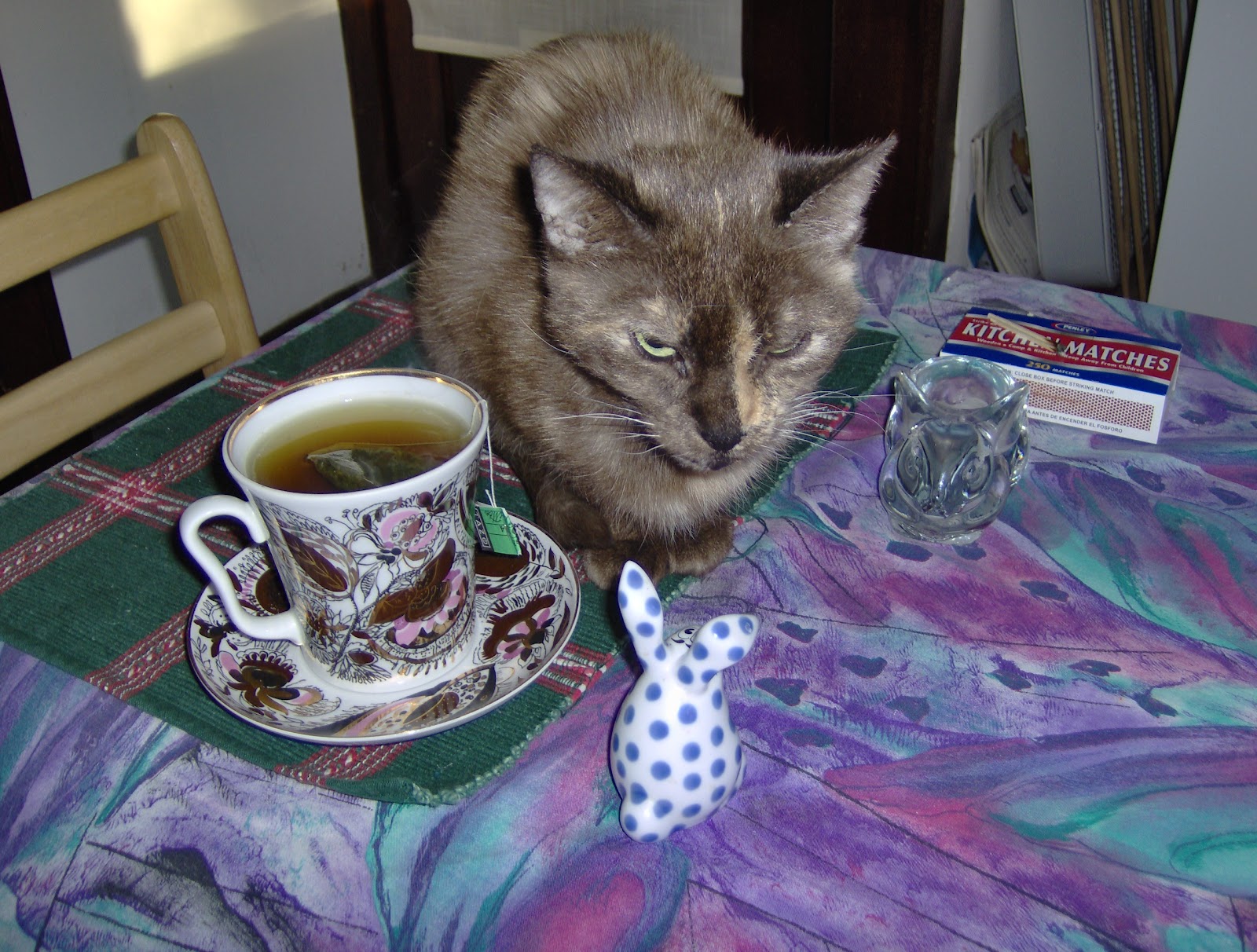
Meditation over a cup of Tea.
Meditation ueber einer Tasse Tee.
Early this morning, she came into bed and crawled under the covers. She settled down in my arm and just like that, she started to purr, for no apparent reason. I think the ability to purr, to spontaneously vocalize the feeling that everything is just right as it is now, is a clear advantage that cats have over humans.  Since we as humans don’t purr, moments of contentment often enough escape our attention altogether. We’re haunted by the past and worried by the future and don’t even notice that it’s thoughts that trouble our minds, while there is actually not so much to worry about in the present moment.
Heute kam sie früh am Morgen ins Bett und kroch unter die Decke. Sie legte sich auf meinen Am und fing an zu Schnurren, ohne direkten Anlass. Ich finde, die Fähigkeit zu schnurren, spontan dem Gefühl vokalen Ausdruck zu geben, dass im Augenblick alles genau richtig ist, ist etwas, das die Katzen den Menschen voraus haben. Weil wir Menschen nicht schnurren, verstreichen Momente der Zufriedenheit oft gänzlich unbemerkt. Unsere Vergangenheit verfolgt uns, die Zukunft ist beängstigend, und uns fällt gar nicht auf, dass uns nur Gedanken durch den Kopf gehen, während es in unserer direkten Umgebung gerade gar nichts Beängstigendes gibt.
Sun bathing
Sonnenbad
Imagine we could purr: passengers purring on public transport, business partners purring in the office, students purring in class, patients purring in the doctor’s office. Piano teachers purring during a lesson and audiences purring during a performance might require some adjustment, but we’ve all got adjusted to the humming of humidifiers, air conditioning, and subways rumbling under concert halls. Even if the purring wasn’t directly related to a smooth ride, a sensational sales offer, imaginative teaching, or the magic cure I’m sure purring would make a difference just by spreading the vibe.
Stellt Euch vor, wir könnten schnurren: Fahrgäste schnurren im Bus oder in der Strassenbahn, Geschäftspartner schnurren im Büro, Schüler schnurren in der Klasse und Patienten in der Arztpraxis. Schnurrende Lehrer im Klavierunterricht und ein schnurrendes Konzertpublikum sind vielleicht etwas gewöhnungsbedürftig, aber mit dem Brummen von Luftbefeuchtern, Klimaanlagen und dem Rumpeln der U-bahn unter Konzerthallen haben wir uns ja auch abgefunden. Selbst wenn das Schnurren nicht direkt auf die angenehme Fahrt, das sensationelle Verkaufsangebot, den inspirierenden Unterricht oder das Wunderheilmittel zurückzuführen ist, einfach die Stimmung zu verbreiten würde bestimmt einen Unterschied machen. 
A purring attitude changes your outlook on your environment. I watched people in the city today, trying to determine whether they were purring inside, and I found quite a few. Out of respect, I refrained from taking photographs. I also got the impression that most dogs are purring secretly, even though you can’t hear it.  

Dog Boutique, Lexington Avenue
Hundeboutique auf der Lexington Avenue
Eine schnurrende Einstellung verändert die Wahrnehmung der Umwelt. Ich habe heute Menschen in der Stadt beobachtet und versucht herauszufinden, ob sie innerlich schnurren. Mir sind einige begegnet, aber ich habe respektvoll davon Abstand genommen, Fotos zu machen. Auch habe ich den Eindruck gewonnen, dass die meisten Hunde heimlich schnurren, auch wenn man es nicht hören kann.
  
Nature has not equipped us with the gift of purring, but I’m sure we all have a personal purr spot within. Whenever the moment is good, it lights up and sends a wave of warmth and well being through the whole person. Let’s find that spot within, and connect to it often. Have a Purr-fect New Year! 
Die Natur hat uns nicht mit der Gabe des Schnurrens bedacht, aber ich bin sicher dass wir alle eine persönliche Schnurrstelle besitzen - etwas, das in guten Augenblicken aufleuchtet und eine Welle von Wärme und Wohlbefinden durch den ganzen Menschen schickt. Auf dass wir alle unsere persönliche Schnurrstelle finden und oft mit ihr in Verbindung treten - ein schnurrig gutes Neues Jahr!